
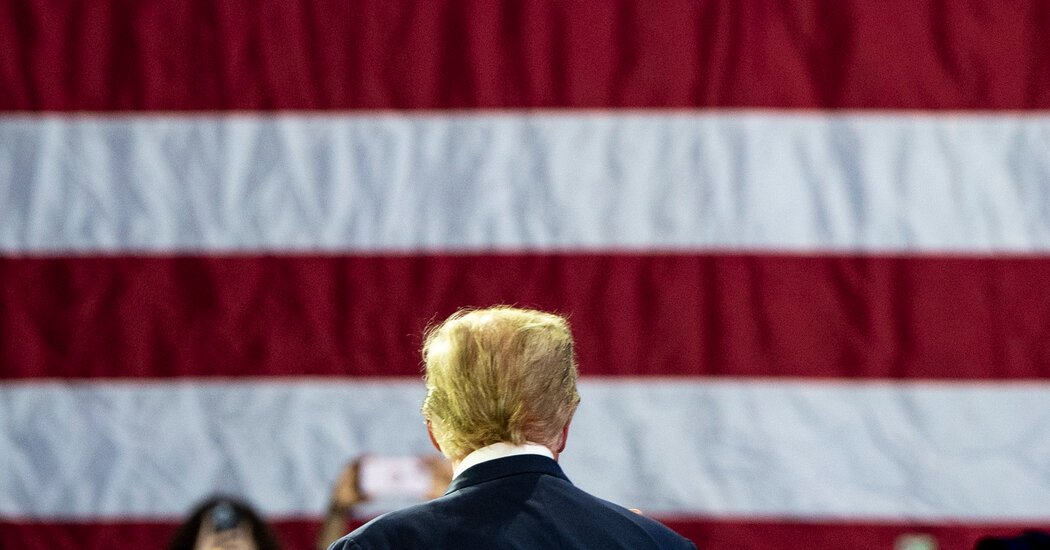
In the nearly five months since Hamas terrorists invaded Israel on Oct. 7, igniting the most divisive foreign policy crisis of the Biden presidency, Donald J. Trump has said noticeably little about the subject.
He criticized Prime Minister Benjamin Netanyahu of Israel, before quickly retreating to more standard expressions of support for the country. And he has made blustery claims that the invasion never would have happened had he been president. But his overall approach has been laissez-faire.
“So you have a war that’s going on, and you’re probably going to have to let this play out. You’re probably going to have to let it play out, because a lot of people are dying,” Mr. Trump said in an interview with Univision a month after the attack. His main advice to Mr. Netanyahu and the Israelis, he said then, was to do a better job with “public relations,” because the Palestinians were “beating them at the public relations front.”
Mr. Trump’s hands-off approach to the bloody Middle East conflict reflects the profound anti-interventionist shift he has brought about in the Republican Party over the past eight years and has been colored by his feelings about Mr. Netanyahu, whom he may never forgive for congratulating President Biden for his 2020 victory.
Mr. Trump has offered no substantive criticisms of Mr. Biden’s response to the Hamas invasion and Israel’s retaliation in Gaza. Instead, he has pinned the blame for the entire crisis on Mr. Biden’s “weakness,” in the same way he often does when violence or tragedy occurs.
“You would have never had the problem that you just had, the horrible problem where Israel — Oct. 7, where Israel was so horribly attacked,” the former president told a crowd in Rock Hill, S.C., on Feb. 23, before switching to more practiced attack lines against Mr. Biden.
It is unimaginable that in a pre-Trump Republican Party, the standard-bearer would have had so little to say about a major terrorist attack against Israel and a broadening regional conflict in the middle of a presidential campaign.
“This is one of America’s closest allies under attack. And it’s stunning that in such circumstances you have heard so little from Trump,” said John R. Bolton, a former national security adviser to Mr. Trump who became a sharp critic of him and who has long been hawkish in support of Israel.
Yet people close to Mr. Trump, who leads Mr. Biden in polls, feel little if any urgency for him to put out more detailed foreign policy plans — about Israel or any other matter.
In 2016, Mr. Trump gave one major speech and a number of interviews about foreign policy. But it is unclear whether he will do the same in this campaign. He has a record in office to point to now. And when it comes to supporting Israel, his advisers see that record as unimpeachable.
“President Trump did more for Israel than any American president in history, and he took historic action in the Middle East that created unprecedented peace,” said Karoline Leavitt, a spokeswoman for his campaign. She added: “When President Trump is back in the Oval Office, Israel will once again be protected, Iran will go back to being broke, terrorists will be hunted down, and the bloodshed will end.”
Moreover, Mr. Trump has faced no dissent within his party over his stance on Israel and Gaza.
By contrast, the Democratic Party is tearing itself apart over the Israel-Hamas conflict. Mr. Biden confronted a protest vote in Tuesday’s Michigan primary aimed at pressuring him to alter his approach toward the conflict. And a New York Times/Siena College poll from December found broad voter disapproval over his handling of the conflict. Among voters between 18 and 29 years old — a demographic crucial to Democrats’ electoral success in recent years — nearly three-quarters of voters disliked Mr. Biden’s handling of the war in Gaza.
Mr. Trump has enthusiastically consumed news about young progressives turning against Mr. Biden over Israel. And his campaign and its allies plan to exploit that division to their advantage.
One idea under discussion among Trump allies as a way to drive the Palestinian wedge deeper into the Democratic Party is to run advertisements in heavily Muslim areas of Michigan that would thank Mr. Biden for “standing with Israel,” according to two people briefed on the plans who weren’t authorized to discuss them publicly.
Trump allies have gleefully deployed similarly underhanded tactics to suppress the Democratic vote in his two previous campaigns. But the latest idea is especially audacious given that Mr. Trump’s Middle East policy as president unapologetically and lopsidedly favored Israel against the Palestinians. He gave Mr. Netanyahu nearly everything he wanted, including moving the U.S. embassy to Jerusalem and recognizing Israel’s sovereignty over the Golan Heights, reversing decades of American foreign policy and bucking the United Nations, while lashing the Palestinians with aid cuts and diplomatic punishments, before brokering accords between Israel and four Arab states.
Given Mr. Trump’s pro-Israel record, the Oct. 7 attack would have seemed to present the opportunity to lean into his credentials by describing how he would deal with the crisis as president.
Other candidates have seized on such moments. Richard Fontaine, who was a foreign policy adviser to Senator John McCain, the 2008 Republican presidential nominee, recalled how Mr. McCain responded that summer when Russian troops entered Georgia — an international land invasion that Europe had not seen in decades.
Mr. McCain offered a list of aggressive actions the United States should take to punish the Russians, and told a Pennsylvania crowd that he had assured Georgia’s leader “that I know I speak for every American when I said to him, today, we are all Georgians.”
Today’s Republican Party is a long way from the “we are all Georgians” era. But there is still a strong pull toward Israel, especially among evangelicals.
Michael Allen, a former national security aide to former President George W. Bush, said that a pre-Trump Republican candidate might have highlighted what he would have done differently from the incumbent president to support and supply Israel, and gone further to “say that the predominant, malign influence in the region is Iran, and we can’t move forward without dealing with them in some effective way.”
Instead, Mr. Trump’s initial instinct in the days immediately following the greatest single-day loss of Jewish life since the Holocaust was to use Israel’s national trauma to settle a personal score with Mr. Netanyahu.
On Oct. 11, Mr. Trump publicly attributed the Hamas invasion to Mr. Netanyahu’s lack of preparation, praised the Lebanese militant group Hezbollah as “very smart,” and piled on another even more gratuitous attack: claiming Mr. Netanyahu had “let us down” during the Trump presidency by declining to participate in the January 2020 strike that killed the Iranian general Qassim Suleimani.
What happened next, behind the scenes, seems to have left a lasting impression on Mr. Trump. Close Trump advisers and allies described his public castigation of Mr. Netanyahu as an unintended act of political self-harm — even if many privately shared some frustrations with the Israeli leader — and privately urged him to issue a statement making clear his support for Mr. Netanyahu and for Israel’s right to defend itself, according to two people with direct knowledge of the outreach who insisted on anonymity to describe it.
One of those people was David Friedman, Mr. Trump’s former ambassador to Israel, according to the people with knowledge of the outreach. Mr. Friedman did not respond to a message seeking comment.
Mr. Trump followed their recommendations. In the fallout from his remarks, Mr. Trump walked back his criticism, posting on social media that he stood with Mr. Netanyahu and Israel. And he proposed expanding his administration’s travel ban on predominantly Muslim nations to cover Palestinian refugees from Gaza.
As something of a makeup effort, Mr. Trump, in an Oct. 28 address to the Republican Jewish Coalition, vowed unyielding support for Israel against Hamas, promising to defend the country from what he called “the barbarians and savages and fascists that you see now trying to do harm to our beautiful Israel.”
More recently, he has promised simply to “stand proudly with our friend and ally, the state of Israel,” as he told a gathering of the National Religious Broadcasters in Nashville last week.
Still, the initial criticism of Mr. Netanyahu aggravated concerns among a broad network of Jewish groups and others on the pro-Israel right that Mr. Trump’s personal grievances and transactional politics could make him a less reliable partner for Israel in a second term than he was in his first.
The worry is that he may allow his animus toward Mr. Netanyahu to color his approach to the relationship, and that he may still court favor with antisemites like the rapper Kanye West or the white supremacist Nick Fuentes, whom he hosted at Mar-a-Lago in late 2022.
Those Trump allies are working quietly to ensure that Mr. Trump feels that he has incentives to support Israel if he is elected.
Mr. Bolton counts himself among the ranks of those concerned.
“Anybody who thinks that he’s going to be pro-Israel as he was in his first term could well be in for a surprise,” Mr. Bolton said. “Like everything else for Donald Trump, support for Israel he saw as a political plus for him. And if he ever saw it as not a political plus, the support would disappear.”
