
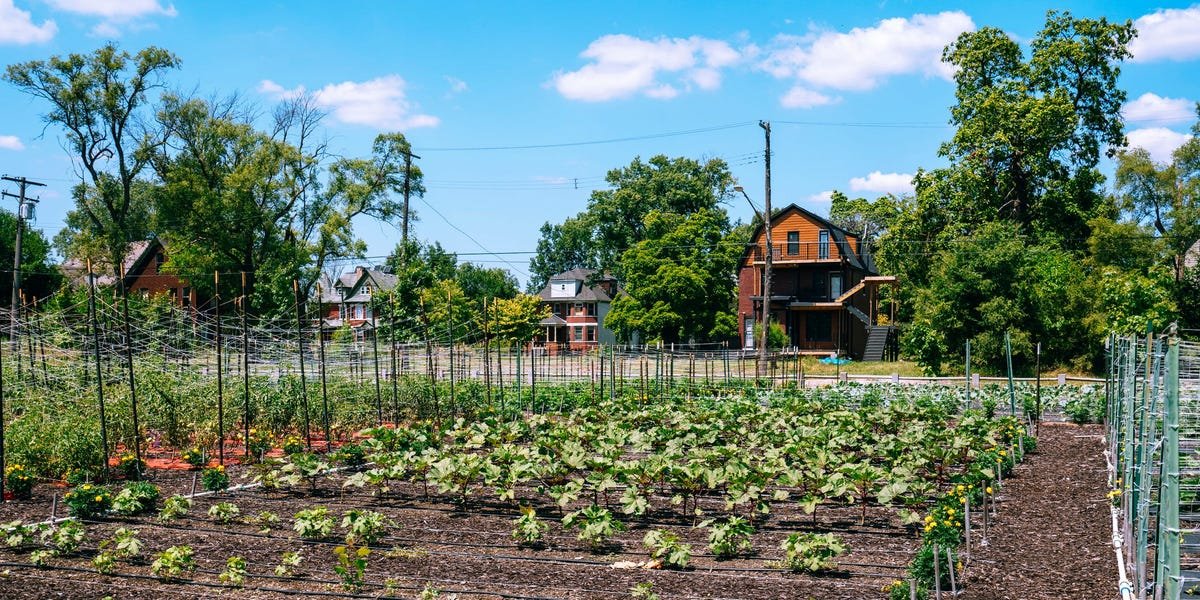
- A University of Michigan study found that urban-farmed produce has six times the carbon footprint of conventional farms.
- The study faced backlash from advocates and students, saying it overlooked broader environmental harms of industrial farming.
- Some gardeners are reevaluating their practices, focusing on sustainability and local biodiversity.
Research out of the University of Michigan sent shockwaves through the urban-farming and home-gardening community earlier this year.
Fruits and vegetables grown on urban farms have on average six times the carbon footprint of produce from conventional farms, the study, which was published in the peer-reviewed journal Nature Cities, found.
The backlash was swift. University of Michigan students organized a rebuttal letter, arguing that narrowly focusing on carbon emissions overlooked the broader environmental harms of industrial-scale farming such as biodiversity loss and water pollution. Some angry homesteaders on TikTok and YouTube circulated conspiracy theories about the government not wanting people to be self-sufficient.
The research landed as cities including Detroit, Philadelphia, and Washington, DC, increasingly invest in urban agriculture to promote sustainability and become more resilient to the climate crisis. The researchers told Business Insider that while the many social benefits of urban farming were well understood — such as improving access to fresh food in disadvantaged communities — some climate claims warranted more scrutiny.
“Urban agriculture is not a magical climate solution,” Jason Hawes, a coauthor of the study and a doctoral student at the University of Michigan School for Environment and Sustainability, said. “But there is evidence that with the right kind of planning and investments, it can be more climate-friendly. So we wanted to figure out what those interventions looked like.”
Hawes said that produce grown on 17 out of the 73 urban farms his team studied across five countries had lower carbon footprints than produce from conventional farms. The urban sites tended to have longer life spans, reuse waste for compost and building materials, reuse water, and maximize social benefits for their communities.
The infrastructure used to build urban gardens matters a lot, Hawes said, because new materials come with their own carbon footprint. Choosing crops such as tomatoes or asparagus, which are typically grown in energy-intensive greenhouses and transported on a plane, respectively, also matters.
Fury among urban farmers
The headlines offended advocates of urban agriculture, according to interviews with a Detroit city official and other academics, as well as the letter circulated by University of Michigan students and shared with BI.
These advocates questioned whether comparing the per-serving carbon footprint of produce from urban and conventional agriculture was appropriate, given the vastly different scale of these systems and the roles they serve in society.
Mainly, they worried the study would let conventional agriculture — which globally accounts for about one-third of greenhouse-gas emissions — off the hook and undermine a burgeoning movement to expand urban green spaces and promote food sovereignty, especially in communities of color burdened by pollution.
“I thought the study took a lot of the onus off of conventional agriculture, which we are in the process of recreating,” Tepfirah Rushdan, who last year became Detroit’s first director of urban agriculture, told BI. “The reason for the shift is because industrial agriculture is a strain on our planet.”
Rushdan also argued that urban farms are a much more sustainable use of land than commercial or industrial development.
The letter organized by students at the University of Michigan said the research addressed “critical research gaps” but should have been more nuanced by incorporating more of the environmental harms of conventional agriculture. The letter also alluded to the structural problems that can prevent urban farms from being more permanent, including commercial development and barriers to landownership.
Hawes and his coauthor Benjamin Goldstein, an assistant professor at the University of Michigan School for Environment and Sustainability, said they’re sensitive to the concerns, and were responding to them, but stood by the methodology.
“Our work does not lessen the many benefits that urban agriculture provides,” Hawes said in an email. “We put one specific claim to the test with the best available data. This is not an indictment of the process as a whole. Instead, it is an indictment of the environment in which urban agriculture is forced to exist — with constant pressures on land tenure, with resource constraints, and with a constant back and forth about the ‘true purpose’ of the practice.”
Hawes and Goldstein said they had crafted policy briefs for city officials and the US Department of Agriculture that underscore how important urban agriculture is for sustainability and local food production. They also are working on a letter to Detroit farmers, many of whom reached out to Hawes to say they’d already adopted the best practices outlined in the study.
Despite the controversy, the research led some urban gardeners to reevaluate their practices.
Monica Fitzgerald, a backyard gardener in Boulder, Colorado, told BI that she didn’t think the headlines were true at first. Part of the reason she grows her own food is to be more sustainable and improve local biodiversity.
But after reading the main findings, she learned a few lessons and shared them on TikTok to dispel other users’ conspiracy theories.
“Try to make things with materials you already have,” she said. “Order fewer seeds online. Compost at home. Extend the lifetime of a raised bed, shed, or shovel. Not only does it save you money, it saves you carbon emissions.”
Are you a gardener or urban farmer who is finding ways to save money and reduce your carbon footprint? Reach out to this reporter at cboudreau@businessinsider.com.
