
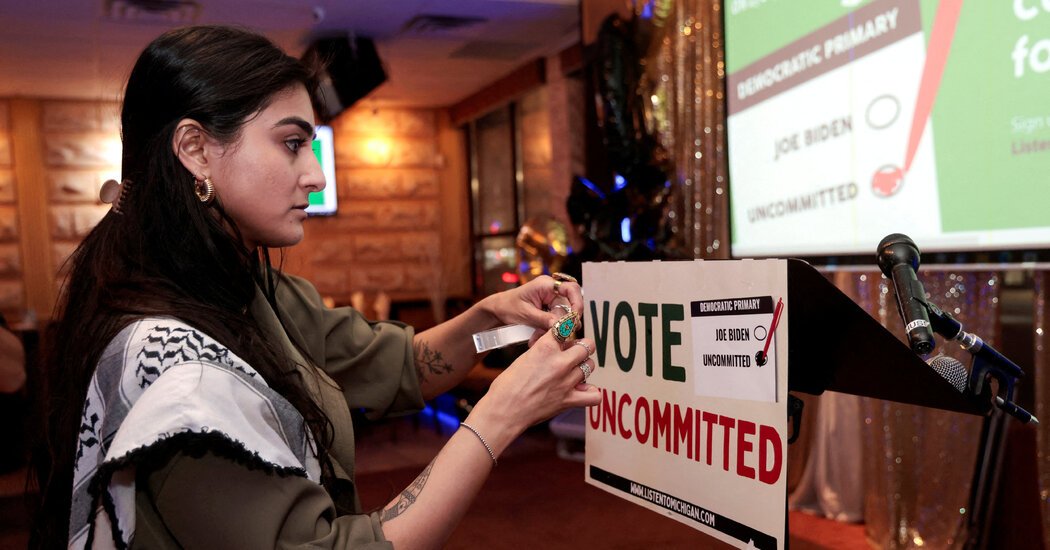
In Tuesday night’s results in Michigan, around one in eight Democrats voted “uncommitted” in the Democratic primary — a protest of the Biden administration’s policies toward Israel and the war in Gaza.
In some predominantly Arab American precincts in Dearborn, around three in four Democrats cast a protest vote for uncommitted.
Having one in eight Democrats vote uncommitted in an uncontested primary is not wholly unusual. As recently as the last time a Democratic president sought re-election, in 2012, 11 percent of Michigan Democratic caucusgoers voted for “uncommitted” instead of for Barack Obama.
Having three in four Democratic primary voters in Arab American communities do it, on the other hand, is an eye-popping figure. It goes well beyond the norm, and it’s a powerful indication that the war in Gaza poses serious political risks to President Biden.
What does it mean for the general election? That’s not an easy question to answer, but here are four things to consider.
1. A protest vote is hard to interpret
A vote for “uncommitted” was a serious form of protest against Mr. Biden, but it’s just not the same as voting for Donald J. Trump in the general election. That simple fact limits how much we can read into the results for November, especially as there was no exit poll to offer insight into the attitudes of protest voters.
At the same time, it’s also possible that Mr. Biden’s problems go well beyond those who voted uncommitted in a primary. The typical Democratic primary voter is disproportionately old, white and loyal to Democrats. Mr. Biden might be faring even worse among the kinds of Democratic-leaning voters who stayed home.
2. Protest votes have a history
Even though it may be hard to interpret a protest vote in a primary, the risk of defection from this group of voters should be taken seriously. This issue is very personal for them. There are also signs of defection in the polling, including in the last Times/Siena poll in Michigan. And their arguments for defection — complicity in genocide — are plainly enough to switch a vote if taken at face value.
There’s another reason it should be taken seriously: history. Major foreign policy conflicts have often reshaped the electoral map, especially among immigrant communities whose identity have remained tied to their home countries.
-
The Cold War. Even today, Cuban Americans tend to vote Republican, as many fled the Communist Castro regime and supported the fervently anti-Communist Republican Party. There’s a plausible case that the Elian González controversy in Florida was sufficient to decide the 2000 election.
A similar anti-Communist story helps explain why Vietnamese Americans typically vote Republican, even as other Asian Americans tend to vote Democratic.
-
World War II. The outbreak of war in Europe turned the American electoral map into an Axis vs. Allies game board. German, Italian and Irish Americans swung Republican in the 1940 election to oppose the Franklin D. Roosevelt administration’s hostility to the Axis powers and support for Britain. There were German Catholic counties in the Midwest that routinely voted Democratic up until the war, and essentially never did so again.
Roosevelt, meanwhile, won overwhelming support from Jewish and Polish voters. And he surged nearly 30 points to almost win Maine, one of the two states he lost in 1936 and home to many voters of English and French Canadian ancestry.
-
The Arab-Israeli War. In 1948, a sizable share of Jewish voters defected to the third-party candidate Henry Wallace over President Truman’s tepid support for the newly created state of Israel. Many Jewish neighborhoods in New York City gave Mr. Wallace more than 20 percent of the vote. It was enough to cost Mr. Truman the state of New York.
-
The War on Terror. Arab and Muslim Americans swung toward Democrats in the wake of 9/11, the war on terror and the Bush administration’s decision to invade Iraq. That was even true in Michigan, where Dearborn voted for George W. Bush in 2000 before voting for John Kerry by a 19-point margin in 2004. Sound familiar?
The relatively recent history of Arab American and Muslim voters being more favorable toward Republican candidates makes it even easier to envision a shift back to Republicans today. This isn’t a liberal voting group.
3. The effect is small
With that history, one could imagine Arab American and Muslim voters lurching decidedly toward Mr. Trump. That would obviously be bad news for Mr. Biden, but there’s one consolation for Democrats: These voters are a small share of the electorate, and it’s hard to see even a huge swing being decisive.
Imagine, for a moment, that in the last election Mr. Biden had lost every single voter in Dearborn, Hamtramck and Dearborn Heights — the three Michigan townships where Arab Americans make up at least 30 percent of the population. He still would have won Michigan — and still would have won it by more than he did Wisconsin, Arizona or Georgia.
For that same reason, Mr. Biden’s deficit in the polling of Michigan can’t mostly be attributed to his weakness among Arab American and Muslim voters. Overall, Arab Americans make up 2 percent of the state’s population and probably an even smaller share of the electorate. There are non-Arab Muslim voters, of course, adding another percentage point or more. In the end, 3 percent of the electorate can only do so much.
4. Still, anything could be decisive
Because the country is so narrowly divided, every vote counts, and right now Mr. Biden appears to need every vote he can get. If Arab American and Muslim voters swing by 30 points toward Mr. Trump, as suggested by our Times/Siena poll in Michigan, that could cost Mr. Biden a percentage point in a critical battleground state where he’s already trailing in the polls. If the race were close enough, it’s possible these voters could decide the 2024 election.
