

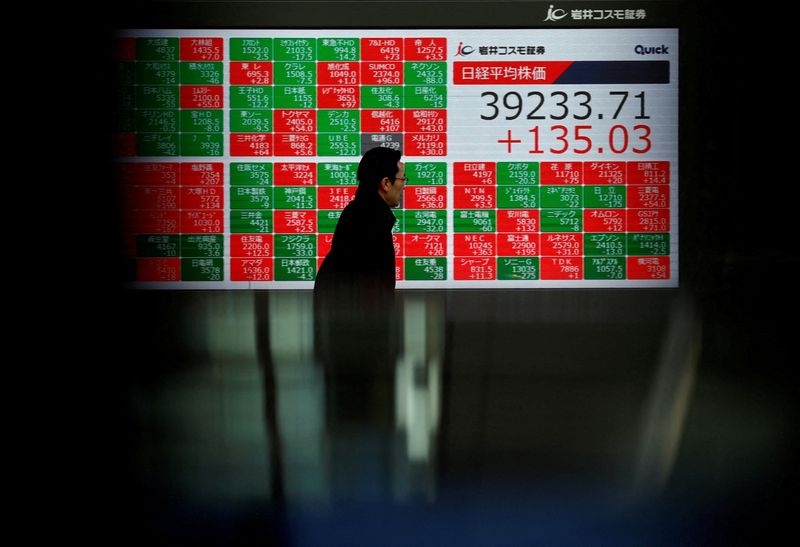
© Reuters. FILE PHOTO: A man passes by an electronic screen displaying Japan’s Nikkei share average as it scaled an all-time closing high in Tokyo, Japan February 26, 2024. REUTERS/Issei Kato/File Photo
By Makiko Yamazaki and Rae Wee
TOKYO/SINGAPORE (Reuters) – A corporate governance makeover has helped fuel the revival of Japan’s once-moribund stock market. Now investors want to see if the change is for real.
The index shattered its all-time high last week, topping a level not seen since the December 1989 asset bubble – and continues to gain ground.
Overseas investors have been responsible for much of the buying. That marks a big shift for Japan, which was long seen as indifferent to shareholders, particularly foreign ones with governance concerns around corporate cross-shareholdings, the lack of independent directors and resistance to takeover offers.
While Japan has been bolstering governance for at least a decade, the effort got a big shot in the arm last year when the Tokyo Stock Exchange called on companies to improve capital efficiency.
The exchange now publishes a monthly list of firms that have voluntarily disclosed plans to improve their use of capital – effectively naming and shaming those who don’t.
“The governance problems in Japan, the kind of things foreign investors pointed out, have been gradually improving,” said Kentaro Takayanagi, the chief executive of Nihonbashi Value Partners and a veteran asset manager.
“We want to see whether this trend continues properly or peters out as a short-lived hope. I think it’s likely to continue,” he said.
Positives include the growing presence of outside directors on boards and the selling down of the cross-shareholdings that typically protected management from investors, Takayanagi said.
Over the last year, the Nikkei is up 46% including dividends. In dollar terms, that’s a 33% return, pipping the ‘s 29% and outstripping other major markets.
To be sure, the Nikkei has benefitted from a number of tailwinds: attractive valuations, the earnings boost from a weaker yen and increasing demand from funds paring China exposure.
But it is the governance reform that has made investors sit up and take note, even to the extent that regulators in South Korea aim to roll out a similar programme.
“Nobody used the word governance back in 1989,” recalled Ken Shibusawa, chairman of Commons Asset Management and a member of an advisory panel to Prime Minister Fumio Kishida.
The reform was part of the “three arrows” of former Prime Minister Shinzo Abe’s “Abenomics” project launched a decade ago to revitalise the Japanese economy and was cheered by investors who sent the Nikkei up more than 50% in 2013.
However progress fell short and lacklustre returns followed – until now, with the Nikkei’s 28% gain last year its largest annual rise since 2013. In some areas, reform remains a work-in-progress, such as the effort to increase female representation on boards.
LOWLY VALUATIONS
The Tokyo exchange’s guidelines are designed to boost valuations – some 44% of 1,656 firms on the exchange’s top section still traded below the value of their assets at the end of last year, an outlier for major developed markets.
One quick fix has been to buy back more stock. Companies have announced plans to buy back a record 9.3 trillion yen ($62 billion) worth of stock so far in the year that ends in March, according to JPMorgan.
But companies are also addressing what investors have said are the deeper, structural problems.
Foreign investors believe that Japan is now going through a “major restructuring of corporate productivity,” said Naka Matsuzawa, chief Japan macro strategist at Nomura.
Analysts at Jefferies are so bullish on the outlook that they believe the country is transitioning to a “golden age” from the “lost decades” of old.
While the cross-shareholdings traditionally used to cement business ties and block potential takeovers have been on the decline for years, the pressure is greater now.
Firms are required to explain the rationale for keeping cross-shareholdings and some asset managers now vote against board directors at companies with large amounts of the shareholdings.
UNSOLICITED BIDS
Veterans of Japan’s equity market say the shift is more than just numerical.
Mike Allen, now research director for Azabu Research in Tokyo, recalled a much different tone in the market when he began his career as a consumer sector analyst at Barclays in 1987 Tokyo.
“Analyst meetings back then were silent. Nobody asked questions after the company gave the presentation. They asked for questions and there weren’t any,” he said.
“And now the question and answer session is the majority of the meeting.”
Companies are also under pressure to sell or delist their subsidiaries, which has paved the way for some spin-offs to private equity.
New government guidelines released last year dealing with mergers and acquisitions have helped remove some of the stubborn reluctance toward unsolicited takeovers.
Since then, both Nidec and Dai-ichi Life Holdings have made unsolicited bids – something once unthinkable.
So far, most of the changes have come at bigger companies. One example is Hitachi (OTC:), which has aggressively sold off subsidiaries in its effort to retool itself as a digital services company.
Over the last five years, its shares have returned around 317%, including dividends, compared to a little over 100% return by the Nikkei.
What’s less clear is how and when the change will take root at smaller companies. It’s also unclear how much patience foreign investors have.
An ongoing tussle over NEC’s rejection of multiple buyout offers from private equity funds for its listed subsidiary Japan Aviation Electronics Industry suggests there is still resistance to governance changes.
The next leg of the rally will depend on companies delivering more earnings growth or delivering on reforms, said Ilan Furman, chief investment officer at Bridgewise.
In the latter case, the impact of the governance reforms will take “way longer to materialise than the headlines about the plans,” he said.
($1 = 150.1700 yen)
