
- Intuitive Machines’ uncrewed Odysseus moon landing almost failed due to a single safety switch.
- Other moon-landing attempts have crashed or burned due to leaky valves or software glitches.
- Their photos show how even the tiniest details make a huge difference in spaceflight.

Landing on the moon is so difficult that, until last year, only three nations had ever done it without crashing. Recently, India, Japan, and one private company — Intuitive Machines — have joined their ranks.
Intuitive Machines’ moon landing on Thursday was particularly significant, returning the US to the lunar surface for the first time in nearly 52 years and softly landing the first commercial spacecraft on the moon.
But the mission narrowly avoided the same fate as several lunar-landing attempts before it: death by small engineering error.
The Houston-based company’s uncrewed Odysseus lander was almost lost to one of the tiniest possible mistakes. A safety switch that should have been switched off before launch was left on instead, effectively disabling the navigation system that was supposed to guide the robot to a safe landing spot.
Intuitive Machines
With less than two hours to go before landing, Intuitive Machines engineers frantically whipped up a new navigation system. They reprogrammed the spacecraft to instead use the laser technology from a NASA experiment it was carrying to the moon. The experiment wasn’t meant to land the spacecraft, but it worked in a pinch.
At the last second, though, the lander tipped over and settled on its side. That seems to be unrelated to the errant safety switch.
NASA TV
“Spaceflight is hard. A million things have to go right, and if one thing goes wrong, you can still have a failure,” Trent Martin, vice president of space systems at Intuitive Machines, said in a NASA press briefing in January, weeks before Odysseus launched.
Indeed, several robotic moon landing attempts have crashed or otherwise malfunctioned in the last few years. Overall, only about 50% of lunar landing missions succeed.
In each recent case, failure comes down to tiny engineering details — of a million steps, just one going wrong. Photos from those missions show just how important the little things are in spaceflight.
Astrobotic’s lander may have succumbed to one leaky valve
Sometimes all it takes to kill a moon landing is one small piece of subpar hardware.
Just a month before Intuitive Machines triumphed, Astrobotic — another US company working with NASA to reach the moon — failed.
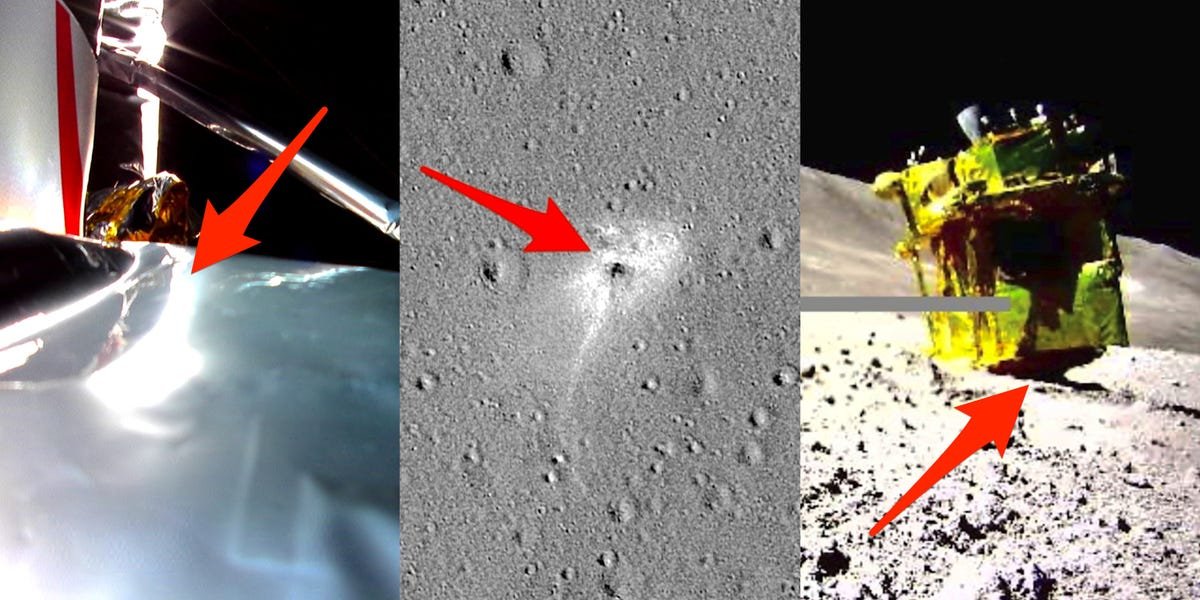
Just hours after launch, Astrobotic’s Peregrine lander began leaking fuel. When it beamed its first photo back to Earth, it showed the lander’s insulation crumpling.
Astrobotic
Astrobotic said the most likely cause was a valve failing to reseal in the fuel-tank system. That small failure was enough to drain the lander’s fuel, cause the crumpling in the photo, and ultimately doom the mission.
Landing on the moon had become impossible, Astrobotic decided, so Peregrine burned up in Earth’s atmosphere instead.
3 moon crashes show how time is compressed in the final ’15 minutes of terror’
Especially in the final stages of descent, there is almost no room for error in a moon landing.
That’s what India learned from its first attempt to land on the moon, in 2019. The Vikram lander crashed into the moon because it slowed down more quickly than its braking system had been programmed to accommodate, SpaceNews later reported.
NASA’s Lunar Reconnaissance Orbiter (LRO) later discovered Vikram’s remains scattered across the lunar surface.
NASA/Goddard/Arizona State University
In those final stages, a spacecraft is completely on its own. There is no time for mission operators to respond to fresh data from the spacecraft, write new commands, and beam them back to the moon.
“Time gets greatly compressed,” Robert Braun, the space exploration lead at Johns Hopkins Applied Physics Laboratory, previously told Business Insider. “There’s very little margin to try something again if it didn’t happen as planned.”
That’s why Kailasavadivoo Sivan, who was India’s space program director at the time, has called this final phase “15 minutes of terror.”
Last year Japanese company ispace also lost its moon lander in those final stages, just a few miles above the lunar surface, due to a software glitch. LRO spotted that lander in pieces, too:
NASA’s Goddard Space Flight Center/Arizona State University
“Once you initiate a landing sequence, you’re committed. It’s kind of like jumping out of a plane,” Braun said. “Your parachute has to work.”
The Beresheet lander, by Israeli nonprofit SpaceIL, also went into freefall during the critical final stages of its landing in 2019. One computer command led to a cascade of technical glitches that made its main engine fail. LRO spotted its wreckage, too:
NASA/GSFC/Arizona State University; Business Insider
Japan’s upside-down moon landing survived a major failure
Japan’s Smart Lander for Investigating Moon (SLIM) recently survived a big malfunction — with a twist.
One of the lander’s two main thrusters failed as it was descending, causing the spacecraft to tumble. It survived the chaotic fall, and managed to deploy the two tiny rovers it carried.
But a photo from one of those rovers later revealed the lander had landed upside-down.
JAXA/Takara Tomy/Sony Group Corporation/Doshisha University
That angled its solar panels away from the sun, which has taken a toll on the spacecraft’s energy generation and left it with too little battery power to operate for much of its mission.
SLIM’s case shows that sometimes extremely robust hardware and software engineering, plus a healthy dose of luck, can help a lander do its job despite an error or two.
Similarly, Intuitive Machines’ success on Thursday shows that small errors don’t necessarily have to spell the end of a mission.
“Space is hard, and equipment doesn’t always operate as expected,” Braun told Business Insider after Odysseus landed. “In this case here, engineers on the ground came up with an ingenious way to keep the mission on track and actually accomplish the landing.”
