
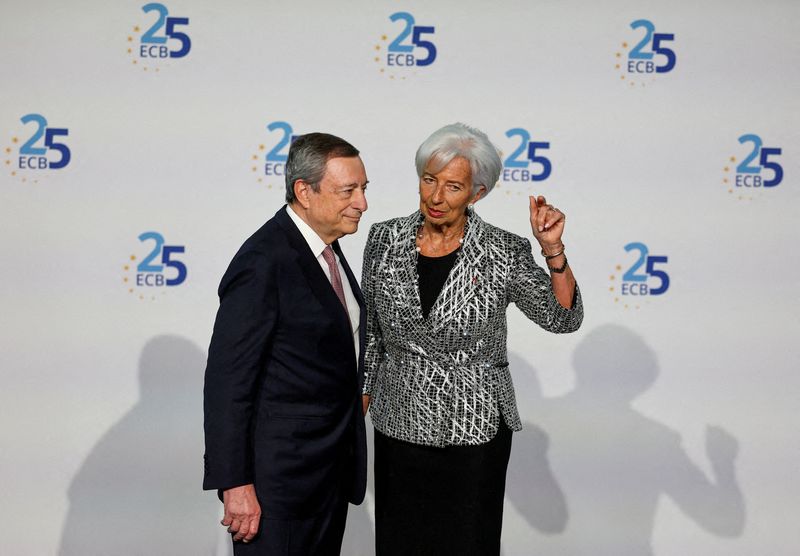
© Reuters. FILE PHOTO: European Central Bank president Christine Lagarde speaks with former ECB president Mario Draghi during a ceremony to celebrate the 25th anniversary of the ECB, in Frankfurt, Germany, May 24, 2023. REUTERS/Kai Pfaffenbach /Pool//File Photo
By Francesco Canepa
GHENT, Belgium (Reuters) – As the head of a small Belgian company making and recycling batteries for European clients, Rahul Gopalakrishnan is at the vanguard of the continent’s dash for green growth.
But even on what is one of the 27-member European Union’s flagship policy goals, Gopalakrishnan is concerned that reality for businesses like his Avesta Battery & Energy Engineering (ABEE) group does not match the ambition.
“Europe always has this ability to shoot itself in the foot,” the 37-year-old Indian told Reuters, adding he was not getting enough state support to combat Chinese rivals and also had to grapple with rules like a proposed EU ban on “forever chemicals” – a type of pollutant used in lithium-ion batteries.
His concerns illustrate the circle Europe wants to square as it seeks to regain economic ground lost to the United States over the past 20 years, even as it strives to protect the environment and become more self sufficient.
The U.S. economy is growing at more than 2% per year while the euro zone is stagnating. Productivity – or the output of each hour worked and euro invested – has also grown more slowly on the east side of the Atlantic for 30 years.
Compared to the United States, the EU is a fragmented bloc suffering from chronic under-investment, a more rapidly ageing population and, despite its 31-year-old single market, snags on the free flow of labour, capital and goods.
The man charged with producing a blueprint to overcome such hurdles is Mario Draghi, the former European Central Bank chief famed for ending the 2012 debt crisis by declaring the ECB would do “whatever it takes” to save the euro.
Draghi, who met EU finance ministers in the Belgian city of Ghent last weekend, recently said the solution involved a low cost of capital, re-working the rules to favour innovation and where necessary coming up with state aid.
“We need to invest an enormous amount in a relatively short time horizon to restructure supply chains and decarbonise our economies, with capital being likely destroyed faster than it can be replaced,” Draghi said in a speech.
HUNDREDS OF BILLIONS
EU institutions estimate Europe will need 650 billion euros ($704.08 billion) in mostly private investments every year until 2030 and 800 billion euros annually thereafter until 2040.
The aim is to close the technology gap with the United States, home to world-leading tech giants, and to make Europe more self-reliant by nurturing local sectors that produce green energy as well as the chips it imports from the Far East.
Far from generating investment however, Europe is bleeding capital — some 330 billion euros last year — as Europeans deploy their savings abroad, particularly on the much larger U.S. stock market.
Public investment is also lower than in the United States, where government funding has led to inventions such as the Internet itself.
The EU finance chiefs in Ghent gave a familiar solution to the problem: knocking down remaining barriers between member countries to turn them into a fully fledged single market.
“We need to ensure that businesses, especially smaller businesses, that are looking to grow quicker have access… to the appropriate funding,” the president of the Eurogroup of EU finance ministers, Paschal Donohoe, said in Ghent.
Yet this so-called capital market union has been stalled for years by countries keen to keep their prerogatives. The latest French proposal for a small group of countries to move ahead was immediately torpedoed by Germany.
BUSINESS FRIENDLY?
Even if it eventually comes, a tighter union would be no panacea for the EU’s lack of competitiveness.
Only one EU member, Denmark, ranks above the United States in the World Bank’s Ease of Doing Business Index, which tracks practicalities such as opening a company or getting a permit. Italy even lags Morocco, Kenya and Kosovo.
Meanwhile, the cost of electricity is three times that of the United States and will stay high until the EU can produce its own sometime in the next decade.
Businesses are lobbying for energy subsidies and easier environmental rules.
“In the transformation to renewables, we are confronted with an electricity price that makes us unable to compete globally,” said Gunnar Groebler, CEO of steelmaker Salzgitter.
Oil major Exxon (NYSE:) even raised the spectre of “deindustrialisation” unless the EU changed course.
Few large companies are leaving Europe for now but some, like French automotive supplier Forvia, are shedding jobs in the region. Others, such as industrial gases firm Air Liquide (OTC:) are doing more business in the United States.
A group of industrial companies last week demanded that the EU subsidises not just investments but also operating expenses, like Washington is doing.
But policymakers in Ghent have made clear the bulk of the money that Europe needs should come from the private purse.
“We’ve never done that in Europe,” said Simone Tagliapietra, a senior fellow at think tank Bruegel. “There’s the real risk that the business disappears when the subsidy is taken away.”
($1 = 0.9232 euros)
