
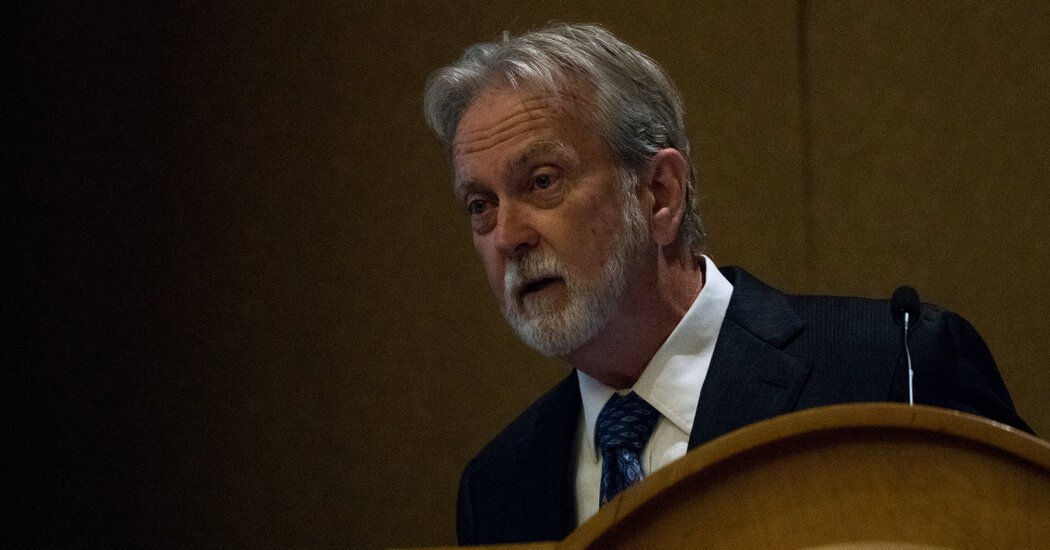
Four years ago, in dramatic testimony, a U.S. psychologist described in open court how he had threatened to slit the throat of a young son of Khalid Shaikh Mohammed, the accused mastermind of the Sept. 11 attacks, if another Qaeda attack claimed the life of an American child.
On Wednesday, Dr. James E. Mitchell told a stunned courtroom that episode had not happened. “I didn’t say anything about killing his son,” said Dr. Mitchell, a retired Air Force psychologist who in 2003 waterboarded Mr. Mohammed 183 times for the C.I.A. “He didn’t have sons until later.”
Dr. Mitchell later acknowledged he had forgotten his threat. But the episode underscores a new challenge for the military court in the case against four prisoners who are accused of conspiring in the attacks that killed nearly 3,000 people on Sept. 11, 2001: the fading memories and unavailability of witnesses whose testimony is central to getting the death-penalty case to trial.
Testimony and other evidence often deteriorate over time, which is one reason that criminal defendants and their victims are entitled to a speedy trial.
This month, two retired military officers were too ill to travel to Washington to testify about the defendants’ health and prison conditions at Guantánamo in early 2007. It was a critical period in the case, when prosecutors say the defendants voluntarily confessed to their crimes. Defense lawyers argue the confessions were contaminated by torture and secret collaboration between the F.B.I. and the C.I.A.
One witness was the defendants’ first psychiatrist at Guantánamo. The other was their first prison commander. A third key witness from that period, the prisoners’ first treating physician at Guantánamo, died in 2018 before his testimony could be obtained.
In November, Jacqueline Maguire, a senior F.B.I. official, said 199 times that she did not remember specific information from the time, as a first-year special agent, she led the investigation of the five hijackers who commandeered the plane that crashed into the Pentagon.
Getting Dr. Mitchell to remember was easy enough. Mr. Mohammed’s lawyer showed him page 31,362 of the pretrial hearing transcript with his testimony from January 2020. In it, Dr. Mitchell explained that he had consulted with a C.I.A. lawyer during the period when he was waterboarding Mr. Mohammed and was told to make the threat to kill his prisoner’s son conditional.
Dr. Mitchell, who is now in his 70s, said the passage “jogged” his memory. But not entirely. He testified this week that in the 2003 threat he was “referring to the son who had just been born.” Mr. Mohammed’s lawyer, Gary D. Sowards, replied that the newborn was a girl, though Mr. Mohammed had four older sons.
Failed memories increasingly figure in the pretrial phase, which began with arraignment in 2012. Rather than try to bring the accused Sept. 11 attack plotters to justice promptly, the George W. Bush administration had them brutally interrogated in 2002 and 2003 to try to uncover more pending attacks — and then held them incommunicado in so-called black sites for years, a detour whose details are still classified.
Anisha P. Gupta, a defense lawyer, told the judge last week that she had tried to speak with two key, if anonymous, witnesses about what had been done to her client, Walid bin Attash, in the C.I.A. prisons — and was told that one was dead and the other “has dementia and cannot speak to us.”
One would-be witness, the C.I.A.’s chief interrogator in its black site prison network, died before the men were charged. In 2003, the officer had medical officers “rectally rehydrate” Mr. Mohammed because he had refused to drink some water during an interrogation. Medical experts have discredited the procedure; defense lawyers call it rape.
Col. Matthew N. McCall, the judge, appears poised to rule on the question of whether all that anonymity and thwarted access to C.I.A. witnesses is an impediment to a fair trial. But Colonel McCall retires later this year. He might have to leave that question to the next judge, who will be the fifth to preside in the case at Guantánamo Bay.
The problem of witnesses dying off or forgetting details also afflicts the government’s case. Lee Hanson, whose son, daughter-in-law and 2-year-old granddaughter were killed aboard United 175, volunteered early to give a victim impact statement at the eventual trial. He died in 2018.
Prosecutors arranged to record his testimony in advance. But a judge would need to decide, if there’s ever a conviction, whether it could be used at a trial.
Last week, a retired F.B.I. agent, James Fitzsimmons, required a headset to hear lawyers standing just feet away from him inside the court. He appeared to misunderstand a question from a military lawyer and said that he was unaware of a C.I.A. program that secretly used F.B.I. agents to interrogate suspects at the black sites.
This week, Clayton G. Trivett Jr., a Sept. 11 case prosecutor, made a rare correction to the record by announcing that Mr. Fitzsimmons actually had been assigned to the program and worked for the C.I.A. as an interrogator at the agency’s black site at Guantánamo, which opened in 2003 and closed in 2004. It was the first public identification of an F.B.I. agent who had been in the program.
Memory figured heavily in Dr. Mitchell’s testimony this week as prosecutors tried to shore up their argument that the suspects had voluntarily incriminated themselves.
In lengthy testimony, he explained the psychological theory of “fear extinction” and his assessment of how it applied to Mr. Mohammed: Yes, waterboarding and other violent “enhanced interrogation techniques” were used on Mr. Mohammed during his first month in the C.I.A. prison network. But, Dr. Mitchell said, the prisoner was then questioned more than a thousand times during his next three years in agency detention and regained his sense of control over his actions and consequences, shed his C.I.A. conditioning — because the violence was not repeated.
Health issues have also impaired progress during the pandemic. On Thursday, the judge postponed more testimony from Dr. Mitchell that had been scheduled to go through the weekend because one of the death-penalty defense lawyers, whose attendance is required at court, had tested positive for the coronavirus at Guantánamo Bay.
