
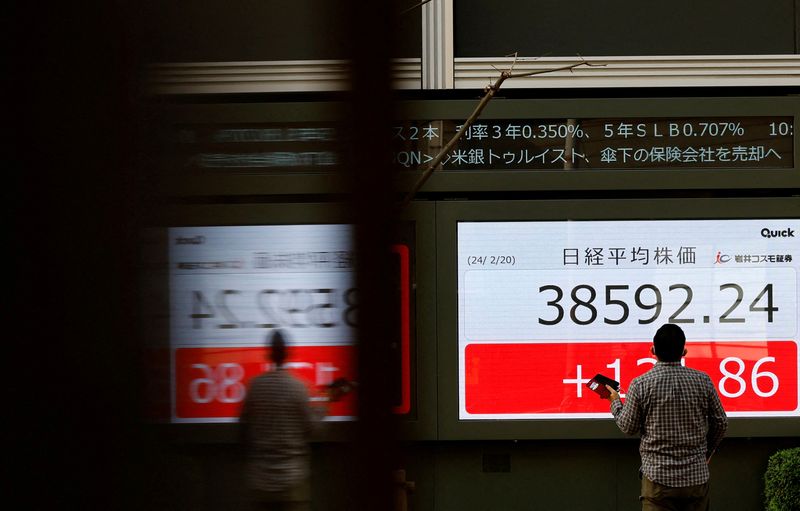
© Reuters. FILE PHOTO: A man looks at an electronic screen displaying Japan’s Nikkei share average outside a brokerage in Tokyo, Japan February 20, 2024. REUTERS/Kim Kyung-Hoon/File Photo
By Rocky Swift
TOKYO (Reuters) – Japan’s benchmark stock index is nearing its all-time high of 38,957.44 set on Dec. 29, 1989 in the heady days of the country’s bubble economy. But like Japan itself, the Nikkei is very different from 34 years ago – especially in terms of the companies that comprise it and what they are worth.
HISTORY
The Nikkei Stock Average is a price-weighted index of 225 large, widely traded Japanese companies and the most popular benchmark for Japan’s stock market.
It was started in 1950, shortly after Japan’s stock market reopened after World War Two. Its name is a contraction of “Nihon Keizai,” which means “Japan Economy” and comes from the name of the newspaper company which compiles it, Nikkei Inc.
COMPOSITION
The Nikkei is reset twice a year when companies may be added or subtracted based on their size and liquidity, so the index’s composition has changed a lot over the past three decades.
In 1989, banks and utilities were among the biggest companies on the Japanese stock market and were more heavily weighted on the Nikkei (see Table 1). Now, about 50% of the Nikkei’s weighting is in technology companies while the second-biggest segment is consumer goods, at 23%.
Table 1: Tokyo Shares in 1989
Rank Market value Previous name Present name (RIC) Present rank
(trln yen)
1 15.00 Industrial Bank Mizuho Financial Group 27
of Japan
2 10.55 Sumitomo Bank Sumitomo Mitsui (NYSE:) 13
Financial Group
3 9.99 Fuji Bank Mizuho Financial Group 27
4 9.12 Dai-Ichi Kangyo Mizuho Financial Group 27
Bank
5 9.16 Mitsubishi Bank Mitsubishi UFJ (NYSE:) 2
Financial Group
6 8.13 Tokyo Electric Tokyo Electric Power 142
Power Holdings
7 8.09 Sanwa Bank Mitsubishi UFJ 8306.T 2
Financial Group
8 7.94 Nippon same 9432.T 6
Telegraph and
Telephone (NTT)
9 7.71 Toyota Motor (NYSE:) same 7203.T 1
10 6.74 Nomura Nomura Holdings (NYSE:) 8604.T 77
Securities
Table 2: The Nikkei Today
Rank Market value Name (RIC)
(trln yen)
1 55.47 Toyota Motor
2 25.54 Mitsubishi Corp
3 18.30 Mitsubishi UFJ
Financial Group
4 16.70 Keyence (OTC:)
5 16.40 Sony (NYSE:) Group
6 16.36 NTT
7 16.13 Tokyo Electron
8 13.29 Fast Retailing
9 12.34 Softbank (OTC:) Group
10 12.11 Shin-Etsu Chemical
VALUATION
While the numerical peaks are similar, today’s Nikkei is much cheaper than the one in 1989. At the height of Japan’s bubble, the nation’s stocks accounted for more than 40% of global equity values, but now make up less than 6%, displaced by the growth of China and other developing markets.
The price-to-earnings ratio, a popular valuation measure, for Nikkei companies rose to about 60 during the previous peak, whereas now it is about 16.
Looking at price-to-book ratios, another common valuation metric, major Tokyo-listed firms sold for more than 6 times their break-up value in late 1989. The average PBR for Nikkei companies now stands at 1.47, and many Japanese firms are priced at below 1, an oddity in global markets.
MOOD
The Nikkei Volatility index, a so-called “fear gauge” among traders, stood at 20.65 on Feb. 21, not much different from 20.3 on Dec 29, 1989.
But the difference in Japan’s economic prospects in the intervening 34 years could not be more different.
Japan was then seen as potentially eclipsing the U.S. as the world’s dominant economy, and the country was flush with cash. Now, Japan still carries the scars of decades of deflation and is grappling with a shrinking economy, a dwindling labour force and a sense of diminishing influence on the world stage.
Even so, the decades of doldrums have made Japan a relative bargain, inviting the interest of foreign investors, such as billionaire Warren Buffett. And the Tokyo Stock Exchange has recently increased pressure on companies trading below their book value, leading to waves of share buybacks and management buyouts that have helped sustain investor enthusiasm.
