
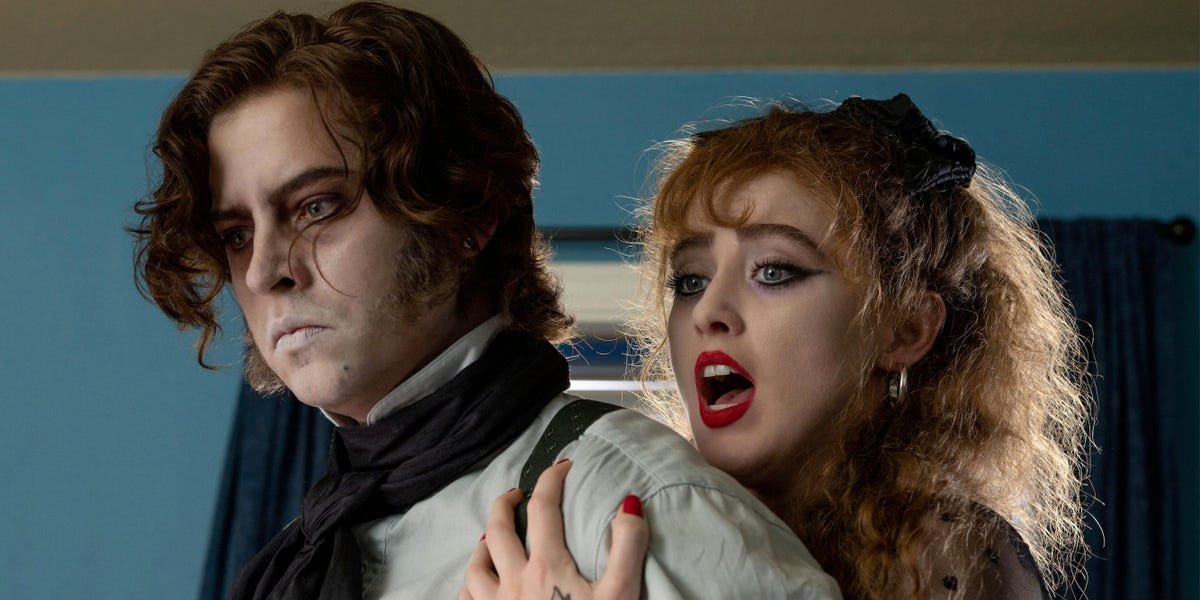
In the new movie “Lisa Frankenstein,” a teenage girl gives an animated corpse a makeover, complete with time in a tanning bed. It’s a modern twist on a 200-year-old story created by an 18-year-old Mary Shelley.
In her 1818 novel, Shelley tells the story of Victor Frankenstein, who cobbles together a creature from different human corpses that he then brings to life. Horrified, he abandons his creation, who (spoiler) goes on to kill everyone Frankenstein loves.
Many movie versions of the Frankenstein story, including the latest rendition that debuts Friday in theaters across the US, use lightning or some other form of electricity to jolt the creature into consciousness. Yet Shelley doesn’t explicitly specify the animating agent in her novel.
In 1816, when Shelley started writing the book, electricity was still a bit mysterious. Many scholars were eager to study it and perhaps learn the secret to life itself.
The scientific atmosphere at home
In the months and years leading up to Shelley’s monumental novel, she was surrounded by some of the world’s leading scientific minds.
Mary Shelley’s father, novelist William Godwin, socialized with several people with scientific backgrounds. Erasmus Darwin, Charles’ grandfather, and Humphry Davy — the discoverer of calcium, magnesium, and other elements — were among them.
Both scientists influenced “Frankenstein.” Shelley incorporated some of Davy’s writings into her novel, and the 1818 and 1831 prefaces both reference Darwin.
Hulton Archive/Getty Images
Poet Percy Bysshe Shelley, whom Mary Shelley married the same year she started “Frankenstein,” was also fascinated with science. He went to anatomy classes, wrote a poem about hot air balloons, and tried to clear up his sister’s skin condition with electricity.
In 1816, the soon-to-be-married couple vacationed at Lake Geneva. During this trip, the poet Lord Byron and Percy Shelley discussed Erasmus Darwin’s experiments, galvanism (the idea that animals had their own kind of electricity flowing through them), and whether a corpse could be reanimated.
Newly pregnant after the recent death of her infant daughter, Shelley had recently dreamed that she’d revived her baby near a warm fire.
With all this swirling, Byron challenged her and the other holidaymakers to write ghost stories. Such was the beginning of what would soon become a literary classic.
The spark
On a rainy November night, Frankenstein finally brings his creation — made of bones and organs stolen from corpses — to life.
“With an anxiety that almost amounted to agony, I collected the instruments of life around me, that I might infuse a spark of being into the lifeless thing,” he explained.
Shelley was purposefully vague about the exact steps Frankenstein took to animate the body. “I will not lead you on, unguarded and ardent as I then was, to your destruction and infallible misery,” Frankenstein tells the book’s narrator.
Some scholars have suggested that the “spark” could be fire or chemical in nature. Since Shelley had Frankenstein refuse to discuss the details, it’s impossible to know for sure.
Yet one passage from the first version of the novel could foreshadow the “spark” that brought the creature to life.
Universal
In the novel, Frankenstein recalled his “extreme astonishment” after witnessing lightning split a tree. His father reenacted Benjamin Franklin’s kite experiment linking lightning and electricity. Frankenstein described it as drawing down “fluid from the clouds.”
In reality, Franklin and others believed electricity was a fluid flowing between objects. When Shelley published her novel, some of the major discoveries about electricity by Michael Faraday and Georg Ohm were still a decade away.
“There was a lot of interest in the question: What is the essence that animates life?” historian Juliet Burba told Atlas Obscura in 2016. “Could it be electricity?”
The electrical experiments
In her 1831 revised edition of “Frankenstein,” Shelley removed the part about lightning and instead referenced galvanism.
While galvanism has a different meaning today, its origins date back to a surgeon who believed he’d discovered a new form of electricity.
In 1786, Luigi Galvani noticed that a spark of electricity caused a frog’s dissected leg to twitch. He believed he’d just discovered “animal electricity,” a unique substance different from lightning or static electricity.
A few years later, Alessandro Volta argued that the frog was merely acting as a conductor between two metals.
Sepia Times/Universal Images Group via Getty Images
In the early 1800s, this debate led to some gruesome experiments carried out by Galvani’s nephew Giovanni Aldini.
Aldini hooked an electrical battery to a decapitated ox head. The eyes opened, the ears shook, the tongue flailed, and the nostrils flared, he wrote. He then repeated the experiment with a horse, dogs, frogs, and other animals.
In 1803, Aldini attached the battery to the corpse of Thomas Forster, whom authorities had hanged for murder. After noting the various twitches and spasms, Aldini wrote that “vitality might, perhaps, have been restored, if many circumstances had not rendered it impossible.”
Some did wonder if such methods could revive someone who’d suffocated or drowned.
Aldini’s experiments were widely covered at the time, and some scholars suggest Shelley’s father might have even taken her to a demonstration.
Whether Shelley took direct inspiration from Aldini or other galvanists, her novel makes her thoughts on attempts to control nature clear.
“Learn from me, if not by my precepts, at least by my example,” Frankenstein tells the narrator, “how dangerous is the acquirement of knowledge, and how much happier that man is who believes his native town to be the world, than he who aspires to become greater than his nature will allow.”
