
American warplanes destroyed or severely damaged most of the Iranian and militia targets they struck in Syria and Iraq on Friday, according to the Pentagon, the first major salvos in what President Biden and his aides have said will be a sustained campaign.
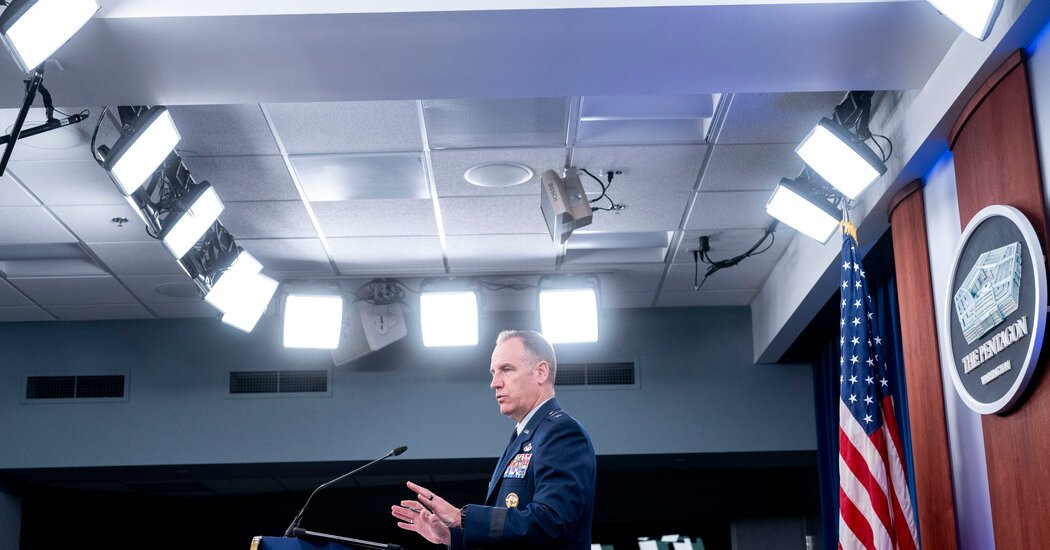
Maj. Gen. Patrick S. Ryder, the Pentagon press secretary, said on Monday that “more than 80” of some 85 targets in Syria and Iraq were destroyed or rendered inoperable. The targets, he said, included command hubs; intelligence centers; depots for rockets, missiles and attack drones; as well as logistics and ammunition bunkers.
It was the first military assessment of the strikes carried out in response to a drone attack in Jordan by an Iran-backed militia in Iraq on Jan. 28 that killed three American soldiers and injured at least 40 more service members.
“This is the start of our response, and there will be additional actions taken,” General Ryder told reporters without elaborating. “We do not seek conflict in the Middle East or anywhere else, but attacks on American forces will not be tolerated.”
But the assessment also shows the limits of the American campaign so far. In particular, U.S. officials acknowledge that the militias targeted still retain the majority of their capability to carry out future attacks.
There were no initial indications that Iranian advisers were killed in the strikes on Friday, military officials said, but General Ryder said there probably were casualties. Syria and Iraq have said that at least 39 people — 23 in Syria and 16 in Iraq — were killed in the Friday strikes, a toll that the Iraqi government said included civilians.
The attacks in the two countries, as well as U.S.-led strikes on Saturday against 36 Houthi targets in northern Yemen, have edged the region closer to a broader conflict even as the administration insists it does not want war with Iran. Instead, U.S. officials say they are focused on whittling away the militias’ formidable arsenals and deterring additional attacks against U.S. troops, as well as merchant ships in the Red Sea.
The militias seem undeterred, however. Hours after the strikes on Friday, an Iran-backed militia fired two rockets at a U.S. military outpost in northeastern Syria where troops are helping stamp out the remnants of the Islamic State. On Sunday, an explosives-laden drone was fired at another U.S. outpost in northeastern Syria. The rockets caused no damage or American injuries, the Pentagon said. On Sunday, the military’s Central Command said U.S. forces destroyed five Houthi land-based and anti-ship cruise missiles that posed an imminent threat.
On Monday, U.S. forces carried out a strike against two explosives-laden naval drones that Central Command said posed an imminent threat to ships in the region.
Overall, Iran-backed militias have carried out at least 166 drone, rocket and missile attacks against U.S. troops in Iraq, Syria and Jordan since the Oct. 7 attacks by Hamas that killed 1,200 people in Israel. The Houthis have conducted at least three dozen attacks against ships in the Red Sea and the Gulf of Aden. The militia says its attacks are in solidarity with Palestinians in the war between Israel and Hamas.
National security experts and officials say privately that to truly degrade the capability of the Shiite militias, the United States would have to carry out a yearslong campaign similar to the six-year effort to defeat the Islamic State in Iraq and Syria. Even then, the officials say, the militias, with Iran’s backing, could probably survive longer than the Islamic State, which was pressured by the United States and Iran, and even Russia.
American officials over the weekend and on Monday warned that more strikes were in store in what is emerging as an open-ended campaign not just in Yemen — where the United States and Britain first launched major retaliatory strikes on Jan. 11 — but now also in Syria and Iraq to avenge the deaths of the three Army reservists, who were killed at a remote supply base.
“The president was clear when he ordered them and when he conducted them that that was the beginning of our response and there will be more steps to come,” Jake Sullivan, the national security adviser, said on CNN’s “State of the Union” on Sunday, speaking about the strikes in Iraq and Syria.
Mr. Sullivan said he did not want to “telegraph our punches” by revealing details of future action. But he said that the goal was to punish those targeting Americans without setting off a direct confrontation with Iran.
Analysts say there are already signs that the most recent strikes are having an impact in Tehran, where a widely unpopular government already struggling with a weak economy, outbursts of mass protest and terrorism has little appetite for an all-out war with the United States.
But regional specialists say reining in Iran’s proxies, which rely on Tehran for weapons, intelligence and financing, may prove more difficult.
“Around 2020, Iran began to give blanket clearance to these groups to attack United States positions in Iraq and Syria,” Gen. Kenneth F. McKenzie Jr., a retired head of U.S. Central Command, said on CBS’s “Face the Nation” on Sunday. “They have the opportunity to generate these attacks without directly going back to Iran.”
A major question for Mr. Biden and his national security aides is what additional targets in Iraq and Syria could be struck.
On Friday, American B-1B bombers and other warplanes hit targets at four sites in Syria and three sites in Iraq in a 30-minute attack, U.S. officials said. John F. Kirby, a National Security Council spokesman, said the targets at each site were picked because they were linked to specific attacks against U.S. troops in the region, and to avoid civilian casualties.
By avoiding targets in Iran, the White House and Central Command are trying to send a message of deterrence while controlling escalation, U.S. officials said. It is clear from statements from the White House and from Tehran that neither side wants a wider war. But, as the strike in Jordan showed, with any military action comes the chance of miscalculation.
Helene Cooper contributed reporting.
