
Only five days after Donald J. Trump left office, one of his aides emailed a lawyer to request approval of a formal-looking seal for use on statements from the office of the 45th president.
Margo Martin, one of his closest personal aides, told the lawyer, Scott Gast, that consultants had designed a subtly modified seal for Mr. Trump. “They said they changed a few things to avoid trademark issues,” she wrote, asking Mr. Gast if the design was acceptable.
The eventual image that Mr. Trump’s team used — a recognizable eagle from the Great Seal of the United States, placed in a circle — was evocative of the presidential seal that identified Mr. Trump with the job he had just left. And while he is hardly the first former White House occupant to affix an eagle to his website, the early conversations about presidential imagery revealed what has turned out to be an important obsession of Mr. Trump’s: being seen as much as a future president as a former one.
Mr. Trump vacated the White House before noon on Jan. 20, 2021, as required by the Constitution. But from the moment he arrived home to Mar-a-Lago, his members-only club in Florida, he has grabbed at every opportunity to inhabit the role of an incumbent president, including by putting the typical trappings of a post-presidency to use in trying to reclaim the office.
At a minimum, that approach may have helped to soothe Mr. Trump’s bruised ego. But it has indisputably become a crucial factor in his effort to return to power.
A majority of Republican voters, polls show, view Mr. Trump not as a “defeated former president,” as President Biden often calls him, but as a wrongly deposed president whose re-election would amend a grave injustice. Elected Republicans who once privately mocked the conspiracy theories about a stolen election now publicly insist that Mr. Trump was the true winner, out of fear of getting crosswise with their constituents or with him.
This widespread accession to Mr. Trump’s denial of reality has reaped him enormous political benefits. His posture as a president in exile robbed his rivals in the Republican primary of one of their most potent available arguments against him. While evoking his presidency has been a net asset for him in the short-term G.O.P. primary contest, it will be used against him — especially on abortion policy — by Democrats and the Biden campaign if he becomes the Republican nominee in the general election.
From the moment he began his post-presidential life, Mr. Trump refused to behave like someone whose days as president were over.
He shut down any conversations about building a Trump presidential library. He clung to classified government documents, reveling in his knowledge of the government’s closest-held secrets and showing them off to visitors and aides — an act that resulted in one of his four indictments. “I get to keep my title for life,” he told a House member in 2017 of the power of having been president.
On Jan. 25, 2021, Mr. Trump’s office emailed a news release, indicating the formal opening of his post-presidential office, under the heading: “Statement from the Office of the Former President.”
The word “former” was never used again. Subsequent statements were sent by “45th President Donald J. Trump.”
As he rolls toward the Republican nomination — which would make him the first former president to win his party’s nomination since Grover Cleveland in 1892 — Mr. Trump is capitalizing on his unusual status to twist the process in his favor in ways big and small.
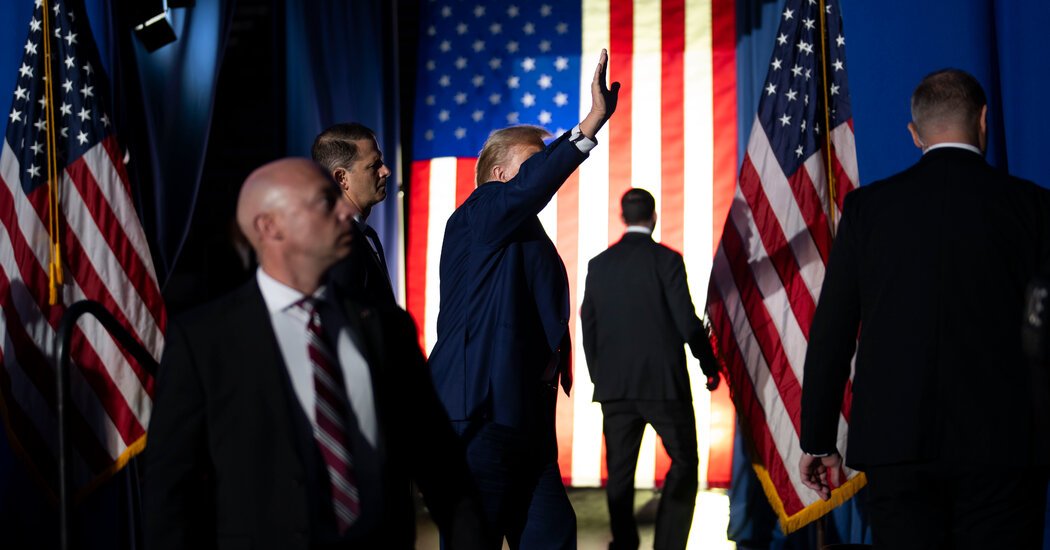
He has cast himself both as the rightful president and as the inevitable future president. He has used the privileges, pageantry and powers afforded to the presidency to make his rivals look insignificant. And he has infused his campaign with presidential imagery, traveling on a plane his aides call “Trump Force One” and using his Secret Service motorcade and security detail as a muscular expression of pseudo-incumbency. Uniquely, his lone remaining rival, Nikki Haley, was appointed to be the United Nations ambassador by him and served under him, making her foreign policy accomplishments also his.
He has also used his post-presidency as a shield — both inside and outside the courtroom. He claimed presidential immunity from charges of conspiring to overturn the 2020 election. And his team granted news networks’ requests to place dashboard cameras in Mr. Trump’s motorcade on courthouse visits, turning his criminal arraignments — there were four in 2023 — into compelling live-TV spectacles.
Asked about Mr. Trump’s use of presidential imagery in the Republican nominating contest, Mr. Trump’s communications director, Steven Cheung, said in a statement: “President Trump is the most famous person in the world and he’s running for the White House. The media needs him and his campaign, because their entire existence revolves around what he does.”
Mr. Trump has used his power as the party’s leader to squeeze Republicans in Congress, intervening in the House speaker races and the current battle over a border security and Ukraine funding deal. He has used the power of his endorsement to exert and retain control over the party aggressively.
Douglas Brinkley, a presidential historian and writer, said Mr. Trump had been “using the presidency as a steppingstone to getting re-elected, but when you’re an election denier, he’s basically telling the country, ‘I’m actually a shadow government.’”
“So that’s where the waters get muddy,” he added.
In this campaign like no other in American history, Mr. Trump has tried to behave more like a sitting president than a typical candidate. He has received many of the benefits of incumbency — the grandeur of the office, the deference from rivals and voters — but, so far, none of the political repercussions of actually occupying the White House, such as being held responsible for foreign wars or inflation.
Pressing Control
In the period immediately after the 2020 election, some of Mr. Trump’s aides and confidants encouraged him to graciously concede his loss. They made the case that if he took credit for Republican victories in House and Senate races and acknowledged Mr. Biden’s narrow win, he would preserve a future for himself in American politics.
That future, they believed, was unalterably marred by his election lies and the attack on the Capitol by a pro-Trump mob on Jan. 6, 2021.
Those aides and confidants were wrong. Far from ruining him, Mr. Trump’s refusal to accept his loss — a monthslong fit of rage that culminated in a deadly assault on the Capitol — almost certainly helped secure his political future: It kept his grip on the Republican Party and allowed him to run his 2024 campaign as if he were the rightful occupant of the Oval Office pursuing no more than his restoration to power.
Mr. Trump — who has inhaled media attention like oxygen for decades — had no interest in the quieter, less visible life of other past presidents. George W. Bush took up painting and high-paid speeches. Barack Obama gave speeches, played golf, sailed with wealthy friends on superyachts and raised money for various causes, including a presidential library in Chicago.
Mr. Trump played a lot of golf, but the similarities end there.
Cut off from social media after he was banned from Twitter and Facebook in the wake of the Jan. 6 attack on the Capitol, Mr. Trump established his own pipelines to voters. He created his own social media website, Truth Social; gave interviews to right-wing influencers with their own platforms; and communicated with his supporters through emailed fund-raising appeals.
Mr. Trump clung to the trappings of the presidency — as instruments of power, leverage and, some have suggested, psychological comforters. Many Republicans have welcomed him behaving as an incumbent. One of his most-covered early stops as a candidate last year was in East Palestine, Ohio, the site of a train derailment that President Biden had yet to visit. There, he met with local officials and urged action to help residents. Mr. Trump’s arrival at a nearby airport and his descent down tall aircraft stairs from his plane were evocative of an Air Force One arrival.
Mr. Trump also never stopped behaving like the leader of the party, holding rallies, intervening in Republican primary races and working to end the careers of congressional Republicans who had opposed him. Candidates traveled to Mar-a-Lago to seek his support. And Mr. Trump made them work for it. He treated their support for his false claims of widespread 2020 election fraud as a litmus test.
In time, he would expect those Republicans to return the favor and support him back. They did not disappoint.
A President in the Courtroom
Perhaps most notably, Mr. Trump has tried to use the powers of his former position as a defensive measure in his criminal and civil court battles.
He has asserted immunity, by virtue of his office, as a defense for his behavior in the months leading up to the Jan. 6 Capitol attack, in both a criminal indictment and civil liability suits. That claim of immunity is being litigated and is expected to be ultimately decided by the U.S. Supreme Court.
In the civil defamation trial against him in Manhattan, Mr. Trump talked back to the judge, Lewis A. Kaplan, without suffering the kind of punitive consequences an ordinary defendant might well have. And while Judge Kaplan called him “Mr. Trump” throughout the trial, when Mr. Trump’s lawyer Alina Habba announced her client as her final witness, she said, “The defense calls President Donald Trump.”
Similarly, in a separate civil case in Manhattan, in which Mr. Trump and his company were found to have engaged in pervasive financial fraud, he faced no consequences for sharply and loudly criticizing the presiding judge, Justice Arthur Engoron of the State Supreme Court, from the witness stand.
And when opposing lawyers protested Mr. Trump’s filibustering, his lawyer Chris M. Kise suggested that Justice Engoron should “grant the former president of the United States” — who, he quickly added, was “perhaps soon to be the future president of the United States — a little latitude to explain himself.”
