
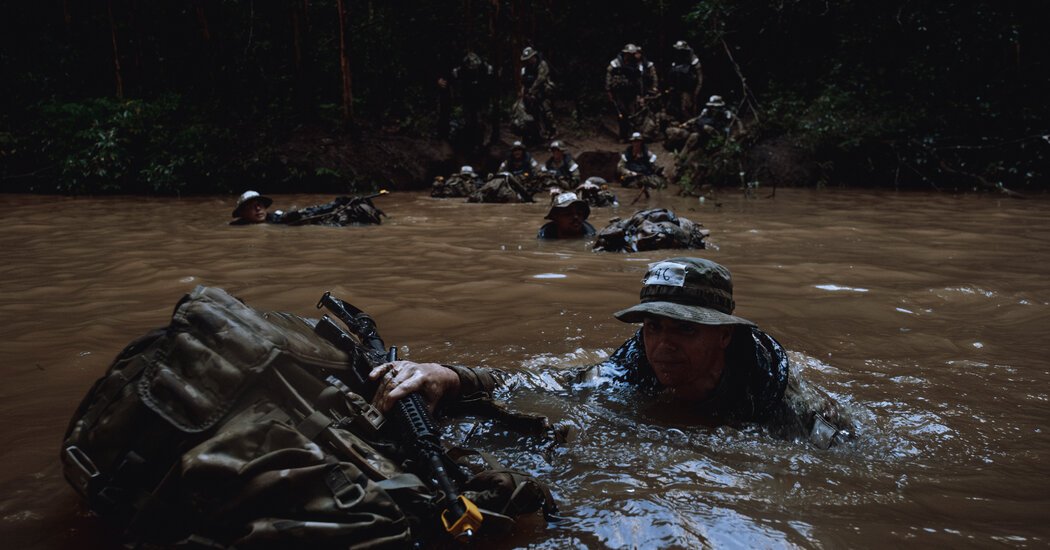
One by one, the American soldiers slid down a muddy hillside to a river deep in the Hawaiian jungle. With guns on top of rucksacks, they kicked their way across, wobbling in the current, trying to stay quiet.
It was a sluggish advance stinking of sweat and silt — reminiscent of Vietnam, and similar to what they might face in a potential fight with China almost anywhere in the Pacific.
“It’s incumbent on us to become resident professionals,” said Col. Christopher D. Johnson, who traversed the river arm in arm with a junior officer. “Firemen don’t figure out how to work a fire engine at the fire, right?”
Military strategists like to say the jungle is neutral, helping neither friend nor foe, but for most of the 79 students last month at the U.S. Army’s only jungle school, “the J” was just plain new. It was nothing like home or deployments to Iraq and Afghanistan, which explained why they were there: To deter China and work effectively with partners in the region, American ground forces need more jungle expertise.
The Marine Corps has been assigning a significant portion of its force to the muggy, rainy terrain of Okinawa, Japan, and training with partners near the Equator. For the Army, Hawaii has become a regional proxy. Commanders are pushing more soldiers through its jungles as the 25th Infantry Division expands instruction at its expeditionary school and leads a new Pacific training rotation that brought together 5,300 troops in November for simulated battles with other services and nations.
The jungle buildup, with roots in the “pivot to Asia” under President Barack Obama, highlights the challenge the U.S. military faces as it tries to prioritize China and unbind itself from decades of war in the Middle East, even as conflict there pulls America back in.
For Hawaii, the shift has been slow but undeniable: Government records point to new command centers, piers, runways and barracks, along with a boost in training tempo, sending more planes over beaches and warships in and out of Pearl Harbor.
Residents have expressed ambivalence about the escalated activity. But some military officials worry they are still not doing enough to prepare American troops, especially the Army’s 452,000 soldiers, for what they might face in the region.
Tensions have been increasing around Taiwan, with China sending more fighter jets near the island democracy, where the capital sits in the middle of a mountainous jungle. In the South China Sea, China’s Coast Guard last week rammed ships from the Philippines — a country that the United States is sworn by treaty to defend, and where it is expanding military bases in areas with dense vegetation and king cobras.
Gen. Charles A. Flynn, the commander of U.S. Army Pacific, said that China had been on “an incremental, insidious and irresponsible path for decades.” Now more than ever, the “total Army,” he said, needs to prioritize relevant Pacific experience.
“It’s more pragmatic,” he said in an interview at the Army’s new headquarters in Honolulu. “Hawaii gives us an invaluable platform,” he added, “to train and generate readiness.”
‘Learn to Live With It’
On the first day of jungle school at Lightning Academy, Adam Elia, a staff historian for the 25th Infantry Division, posted a presentation on the wall of an outdoor classroom.
He showed grainy photos of the division from World War II, fighting in Guadalcanal, where it earned its nickname Tropic Lightning for a quick assault against Japanese troops. He stressed that history offered several lessons about jungle warfare: The climate and terrain slow down efficiency, separate units into small teams, make communication difficult and increase the chance for disease.
“It’s not the enemy,” Mr. Elia said. “Learn to live with it.”
The soldiers nodded. Their class of 90 had already lost 11 students to a swimming test and a hilly, humid run that had to be completed in 40 minutes. Those who remained were mostly from the 25th, playing various roles, but their ranks and patches had all been replaced with a number scrawled on their fatigues.
Maj. Gen. Marcus Evans, who came to Hawaii in August to lead the 25th after serving at U.S. Special Operations Command, said the school aimed to build “leadership, and physical and mental toughness, and then, finally, the ability to work with your peers.”
When the course started a decade ago, after the military’s jungle school in Panama was closed in the 1990s, it was more about getting a feel for the environment. But instructors sent to other programs, from Brunei to Brazil, soon developed a more demanding regimen.
During downtime between classes on how to waterproof a rucksack or set up an ambush, last month’s jungle students worked on ropes and pulleys for a test they have to pass to graduate. Map and compass navigation has also become mandatory.
The analog instruction remains necessary even with the Pentagon’s relentless push for new technology. Army commanders note that artificial intelligence and drones cannot hold territory or manage resupply in soggy gulches where electricity and clean water are scarce.
For many American soldiers, learning about the jungle — including jaguars and trench foot — has meant confronting the limits of American technological prowess, inspiring a greater degree of humility.
During the river crossing, even competent officers drifted and needed help. At one point, as the cloudy sky turned charcoal gray at sunset, a soldier’s M4 machine gun fell to the murky bottom, slowing everyone down until it could be recovered.
“You can’t underestimate the water,” said 2nd Lt. Kendall Elms, a skinny Midwesterner drip-drying by the river. “Never underestimate nature.”
Sense of Urgency
The landscape of the 50th state — more than a century after the U.S. military overthrew the Hawaiian monarchy — is still heavily tattooed with the marks of militarization. The sunken steel digging into Pearl Harbor is well known, but the Army controls around 175,000 acres of Hawaiian land, out of 222,000 under military management.
And with an eye toward China, American military designs continue to find new forms.
In a coastal corner of Oahu about 40 miles from Honolulu, two giant white globes sit atop a hillside. A sign for the U.S. Space Force hints at their links to distant satellites.
A few hundred yards up the road, fences block access to the Makua Valley, a training ground where old ordnance lurks beneath a carpet of green foliage. After residents lobbied against it, the Pentagon has agreed to never again conduct live fire training there, but it has resisted returning the land.
For commanders like General Evans and General Flynn, now isn’t the time to let go of anything that might be useful. As every branch of the U.S. military does more with regional partners like the Philippines — which will host a major training exercise next year, with a lot of jungle activity — there is a profound sense of urgency.
General Flynn said he wanted the National Guard and Reserves to train in Hawaii.
General Evans said he wanted the 25th to tailor its approach to the region’s challenging geography.
“Our mission command posts have got to get smaller, they’ve got to become more agile,” General Evans said.
He listed two more areas of needed growth: protecting supplies in a contested environment, and working more effectively with the armies of other nations.
All three skills could be vital in a battle for Taiwan, which Beijing has threatened to take by force, and Hawaii has become a testing ground for them all. The latest rotation for the Army’s Joint Pacific Multinational Readiness Center involved an exercise with a handful of nations simulating a fight against a major power, island-hopping across Hawaii and to Palau.
But even as the military’s posture shifts, questions remain about whether more must be done.
Army leaders still often struggle to give the region its due. Lightning Academy is on track to graduate only around 600 students this year, and today’s jungle warriors have yet to receive at least one sign of respect.
Under current rules, the jungle tab they earn for finishing the course can be worn only by those assigned to U.S. Indo-Pacific Command.
If they take a job at the Pentagon, they must take off their jungle patch, as if their expertise is no longer relevant.
