
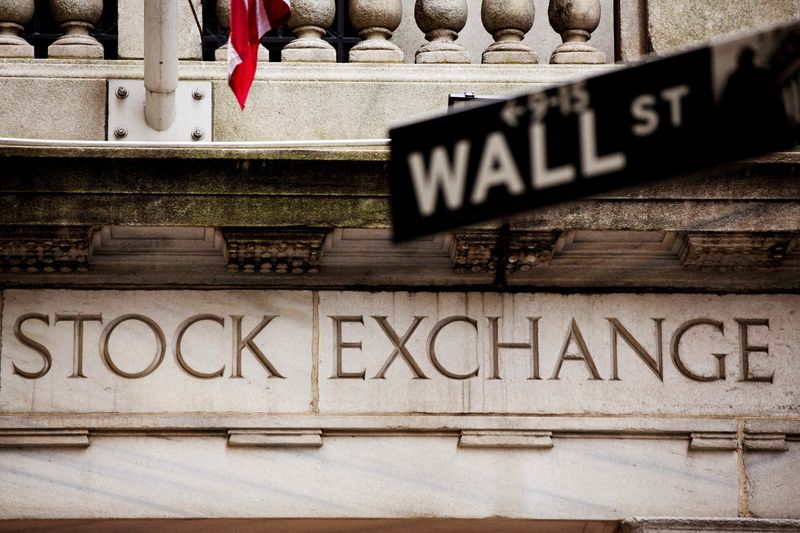
© Reuters. FILE PHOTO: A street sign for Wall Street hangs in front of the New York Stock Exchange May 8, 2013. REUTERS/Lucas Jackson/File Photo
2/2
By Paritosh Bansal
(Reuters) – U.S. short-term financing markets saw a three-day spike in interest rates at month-end. That’s left Wall Street wondering whether the financial system is running out of cash.
A spike in repurchase agreements, or repo, where investors borrow against Treasury and other collateral, can be a sign that cash is getting scarce. Markets need a minimum amount of liquidity to function smoothly.
Eventually, the elevated level of the interest rate, called the Treasury GCF Repo Index, between Nov. 30 and Dec. 4 was explained by factors other than cash scarcity, such as month’s end book-closing by banks and hedge fund trading, interviews with more than half a dozen bank executives and market participants show.
But it set Wall Street abuzz. The U.S. Federal Reserve is draining hundreds of billions from the financial system by selling bonds in a process called quantitative tightening (QT) to normalize monetary policy after the pandemic-era stimulus. That has caused concern that cash levels could be approaching a tipping point, the executives said.
One problem for the market is that there is no consensus on how much cash in the system is too little, and so there is no telling when that level might be breached. Estimates vary widely, adding to the jitters.
Tell Alessio, treasurer at regional lender Cadence Bank, said while they have access to ample liquidity they are watching for the threshold below which market functioning could be disrupted.
“We actively monitor the repo markets for leading indicators of what that lower boundary is,” Alessio said in an email.
The interviews with bank executives, some of whom requested anonymity to speak freely, also provide a flavor of a Fed survey of senior finance officers. The executives work at banks that combined oversee several hundred billion dollars of assets.
In the survey, the Fed polls for information such as the lowest comfortable level of reserves (LCLOR), below which the financial system starts to get impacted. The Fed did the last survey in September but has not released results, leaving only data from May in the public domain.
Two sources at a major U.S. bank said their LCLOR was up by 20% to 30% above what they were before the March banking crisis. Their reasons ranged from market volatility to tighter regulation.
The May survey found that the crisis had led some banks to raise reserves. Three of four mid-sized bank executives said their cash levels have returned to normal after increasing many-fold in March and April, while one said it had higher levels. They all said they were being more conservative in business.
Raj Singh, CEO of BankUnited (NYSE:), said his bank had increased cash levels to $2 billion during the banking crisis, but had brought it down to pre-March levels of around $400 million by the summer.
Amalgamated Bank (NASDAQ:) CFO Jason Darby said they had increased coverage of the riskiest portion of their uninsured deposits to over 200% from 185% after March. Such deposits come from its newer customers, who have been with the bank for less than five years.
“It feels like the events of March are literally only yesterday,” Darby said. “That’s the way we’ve been thinking about trying to manage our business conservatively.”
HOW MUCH IS NEEDED?
Estimates of the minimum amount of bank reserves needed range from about $2.5 trillion to $3.3 trillion. Such reserves currently total nearly $3.5 trillion; another $820 billion or so is held by entities like money market funds.
One treasurer at a mid-sized bank calculated the threshold to be around $2.9 trillion to $3 trillion, while an executive at a large bank said it might be in the middle- to higher-end of the range in the short term.
The large bank executive said a survey of financial officers showed most expected to hit the threshold around the middle of next year. But it also underscored the uncertainty: Some expected it could be breached as early as February or March.
Fed Chair Jerome Powell has said the bank sees no reason to change the pace of QT. “It’s hard to make a case that reserves are even close to scarce at this point,” he said last month.
In broad strokes, financial system liquidity is the sum of reserves held by banks and money parked overnight with the Fed by money market funds and others, called a reverse repo. The levels are affected by the Fed’s balance sheet and the Treasury Department’s general account, where it keeps cash to pay the U.S. government’s bills.
The last time the financial system found out liquidity had dipped too low was in 2019, when bank reserves hit around $1.5 trillion. The Fed had to step in.
Since then, the threshold has likely increased, in part due to the growth in economic activity and tighter regulations, the executives said.
AN ESTIMATE
The mid-sized bank’s treasurer said he looks at the ratio of cash held by domestic banks and their assets, setting his lowest comfortable level at around 9%.
The treasurer draws from 2019, when the ratio fell well below that for a sustained period and markets were affected. It again breached 9% ahead of the March crisis.
The ratio is now above 10%. Roughly $200 billion to $230 billion of cash drain would bring it down by a percentage point, the treasurer estimated.
But before bank reserves get hit, the system has a buffer in the Fed’s reverse repo facility, leading to questions about whether that can be drained to zero. A New York Fed survey shows Wall Street expects the Fed to stop QT when the facility hits $625 billion.
Meanwhile, more tests to liquidity are likely in the coming weeks, keeping Wall Street on edge.
Year-end cash needs still have to be sorted. Early next year, the Treasury will lay out plans for debt issuance that would eat into cash. Then, the tax season will be upon us with more cash needs, said John Velis, forex and macro strategist for the Americas at BNY Mellon (NYSE:).
“That’s another thing to keep in mind as a wild card,” he said.
