
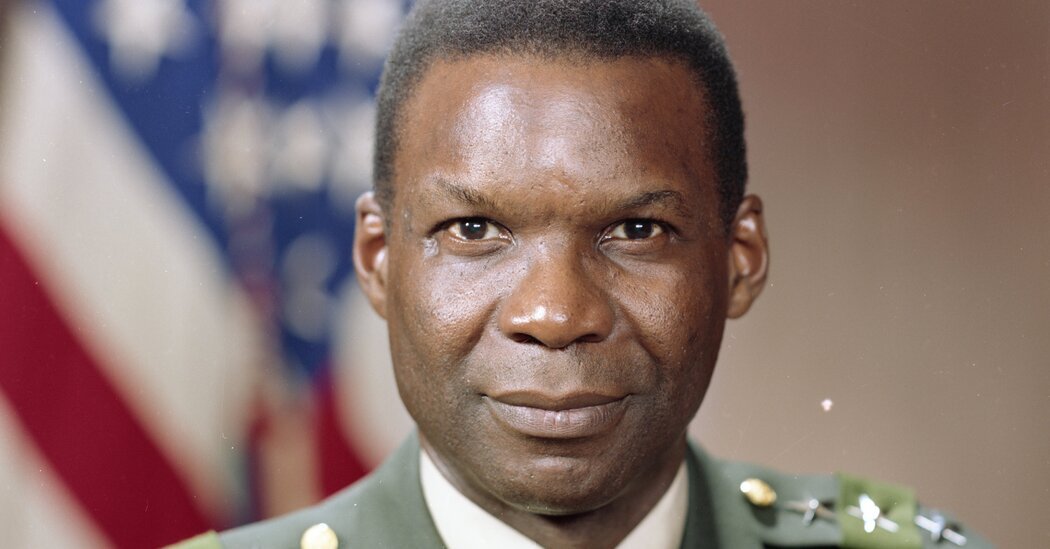
Julius W. Becton Jr., a three-star general who was tasked with defending Europe from a Russian invasion during the Cold War as the first Black commander of an Army corps, and later led the Federal Emergency Management Agency and the Washington, D.C., school system, died on Nov. 28 at Fort Belvoir, Va. He was 97.
His son, Julius W. Becton III, said the cause of death, in a home for retired military officers, was complications of dementia.
General Becton’s uniformed career spanned nearly 40 years, beginning in the era of segregated troops in World War II and including the ascent of Colin Powell, the first Black chairman of the Joint Chiefs of Staff. Mr. Powell, who died in 2021, called General Becton a mentor without whose help and example he would “never have risen.”
General Becton saw combat in three separate wars, earning Silver Stars in Korea and Vietnam. He was the first African American to oversee what was then the Army’s largest basic training program, at Fort Dix, N.J., and in 1978, following his promotion to lieutenant general, he led the VII Corps based in Stuttgart, West Germany, during the Cold War.
In a 2015 oral history for the National Museum of African American History and Culture in Washington, General Becton recalled that when America was convulsed over racial injustice in the 1960s and later over affirmative action, the Army was a rare meritocracy for Black soldiers, offering opportunities and prestige.
“We worked hard. We knew what we had to do. We had our jobs to prepare for and we advanced in the ranks and were respected for what we did,” he said. “Not because we were Black. But because we were good at what we did.”
The challenges and politics of civilian leadership proved not so straightforward.
When General Becton was appointed by President Ronald Reagan to head FEMA, he at one point got crosswise with Gov. John H. Sununu of New Hampshire for withholding approval of a nuclear plant. By the general’s account, he was pushed out of the position when Mr. Sununu became chief of staff to President George H.W. Bush in 1989.
At the age of 70, General Becton accepted an offer to lead Washington’s deeply troubled school system, but he resigned 17 months later, falling short of expectations that he would bring sweeping change. “He suggested he was undermined by enemies,” The Washington Post reported.
Julius Wesley Becton Jr. was born on June 29, 1926, in Bryn Mawr, Pa. His father was head janitor for an apartment building near Bryn Mawr College, and the family, including his mother, Rose (Banks) Becton, a housekeeper and laundress, lived in a basement apartment.
When he was 17 and a senior at Lower Merion High School, Julius Jr. enlisted in the Army Air Corps reserves, then went on active duty after graduation. He was commissioned a second lieutenant in officer candidate school in August 1945, just as Japan surrendered in World War II. He was nonetheless shipped out with an all-Black division to the Pacific, to the island of Morotai, where his unit used a bullhorn to tell Japanese soldiers holding out in the jungle to surrender. They did not always comply.
“That took care of my first combat experience of being shot at,” he recalled in the oral history.
In 1948, while he was a student at Muhlenberg College in Allentown, Pa., he married Louise Thornton, who became a nurse; she died in 2019. In addition to their son, Julius III, he is survived by their four daughters, Shirley McKenzie, Karen Becton-Johnson, Joyce Best and Renee Strickland; 11 grandchildren; and eight great-grandchildren.
General Becton was serving in the Army reserve in Maryland in the summer of 1948 when his base commander read aloud President Harry Truman’s executive order desegregating the military.
“‘As long as I am the commander here, there will be no change,’” he recalled the base commander saying. “I didn’t believe what I heard,” he added in an interview with The Washington Post in 2018. “This was the commander in chief saying this is what it’s going to be. But here was a commander saying nothing would change.”
Despite the discouragement, General Becton left college and returned to active duty. “I really had enjoyed being in the military,” he later said.
Actual integration did not occur until the Korean War.
There General Becton was in charge of an all-Black platoon in the 9th Infantry Regiment, and was ordered to lead a breakout from a defensive line known as the Pusan Perimeter. While assaulting an incline named Hill 201, he came under heavy fire. He was wounded, earning a Purple Heart as well as a Silver Star for valor.
As the war ground on and troop casualties rose, replacements were assigned to units regardless of race. General Becton’s platoon was sent a Mexican American soldier from Texas. “I told my platoon sergeant, ‘Don’t let anything happen to that guy, he’s our first one non-Black, we’re not going to hurt him at all,’” he later recalled. “And with that, we became integrated.”
After the war, General Becton continued his education, earning a B.S. in mathematics in 1960 from Prairie View A&M University in Texas, graduating from the National War College in 1961 and earning an M.A. in economics from the University of Maryland, College Park, in 1967.
In 1968, as a lieutenant colonel in Vietnam, he commanded a cavalry squadron of the 101st Airborne Division. He attracted the attention of Creighton Abrams, the commander of all U.S. military operations in the country, whom General Becton said became a “godfather” to him, aiding his career.
He was promoted to brigadier general in 1972, one of eight Black Army generals.
After retiring in 1983, he led the Office of U.S. Foreign Disaster Assistance, coordinating American aid during a famine in Ethiopia. The job led to his appointment in 1985 to head FEMA; the prior director had resigned amid a federal investigation into fraud and mismanagement.
“He brought a sense of integrity back to the agency,” Jane Bullock, the agency’s chief of staff at the time, recalled in a 1996 interview. “He gave people in the agency a sense of direction.”
After leaving FEMA in 1989, General Becton was recruited as president of his alma mater, Prairie View A&M University, as the historically Black institution faced financial and management problems. He invited the Texas Rangers to investigate the school’s administration and suspended football and most other sports programs, deeming them money sinks. Although some alumni were discomfited, during his five-year tenure, the endowment and corporate donations rose.
He was recruited in 1996 as superintendent of Washington’s troubled school system, with its crumbling buildings, chaotic finances and some of the lowest test scores in the nation.
He fixed roofs on more than 60 schools and toughened security, but as a result, the academic year began three weeks late. And he could not fix systemic problems, including a $62 million budget hole.
Several years later, recalling his decision to quit, he said that running a university had proved child’s play compared to a city school system and that his family urged him to give up the aggravation.
“‘We’re tired of seeing the name Becton in the press,’” he recalled them telling him. “‘We’re tired of seeing the beat-up you’re taking.’”
The general convened a news conference in March 1998, during which he said, “I’m tired, and I want to go home and enjoy it.”
