
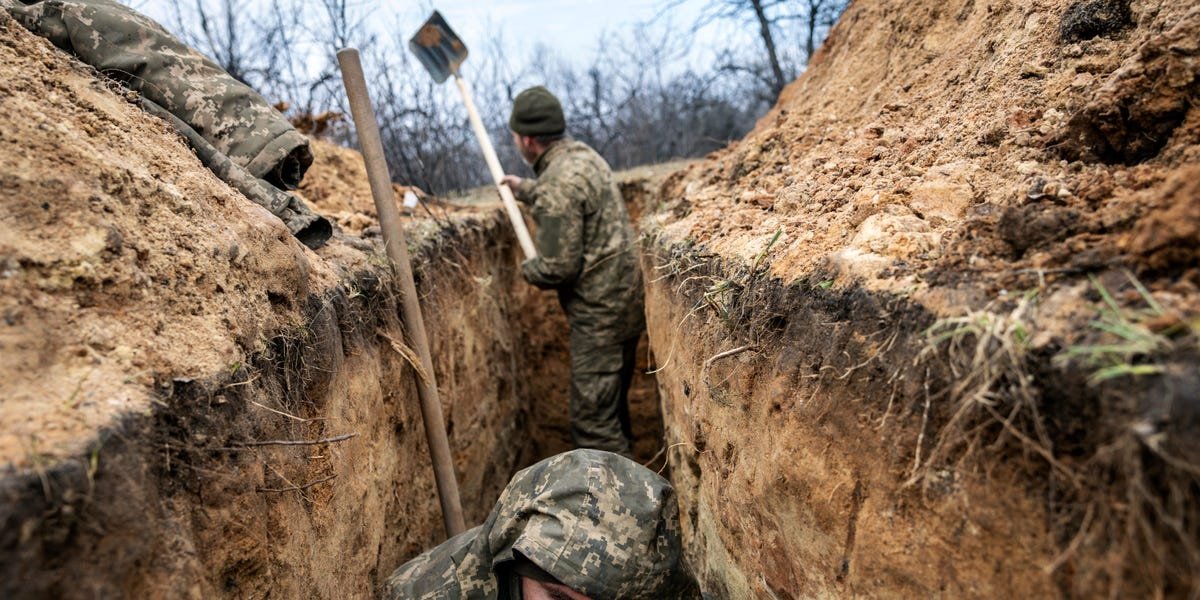
The war in Ukraine showed the British Army that it was training its future leaders to dig trenches in the wrong shape and in the wrong locations.
Defensive trench training for future British Army officers at the Royal Military Academy Sandhurst had remained largely unchanged for decades, but the war in Ukraine is changing how cadets are taught to build and defend their positions.
Trenches that were once straight now have bends to offer better protection from grenades and gunfire. And instead of digging in open fields, cadets are seeking cover from the drones that have made exposed positions increasingly dangerous.
Business Insider recently observed elements of a six-day defensive exercise for officer cadets on England’s Salisbury Plain. Lessons from Ukraine’s battlefields are being incorporated into the training. A Ukrainian officer is also on site to share his experiences and answer questions on modern warfare.
The goal of the training is to be “as realistic as possible” about the realities of modern warfare, Brigadier Nick Wight-Boycott, the commander of the Royal Military Academy Sandhurst, told Business Insider. Achieving that has meant reconsidering long-standing practices based on lessons from Ukraine.
Wight-Boycott said it’s about preparing for the kind of “operations the British Army might be asked to do.”
A different trench shape
The resurgence of trench warfare in Ukraine has driven partner militaries to give it more attention in training.
At Sandhurst, that means making trenches L-shaped, Wight-Boycott said.
Previously, “they were just straight,” he said. “If you dropped a grenade in, all the shrapnel just went one way, and everybody who was in the trench would probably get a bit of the fragmentation.”
Sinéad Baker
With L-shaped trenches, “if someone does throw a grenade in, you can hide around the other side, and you’re not going to get any of the frag,” he said. “Or if someone gets in and they start shooting, you could hide behind it.”
Capt. Will Kriehn, a British platoon commander, told Business Insider that previously trenches in the exercise were “essentially a deep hole.” Now, they’re focusing on the new shape because it’s what they’re seeing in Ukraine.
Business Insider observed small groups of officer cadets digging independent L-shaped trenches close together. In a real conflict, the goal would be to dig further to link the trenches. “If we had more time, we would connect them,” Kriehn said.
Zero, an advising Ukrainian officer who has served as a platoon commander on Ukraine’s front lines, told Business Insider that the change is a positive development.
Ukrainian troops and unit representatives have said trenches with turns better protect troops from the kind of threats becoming more pervasive in battle. Ideally, they’ve said in local media interviews, trenches should not have long, straight sections.
Elements of the US Army have made similar observations on survivability from the war in Ukraine. Citing observations of conflict, a 2024 US Army Center for Army Lessons Learned report said that “fighting positions should be made as deep as possible with a blocked ‘L-shaped’ entrance.”
L-shaped and zigzag trenches are nothing new, having been used in World War I, but Ukraine’s war has renewed attention to how these defenses are built and adapted to modern threats.
TETIANA DZHAFAROVA/AFP via Getty Images
Working with Ukrainians has challenged some British Army assumptions about what trenches actually look like in a modern war. Instead of being clean and surgical, they are likely to be messy, uneven, and full of traps.
It’s also triggered changes in how the army defends its fighting positions.
Wight-Boycott said his officer cadets are using nets and chicken wire to protect fighting positions from grenades and drones, drawing those lessons from Ukraine.
Digging away from the open
The hills of the Salisbury Plain were scarred by old trenches dug in open fields. Kriehn said that when he did the exercise in 2022, cadets were “deployed into an open field” where they dug for days and “there was no cover.”
Now, cadets are digging under trees, reflecting lessons from Ukraine about how easily reconnaissance drones can spot exposed positions.
Sinéad Baker
“In the past,” Wight-Boycott said, “they’ve basically gone into an empty field in the middle of Salisbury Plain and dug trenches where you can see the whole of the field.”
But, he continued, “everything that we’ve seen in warfare, not just in Ukraine, is that nobody ever digs in an open field.”
The training also wants officer cadets to be faster at digging and moving between defensive positions. For instance, instead of spending much of an exercise digging and defending a single position, cadets might now practice quickly digging in, defending, and falling back to do it all over again. The intent is to slow an enemy advance and buy time for other forces to counterattack.
The new approach at Sandhurst doesn’t mean a change for everything the British Army does. Officers leaving Sandhurst may be deployed away from Europe, or face a conflict that needs different defenses. But the army is preparing for a potential land war with Russia in Europe, and wants its future leaders to be ready to adapt to different threats and battlefield conditions.
Sandhurst wants “to make them agile leaders, thinking leaders so that when they leave, no matter what job they go into, they can apply those skill sets to them,” Kriehn said.
For Sandhurst, new knowledge comes in part from its instructors training Ukrainian soldiers, who have “seen how the Ukrainians have changed their tactics,” Wight-Boycott said, and brought that knowledge back.
“We’ve adapted really quickly to that changing character of conflict.”
