
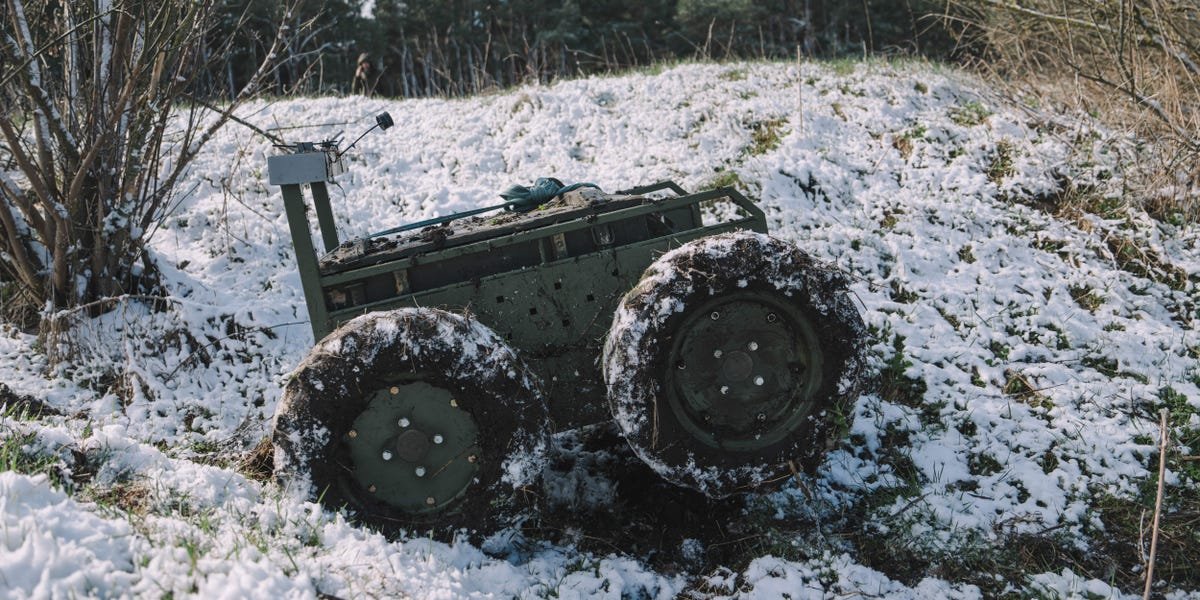
War robots are becoming a growing presence on modern battlefields, and defense manufacturers are pushing to make them more autonomous to further reduce the risks to soldiers.
But making uncrewed ground vehicles that can drive themselves into battle presents a challenge that self-driving cars don’t.
The number of robots in military arsenals is soaring, particularly in Ukraine, where they fire weapons, attack positions, and carry wounded soldiers, all while their operators remain farther from danger. Greater autonomy would allow fewer soldiers to operate more vehicles, let troops stay farther from the front, and allow robots to keep going when communications are disrupted.
A chaotic battlefield, however, is far different from safe, well-mapped roadways. Robots have to navigate muddy tracks, forests, and dangerous terrain while facing enemy attacks.
Terrain, conditions, and targets change constantly. And there are no rules. No speed limits, no predictable traffic, and no guarantee of safety.
Yan Dobronosov/Global Images Ukraine via Getty Images
German defense technology company ARX Robotics makes GEREON robots, autonomous systems that have been used by Ukraine and procured by the UK. David Roberts, CEO of the company’s British arm, told Business Insider that, when it comes to making self-driving vehicles, companies working on civilian roads face a less challenging environment.
“Roads are structured,” he said. “They’ve got rules. Roads are wide enough for cars to drive down. They have markings to tell a vehicle what to do and when to do it.”
In war, “there are no real rules,” Roberts continued. “You don’t quite know if someone’s going to step out in front of you or be in the long grass in front. It’s a very challenging environment in the first place to build autonomy.”
Mike McGinty, the CEO of British firm Digital Concepts Engineering (DCE), whose X-series ground robots have been procured by the British Army, also spelled out the differences.
A street is “flat, of a guaranteed surface. It’s marked. It’s a track. It has a left and a right. It’s signed,” he said. And it’s unchanging. “The same street’s there tomorrow.”
“True autonomy is an extremely hard problem on cross-country ground,” he said. “If you see a line on the ground, is it a hole, a log, a burn mark, a shadow, a crocodile, a person?”
Dmytro Smolienko/ Ukrinform/Future Publishing via Getty Images
That doesn’t mean it’s easy to develop a self-driving car or taxi. “The truth is it’s still extremely difficult,” McGinty said, but developing autonomous uncrewed ground vehicles for war is a much more daunting task.
The push for battlefield autonomy
Autonomy can mean anything from following preset routes to independently navigating to a destination. Capabilities in Ukraine have grown, with AI helping robots navigate when Russian electronic warfare cuts communications.
Yevhen Titov/Global Images Ukraine via Getty Images
Autonomy remains limited. Roberts said that most robots in Ukraine are simply remote-controlled, with autonomy in “very niche areas,” such as following waypoints if they lose their operator connection.
He said autonomy needs to evolve beyond what has been demonstrated in Ukraine.
The GEREON robots that ARX Robotics makes run on Mithra, a software layer that connects their sensors, AI, and autonomy functions. The “supervised autonomy allows a single soldier to task and oversee multiple systems simultaneously, delivering more mission output with fewer personnel,” the company says.
Roberts said the “ability to tell a vehicle to go to a certain place on the battlefield is very much where we are working at the moment.” ARX’s robots can already follow waypoints, detect people, avoid collisions, and make safety stops, he said.
The next step is at the mission level, and he predicted that, within the next year or two, battlefield management systems will be able to tell vehicles where to go. “I don’t think that this is something that anyone has actually got deployed yet, but I think there are a number of companies who are working on that sort of problem set.”
McGinty said Ukraine’s current level of autonomy typically allows operators to control robots remotely, calling this the level of autonomy that DCE had “mastered.”
“Full autonomy is still a very difficult technological step,” he said. “So someone will take it, but it won’t be us because we’re not the software company doing that.”
Angelika Warmuth/REUTERS
DCE’s robots can be fitted with a Marionette kit, which enables remote control and supports autonomous features, including software developed by other companies.
Oleksandr Yabchanka, head of robotic systems for Ukraine’s Da Vinci Wolves Battalion, told Business Insider that ground robot autonomy in Ukraine “is still in the early stages of development,” but units want more to protect their soldiers. “The future of both aerial drones and unmanned ground systems lies in the development of autonomy.”
Multiple projects are underway.
Ukraine’s state-backed innovation platform Brave1’s grant program, for instance, calls for “autonomous logistics” robots that can independently return to base and move autonomously if communications are lost.
Ukraine has integrated AI into aerial drones, which have been more prominent in this war, as well as fixed weapons, and it is increasingly being incorporated into ground robots as the country pushes for greater autonomy in its uncrewed warfighting systems.
The aim is to enable a single soldier to oversee multiple pieces of equipment simultaneously.
