
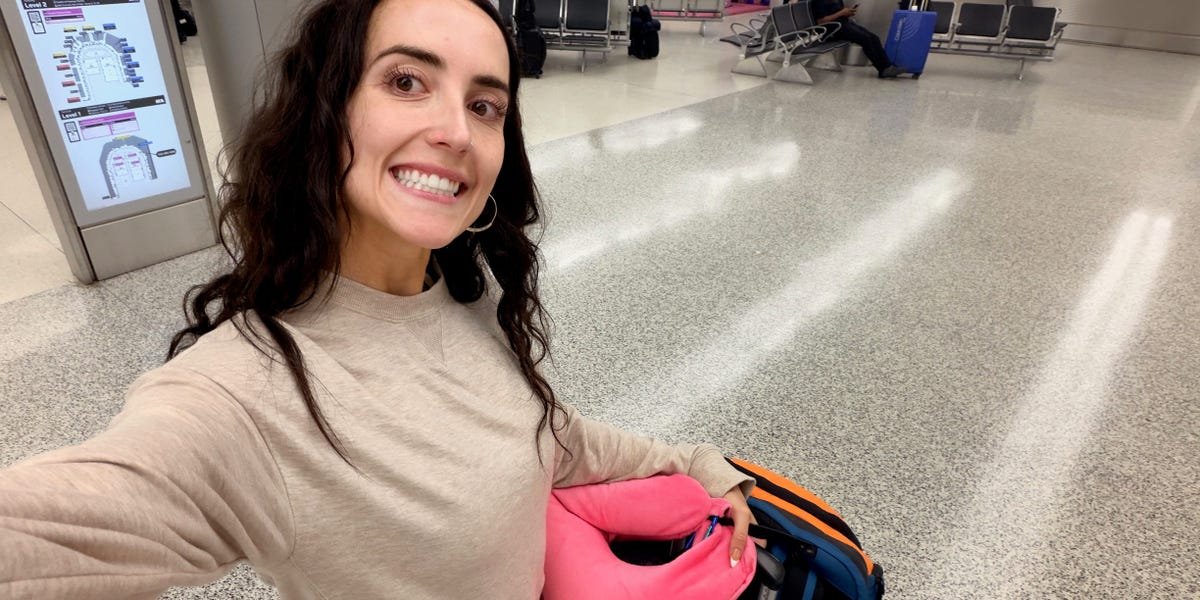
I spend a huge portion of my life on airplanes as a frequent traveler and journalist, so I’m used to the usual delays, missed connections, and last-minute flight changes that come with commercial air travel.
But I have never experienced anything like the crippling air traffic control outage on Friday, November 13, that displaced thousands of passengers and crews and canceled over 12,500 flights.
I had been at cruising altitude, flying back from a vacation in the Caribbean island of Curaçao toward my home in Salt Lake City, when the Federal Aviation Administration halted departing flights across the entire US.
Before Friday, the FAA had only ordered a nationwide ground stop twice in modern history: once in January 2023, following a failure of a key pilot-alert system, and after the September 11 terrorist attacks.
Given the rare track record, I wasn’t thrilled to find myself midair when I heard the news.
What should have been a quick two-hour layover in Miami unraveled into a chaotic overnight delay, with hours spent on a gridlocked tarmac as passengers raced for vanishing hotel rooms and flight inventory.
We learned about the nationwide shutdown at 35,000 feet
Before boarding in Curaçao, my flight had already been delayed by about 30 minutes, and I jokingly texted a friend that it better not be delayed any further because I refused to spend the night in Miami.
I should have knocked on wood, because about 40 minutes out from landing, the cabin speakers crackled to life.
The captain said he was sure some of us had WiFi and had seen messages about a nationwide ground stop, then confirmed it was true.
Gentry Hale
Hushed conversations throughout the cabin ensued, and I looked to my neighbor to check the news since I didn’t have WiFi myself. This was the first time in a long time I was nervous on a plane.
I read that officials said a telecommunications issue was affecting Air Route Traffic Control Centers, the regional facilities responsible for directing and guiding aircraft at higher altitudes between airports.
I also read that officials did not believe the disruption was the result of AI or a cyberattack — something that I’d been wondering about. For some reason, that scared me even more. What was it, then?
My next thought: If air traffic control has a communications failure, how are we going to land?
I was relieved when the captain informed us that planes already in the sky, including mine, were cleared to land at their destinations, and that the order had frozen departures.
Although I didn’t know it at the time, officials later said that pilots, air traffic controllers, and dispatchers have various backup methods and digital tools for communication, and pilots are trained to navigate and land without comms.
Still, the timing of the halt was unnerving, coming after the widespread Microsoft cloud disruptions the day before and the National Weather Service data hiccups earlier Friday.
Landing in Miami was only the beginning of the chaos
When our wheels finally touched down at Miami International Airport, I checked my phone and saw that the captain had kept us informed to the best of his knowledge; no further news had been released, but at least we had been able to land.
But now we were stuck on the plane. Because inbound flights were still arriving while outbound planes sat at their gates, the airport’s ramp space was gridlocked.
With nowhere to park and unload passengers, our plane sat idling on the tarmac for the next two hours.
Giorgio VIERA / AFP via Getty Images
Around 7:30 p.m., about an hour after landing, passengers around me began murmuring that rebooking options were finally appearing in the American Airlines app.
When I refreshed my screen, every option required flying out the following evening on grueling 12- to 14-hour itineraries with multiple layovers.
Unwilling to spend a half-day hopping around the US from Florida to Utah, I accepted that I would spend the full weekend in Miami. But before I booked something for Sunday or Monday, I refreshed the list one more time.
Buried at the very bottom was a single direct flight departing at 7:45 p.m. on Saturday night. I booked it immediately, snagging one of the final three open seats — and crossed my fingers that the snowball effect would slow by then and my flight would actually take off.
Hotel rooms disappeared almost as quickly as flights were canceled
Still trapped on the tarmac, another problem emerged: finding a place to sleep.
Around me, passengers were frantically refreshing booking apps as airport hotels sold out in real time. I barely managed to book a room at the Hyde Hotel in Midtown Miami, about 15 minutes away.
It wasn’t cheap — $621 for the night, to be exact.
The airline wasn’t required to help me out in the uncontrollable flight disruption, and I’m not sure my travel insurance will reimburse me, so I’ve accepted I may eat that money.
Gentry Hale
When I finally deplaned around 8 p.m., cleared customs, and arrived at the lobby, the front desk agent told me the hotel had surged from about 40% full at 5 p.m. local time to sold out by 9 p.m. — filled to capacity by displaced flyers in under four hours.
Even in a major hospitality hub like Miami, inventory evaporates quickly when thousands of stranded travelers are competing for the same beds. Despite the pain in my wallet, knowing I wasn’t spending the night on an airport terminal floor felt like I had won the lottery.
I was reminded that no matter how much I prepare, I’m at the whim of the air system
Once I reached my hotel, I refreshed my news app to see that the FAA had lifted the nationwide ground stop, allowing departures to slowly resume, but the effects had already disrupted the whole country.
Air travel is notorious for its snowball effect: a single thunderstorm in Dallas or Atlanta can trigger cascading delays thousands of miles away as planes and crews get displaced. A simultaneous shutdown of the entire US airspace system was a whole other beast.
A friend scheduled to fly to Las Vegas had his trip canceled before he had even left for the airport. But another friend flying from Panama to Denver ended up stranded in Houston — her second overnight stall in 48 hours after weather disruptions the day before.
Joe Raedle/Getty Images
For someone who flies regularly, the unexpected chaos was a reality check. I can build buffer time into my schedule, book early-morning departures and pack carry-on only, but none of that will protect me when a backbone of the national airspace system goes offline.
Lying in my hotel room in Miami, I’ll admit I felt a flicker of hesitation about stepping back onto a plane Saturday evening. The thought of pilots losing clear communication with the ground is terrifying.
But that fear is merely one of the trade-offs we accept every time we board a flight to see the world — and I know the pilots are highly trained to deal with emergencies like lost comms.
