
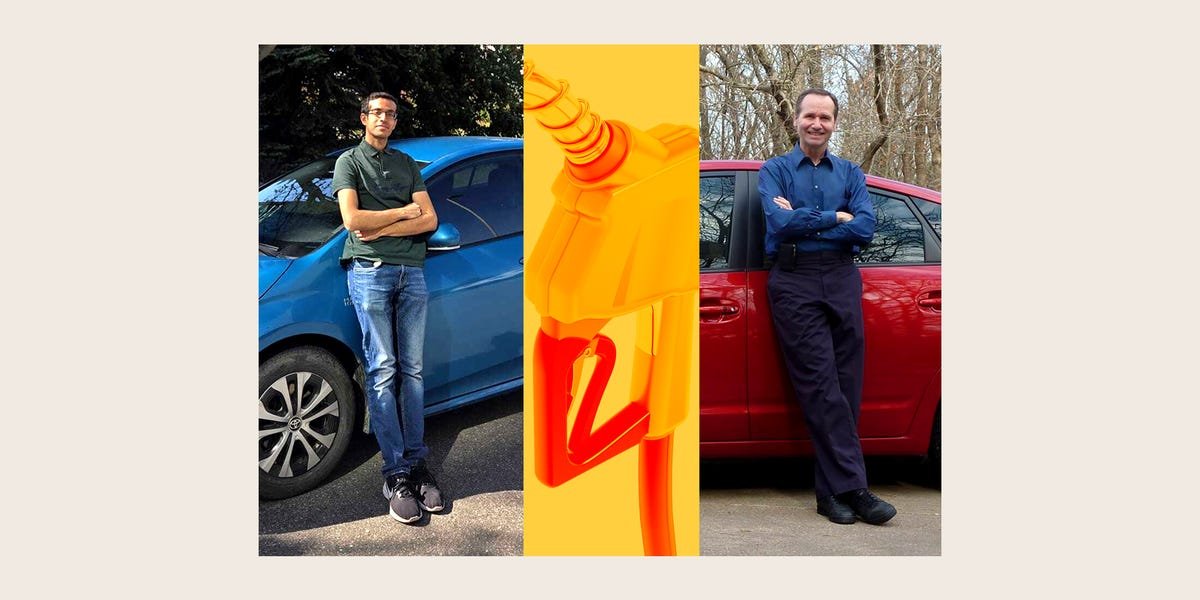
Dave Castino has tracked his fuel economy across all 43,497 miles he’s driven in his 2021 Mazda3 over the past three years. He averages 39.4 miles per gallon — 46% better than the Environmental Protection Agency’s combined estimate for the car — and has topped out at 45.6 mpg on a tank of gas. Fuelio, the app he uses to track his gas mileage, shows a steep drop on December 12 of last year — the day he got new tires. They’re great for the winter weather in Indianapolis, but they’ve resulted in a 10% decrease in fuel economy. Still, he’s never had a tank fall below the EPA’s rating.
The 37-year-old father of two recognizes this can sound tedious, but it’s actually a way for him to manage the tedium of his commute. The 38-mile drive each way is pretty boring, and tracking his gas mileage is a weird, secret little game that keeps him entertained.
“If I’m going to be in the car two hours a day, four days a week, it gives me something to do,” he says. “This is one way for me to try and beat yesterday’s high score.”
Castino is a hypermiler — part of a small but enthusiastic community of drivers determined to get the best bang for their gas-tank buck. They swap tips on Reddit, brag about their stats on online forums, and engage in driving tactics that range from deft to dangerous. The practice is making a comeback as gas prices rise, as The New York Times recently noted, but the true mpg maniacs are in it for more than money. The motivations are part environmental awareness, part anger management, and part nerdy glory.
David Castino
Optimizing his fuel economy comes naturally to Castino — he’s an energy manager for an apartment development and management company where small tweaks can translate to millions of dollars. He thinks he saves about $600 a year through hypermiling, a drop in the bucket given that he pays $700 a week for day care. Still, he doesn’t dare push his wife to join his efficiency quest in the family minivan. “I value my marriage too much for that,” he says.
The term “hypermiling” was coined in 2004 by Wayne Gerdes, a fuel-efficiency guru and the founder of CleanMPG, an online community devoted to the hobby. Hypermiling was the New Oxford American Dictionary’s word of the year in 2008, and for good reason: The cost of gas surpassed $4 per gallon and gobbled up 4% of the median household income. It’s since fallen out of the zeitgeist, and while gas prices are going up again, they’re not quite as painful as they were nearly two decades ago. Adjusted for inflation, a gallon of gas in 2008 would cost $6-$7 today. Rising fuel costs are nudging some people toward adjusting their driving habits to save money, but it’s not shoving them. (Also, many drivers are likely doing some light hypermiling without realizing that’s the term for it.)
The bigger change has been the ability to use modern technology to lean into gamification. Most cars now come equipped with real-time fuel economy displays, turning efficiency into an instant feedback loop and personal scoreboard.
“One thing about human nature is you put a meter in, and suddenly you’re trying to compete,” says Jake Fisher, who oversees Consumer Reports’ auto testing program. “The problem is that, as with everything, you could take it to an extreme.”
People think I drive slow, whatever.
Sarah Holmes, a 39-year-old social worker, stumbled into hypermiling when she started a new job with a “hellscape” of a commute. The stressful drive along a Connecticut interstate was putting her into a daily rage, so she made a deliberate effort to slow down, stick to the speed limit, and stop passing other cars. Not only was it good for her mental health, it was also great for her gas mileage. Fiddling around with the controls in her 2015 Subaru Forester, she realized her average gas mileage had increased from 24-25 to 30-31.
“The general perception is that I’m just a nervous driver, not that I’m doing it intentionally to remove my nerves, which is fine,” she says. “People think I drive slow, whatever.”
Holmes occupies a peaceful, practical end of the hypermiling spectrum. On the other end of it are the purists who’ve turned fuel efficiency from a mild hobby into a neurotic sport.
Courtesy of Hadi Ahmad
Hadi Ahmad, 25, is closer to the latter camp. The Toronto-based data analyst shares two Toyota Priuses with his parents and is currently obsessing over 120 miles “missing” from his logs after his dad filled up one of the vehicles and failed to track it. Ahmad never turns on the car’s air conditioning and occasionally engages in “drafting,” by tucking in close behind a big truck on the freeway to reduce wind resistance. Is that dangerous? “Yes,” he responds matter-of-factly, but it’s an easy way of getting “25% or more gains in your efficiency.” He still considers himself a casual hypermiler, though, since he hasn’t yet ventured into vehicle modifications or weight reduction strategies. But he may be about to take the leap: he’s considering a plan to drill pizza pans onto the wheels of one of the family cars to decrease drag. Whether his parents will go for it is “debatable.”
When I describe this idea to Jonathan Elfalan, director of vehicle testing at Edmunds, he also has his doubts. “You’ve got to make sure that your brakes don’t overheat because of lack of airflow,” he says. He adds that new cars are so optimized for aerodynamics straight out of the factory, modifications may wind up being counterproductive: “Joe Schmo in his garage is most likely not going to improve on the engineering of a car that’s had teams of classically trained engineers in wind tunnels.”
Most hypermilers aren’t so dedicated to their cause that they’re putting themselves and others at risk. In general, auto industry experts and fuel economy-conscious drivers agree that there’s a lot to be gained from modest behavior modifications and basic physics.
Aerodynamic drag increases quadratically with speed, so the faster you go, the harder your car’s engine has to work and, in turn, the more fuel you burn. Just slowing down from 75 to 65 miles per hour provides a meaningful, instant boost in fuel efficiency. As a general rule, the less braking, the better on regular-gas vehicles, so hypermilers will coast to stoplights and keep their eyes far ahead on the road to anticipate slowdowns. Hypermilers prefer roundabouts to stop signs. If they do hit a stop sign or red light, they try to accelerate gradually when they get moving. They also keep their tires inflated to the manufacturer’s recommended pressure — or slightly higher. They see roof racks and bike racks as a no-no, due to air drag. They’re a bit split on cruise control — some think it helps, others think they can beat the machine at efficiency.
Joe Schmo in his garage is most likely not going to improve on the engineering of a car that’s had teams of classically trained engineers in wind tunnels.
Hypermiling can become foolish when drivers take it too far, for example, by tailgating semis or driving dangerously slowly. Fisher recalls following a Honda Insight years ago that was going five miles per hour under the speed limit. He thought the driver was extra-cautious — until they blew a stop sign, in an attempt to avoid braking. “You’re saving a couple of bucks, but potentially getting into a crash. It just doesn’t make sense,” he says.
Many of the hypermilers I spoke to for this story emphasized that the practice does not mean they drive like a grandma, which led me to suspect that it is kind of what it means for those not on the risky fringes.
“Hypermiling is a misnomer. There’s nothing hyper about it, it’s just common sense,” says Dan Gray, who runs MPGomatic, a YouTube channel that reviews cars on gas mileage. “Overall, don’t piss off the people behind you because you don’t want to get people angry because they think you’re going too slow, even though you’re not.”
Hybrid vehicles are especially popular among hypermilers because they do a lot of the efficiency work for you. They combine a regular gas engine with electric motors and a battery pack to save fuel and reduce emissions. Braking captures energy as they slow down, and at low speeds, many hybrids can rely entirely on the electric motor.
Paul Westbrook, 65, has gotten so good at hypermiling in his Prius hybrid that he’s only purchased 50 gallons of gas all year. The Texas retiree acknowledges that’s partly because he’s not driving to work anymore, but even then, he was filling his tank a dozen times a year at most. He’s been tracking his fuel efficiency since 2004 and averages 53 miles per gallon. He would love to trade for a plug-in hybrid, like his wife has, but all the hypermiling means his 2007 vehicle still works like a charm. “The wear and tear on the car is less when you drive it a little more responsibly,” he says.
Paul Westbrook/Enerjazz
For Jay Olson, a 53-year-old IT manager in California, hypermiling is more about the environmental case for making things last than anything else. His 2010 Prius has nearly 238,000 miles on it, and when his fuel economy dropped recently, he figured out the problem and fixed it himself.
“Hypermiling is just one piece of the conversation if you start to look at your carbon footprint and your effect on the planet,” he says.
The greenest move isn’t upgrading to a new car with all the bells and whistles — it’s making sure old reliable stays reliable as it gets old.
As gas prices surge due to the war in Iran and other ongoing inflationary pressures, more drivers may be inclined to see what this hypermiling thing is all about. A 2008-esque resurgence, however, is unlikely. Americans are still spending a relatively low proportion of their incomes on gas, says Patrick De Haan, the head of petroleum analysis at GasBuddy, a gas station finder app. Plus, most people are “not the brightest bunch” when it comes to efficient driving. “I still see people out there driving around like it’s the Indy 500,” he says. “If anything, driving has gotten to be more of a competition than anything else.”
Hypermiling is just one piece of the conversation if you start to look at your carbon footprint and your effect on the planet.
The auto industry has also shifted toward larger, bulkier vehicles, in part because that’s what many American drivers prefer and, in part, because that’s what makes them the most money. Hypermiling entails some strategic undertakings that not everyone has time for or interest in. As much as we live in an optimized-obsessed culture, for most people, devising a route to work based on what has the most roundabouts feels like a bridge too far. The practice often also involves unlearning some pretty ingrained driving habits.
For David Raine, a 65-year-old warehouse manager who lives outside Toronto, the interest in hypermiling has come with age. “When I was young, gas was cheap, and when you’re young, you’re kind of reckless with your right foot,” he says. Try as he might, much like Castino, he still can’t get his wife to go along with any of this. “She is somewhat of a lead foot,” he says. “I’ll be honest, when I’m in the passenger seat, I’m a bit of a nag.”
David Raine
America may not become a nation of hypermilers anytime soon — or Canada, it would seem. But for some people, it’s not bad to live life in the slow lane economically, environmentally, or emotionally.
Emily Stewart is a senior correspondent at Business Insider, writing about business and the economy.
Business Insider’s Discourse stories provide perspectives on the day’s most pressing issues, informed by analysis, reporting, and expertise.
