
Author
Ahmed Barakat

Author

Share

Fact Checked by
CryptoNews Editorial Team
Author

CSD BR, a Brazilian financial-market infrastructure operator overseeing more than 22 trillion reais in registered assets, has been in the news as it began mirroring ownership records for selected BTG Pactual investment funds on the public XRP Ledger. The deployment adds a near-real-time verification layer to live fund records, but CSD BR’s database remains the official record for registration, custody, and settlement.
When an investor buys into a fund, the depository updates its ownership records while banks serving investors maintain their own books. Those records have to be reconciled, a process that can be slow and costly; a mismatch can delay a trade.
Under the new arrangement, however, approved banks and companies can check the XRPL copy against CSD BR’s database at any moment, without waiting for a later comparison. That could make discrepancies easier to identify, although the official record remains in CSD BR’s system and the project does not eliminate the need for that system’s controls.
The design puts the focus on infrastructure efficiency, not just token issuance. XRPL’s features for tokenized assets and financial applications are relevant to that use case, but the practical test is whether participants can verify records reliably without disrupting existing fund processes.
Earn $50 and Enter $300K Prize Draw on EdgeX
How CSD BR’s XRP Ledger Record Works?
Fund shares already deposited with CSD BR will be represented as tokens on XRPL using its Multi-Purpose Token standard. This mirrors ownership information; it does not transfer the underlying assets or replace CSD BR’s database as the legal source for registration, custody, and settlement.
The ledger is public, so anyone can read token movements and see changes, including reversals made by CSD BR. Participation is controlled, however: CSD BR retains authority over who can own and transfer the tokens, and approved institutions remain subject to identity and anti-money-laundering checks.
CSD BR can also freeze assets or reverse transactions when required by a regulator or court. The result is a public record with issuer controls, rather than an unrestricted token that can be transferred by any account.
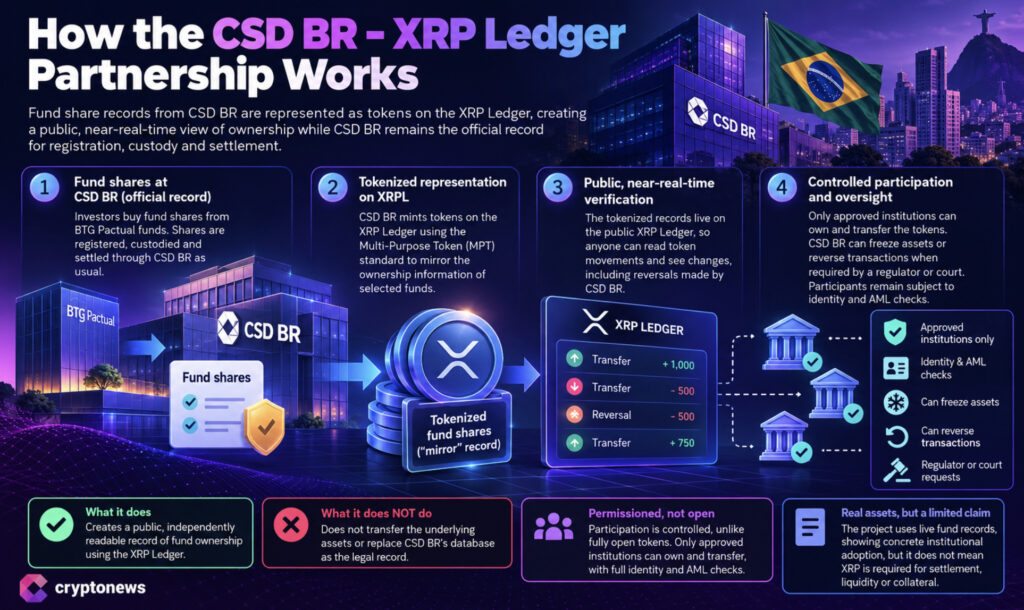
This public-but-permissioned structure differs from the private blockchain experiments many banks and depositories have pursued, where access is limited to invited members. The initial project uses live fund records rather than only test assets, but that does not establish that it is the first deployment of its kind in Brazil or globally.
Its significance for institutional adoption is therefore concrete but bounded: approved participants get a shared, independently readable record, while the existing regulated infrastructure keeps legal authority. Wider XRPL use in multi-asset financial applications likewise should not be conflated with proof that XRP itself is required for those applications.
Trade XRP on Bybit and Get a Chance to Win Our $1,000 USDT Airdrop
Regulated Infrastructure News Away From XRP native Issuance
Founded in 2018, CSD BR is authorized by Brazil’s central bank and securities regulator to operate registration, securities-depository, and settlement systems. Those regulated functions remain central to the arrangement, alongside the identity and anti-money-laundering checks required of participants.
Nothing in the announcement news establishes that XRP is needed to issue, hold, settle, or trade the fund tokens, or that it will provide liquidity or collateral. Adoption of the XRP Ledger is not, by itself, evidence of direct demand for XRP; institutional activity involving Ripple also needs to be separated from confirmed use of the token.
CSD BR and Ripple plan to explore direct issuance and trading on XRPL after assessing the record-mirroring phase. Potential candidates include Brazilian real-estate and agribusiness receivables, but no launch date, transaction volume, or asset value has been disclosed for the next step.
Direct issuance and trading would represent a larger change than today’s mirrored records: assets could be created and exchanged on the ledger rather than represented there for verification. For now, the $4 trillion figure describes the scale of CSD BR’s registered-asset infrastructure, not assets being tokenized on XRPL.
Discover: The Best Token Presales
