
A
fter 246 days in Hamas captivity, Israeli special forces rescued Noa Argamani and carried her by helicopter to a hospital outside Tel Aviv. There, a doctor turned to her and said, “Noa, we’re really happy that you’re here with us.”
Argamani was confused. “The first thing I asked is, ‘How do you know my name?'” she recalls. “I didn’t realize the whole world knew who I was.”
At 25, Argamani had become one of the faces of the October 7, 2023, attack on Israel. On the morning of her kidnapping, she was a college student about to begin her third year studying artificial intelligence. She imagined becoming a software engineer. Maybe she would start a company someday.
Sydney Krantz for BI
This month, she started a new job. Argamani has joined the venture capital firm Vine Ventures, which backs early-stage startups, especially in artificial intelligence, cybersecurity, and defense tech. She’s working with Israeli founders and companies looking to grow their business in the United States. Her new role puts her contact list to work: Her ordeal thrust her onto a global stage, connecting her to world leaders and business titans alike.
“In this moment, if I want to learn and make an impact, VC is the right place for me,” she says. “I want to be surrounded by people who dream big.”
For Israeli founders, America is often the market that determines whether a promising startup becomes merely successful or truly enormous. Argamani sees herself as a potential bridge between the two countries — someone who can help Israeli founders turn their companies into global category leaders.
“My mission is to help Israeli startups go to market and really break this border,” she says. If she succeeds, she could bring more of the world’s best technology, networks, and business know-how back to her home country.
Sydney Krantz for BI
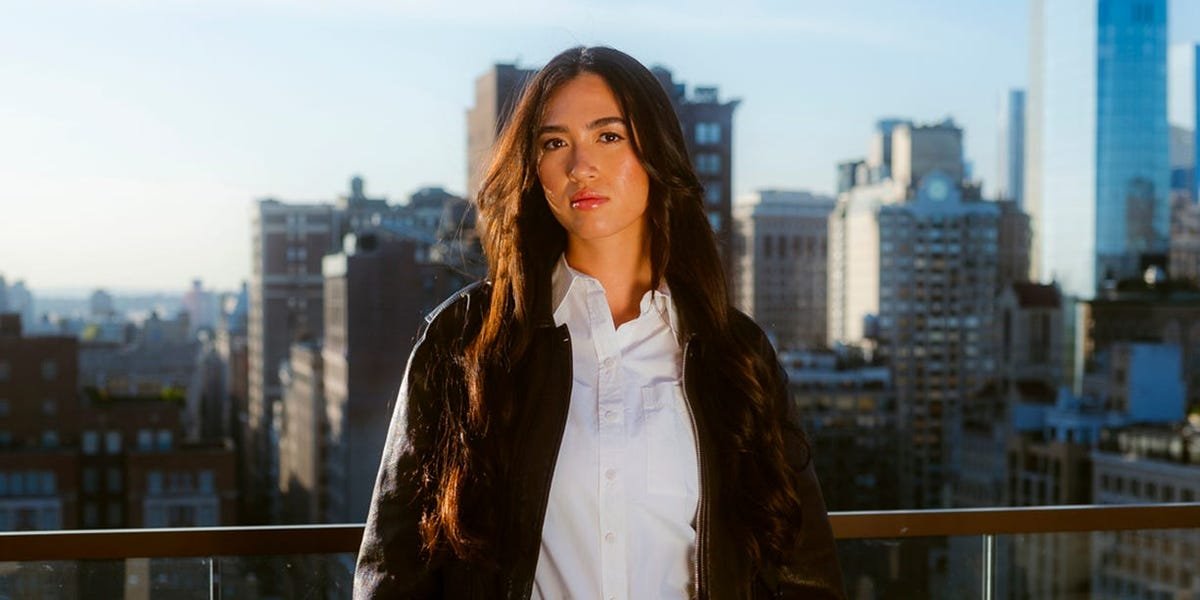
On an early fall morning, Argamani, now 28, met me in the lobby of Vine’s New York office, clutching an iced matcha. She is willowy, her long dark hair falling down her back. In a blue button-down, faded jeans, and mules, she could be any West Village twenty-something on her way to work. She speaks softly and deliberately, holding unbroken eye contact. She flew into town for this interview before heading to San Francisco for meetings.
Argamani has spent much of the past two years being asked to revisit what happened to her. This time, she wanted to talk about what came after. Before we met, she texted: “This interview is so special cuz [we’re] focused on back to life and rising from hell.”
Hours after the initial assault on October 7, a mob of Gazans swept through the Nova music festival grounds looking for survivors. They found Argamani and forced her onto a motorbike. Someone filmed it. Argamani, eyes wide, her mouth open, stretches her arms toward her boyfriend and begs her captors, “Don’t kill me.” The video ricocheted across newscasts and social media, turning Argamani into an accidental celebrity.
This past weekend, Israel’s military said it killed the terrorist who drove the motorcycle used to abduct her.
In the months after her rescue on June 8, 2024, she became a prominent advocate for the hostages who remained in Gaza, meeting with presidents and diplomats and speaking at events including the Time100 Gala. She stood in the gallery of the House chamber as Benjamin Netanyahu addressed Congress. She wore a borrowed suit; her own clothes stopped fitting after eight months of captivity.
Sydney Krantz for BI
She went back to school at Ben-Gurion University of the Negev, a public research university in southern Israel. She found that artificial intelligence had remade the field of software engineering during her captivity. Models wrote better code. Digital workers, known as “agents,” were starting to take on work once reserved for humans.
Argamani jumped back in. She and her classmates used large language models to scan news articles for patterns of antisemitic rhetoric, then map the countries where they originated. They built a website where users could pick a date and see where that rhetoric appeared most heavily. Through an entrepreneurship program, she designed a startup aimed at helping children with autism.
But the life waiting for her outside school had changed. “There’s the person you were before October 7, and the person you are after,” she says. Strangers stopped her in airports and crosswalks. She spoke on stages and shared glimpses of her life with her 201,000 Instagram followers: posing on the steps of the United States Capitol, gazing from the bow of a yacht, and video-calling her dad from her seat at the World Cup final.
Job offers followed. She could join a company or help start one. She could make a career of public speaking or modeling. A desk job no longer felt ambitious enough. She had access. She had attention. Sitting behind a screen suddenly seemed like a poor use of both.
“I felt that coming back to coding would be a waste,” she says. “I want to do something with more impact — to make a change in the world.”
Through her advocacy work, Argamani met Eric Reiner, founder of Vine Ventures. Reiner had spent his career straddling Israeli startups and American capital, first at Insight Partners, then at Dynamic Yield, an Israeli startup that used algorithms to personalize digital ads and websites, before its sale to McDonald’s in 2019.
Reiner launched Vine to invest in companies on both sides of the Atlantic, but its edge would be in Israel, where its team would spot founders and help them reach into new markets. The firm, which manages about $500 million, has backed Israeli breakouts including Wonderful, Qodo, and Eon.
Israel has long punched above its weight as a startup hub. This year, Google completed its $32 billion acquisition of Wiz, founded by a group of ex-Israeli military officers. But the war had put the “startup nation” under strain. A 2025 report from the Israel Advanced Technology Industries Association found that 53% of tech companies in the country had seen more employees ask to relocate abroad, citing growing security concerns. After two straight years of decline, venture funding to Israeli startups is climbing again, driven by mega-rounds for companies including Cyera, HiBob, and Wonderful, according to PitchBook.
In April, Reiner invited Argamani to intern. Something clicked. In venture capital, she says, she could help more than one company at a time. She could use the network she had acquired to open doors for founders. And at Vine, whose footprint stretches from San Francisco to Boston to New York to Tel Aviv, she could help Israeli startups make the all-important jump to the US.
Sydney Krantz for BI
For the past five months, she has been learning the job. How to size a market. How to validate a young company. She helps founders pick apart another investor’s “no.” Israeli investors, she says, will cut a founder off mid-pitch to explain what is wrong. Americans tend to be more polite. “They can smile the whole pitch, but after that they will pass and never tell you why,” she says. She started a full-time role in September and will split her time between San Francisco and Tel Aviv.
Opening her network is one way she thinks she can be helpful. Coaching is another. Her time in captivity showed her that a person can do everything asked of them and still have no control over what comes next. That’s a fact of startup life, too, she says. “Sometimes, no matter how hard you work, things are not going to work out well,” she says. She wants to help founders get through those stretches of uncertainty and understand what they can learn from them.
She insists she has always been an optimist, even, she says with a laugh, a “naïve optimist.” That instinct, she says, helped her recognize the miracles that punctuated the darkest period of her life. She survived captivity. She made it home in time to see her mother, who died of brain cancer three weeks later. She watched surviving hostages return to their families. “After seeing so many miracles,” she says, “it makes you more of an optimist.”
But she has also seen how much can be taken away. She watched friends be murdered. Others remained in captivity after they were killed, their bodies returned months later in hostage exchanges. She went to funeral after funeral.
For Argamani, optimism is no longer simply a personality trait. It is a choice she makes in spite of the past — a refusal to let the worst thing that ever happened to her dictate what comes next.
“I lost a lot of people. I saw in my own eyes hell, being in tunnels, looking in Hamas’ eyes,” she says. “But I choose every day to have another part of my life, to look forward, to go to work, and not let the grief become my identity.”
Melia Robinson is a senior correspondent at Business Insider, writing about how artificial intelligence is changing the legal industry.
