
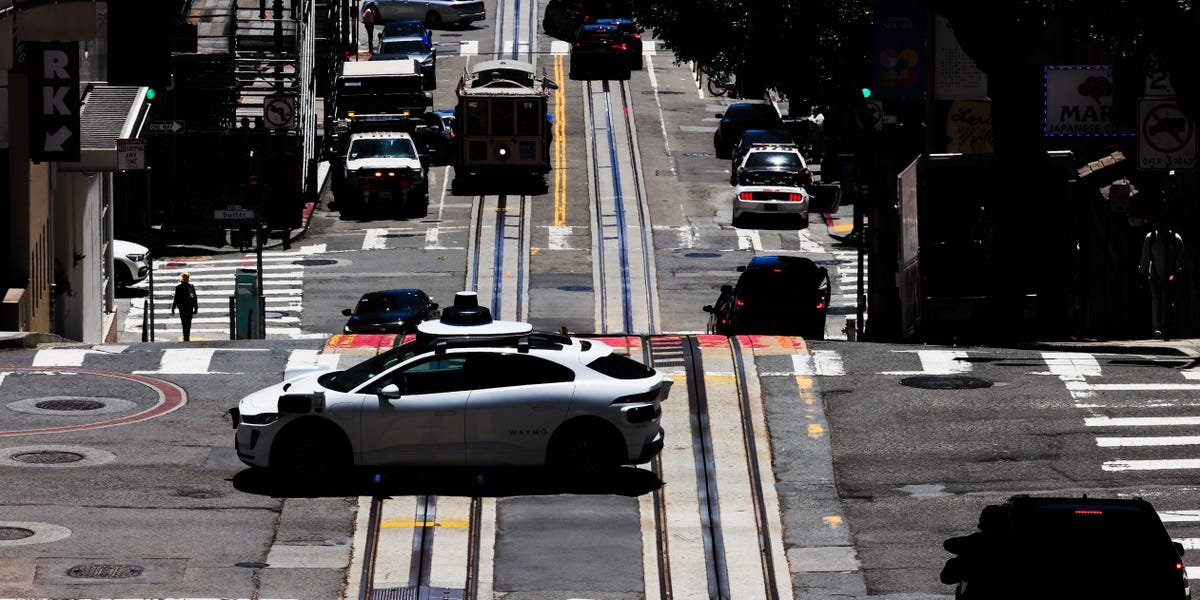
Alphabet’s Waymo is taking a bite out of ride-hailing in its most mature markets, third-party data showed.
And that share is large enough that its effects on human drivers could be detectable, Gad Allon, a Wharton professor who studies the gig economy, said.
Just don’t expect it to look like a visible wave of displaced drivers.
“My initial view is that the impact would not first appear as large numbers of drivers suddenly losing their jobs,” Allon told Business Insider. “Because driver supply is flexible, the earliest effects would likely show up in utilization, longer waits between rides, fewer trips per hour, and possibly more unpaid repositioning.”
Utilization refers to the percentage of a driver’s time online spent on paid trips.
Data from Yipit, a market research firm, estimated that Waymo accounted for 15% of gross bookings — dollars spent on rides — in San Francisco and Los Angeles in June and 16% in Phoenix. In January, the figures were 16%, 17%, and 19%, respectively.
Yipit calculated the shares among Waymo, Uber, and Lyft by looking at trips that begin and end inside Waymo’s operating zones, a Yipit spokesperson said. Estimates are based on email receipts from a sample of about 1.5 million active US consumer accounts.
The figures don’t represent the number of trips. Waymo’s share of actual rides could be higher or lower depending on its prices compared with Uber and Lyft.
Yipit also cautioned that Waymo’s share can appear to decline as it expands into new areas, where the service may initially be less popular. In May, Waymo said it expected to expand its Bay Area footprint by 60 square miles.
Despite the caveat around expansions, Waymo’s share remained in the mid-teens in all three markets through June.
Uber CFO Balaji Krishnamurthy also shared Yipit’s data on X this month while discussing Uber’s competitive position. He said Uber uses internal tracking for decision-making and shared Yipit’s figures as an externally available reference.
Driver displacement may not look like layoffs
There have been hints that the rideshare workforce is changing as robotaxis grow.
Allon, the Wharton professor, said Waymo’s 15% share is a “serious shock” to the labor market, even if the impact on human drivers is diluted because they also work beyond Waymo’s geofences.
“The reason it doesn’t look like one is that the adjustment runs through hours and exits rather than layoffs,” Allon said, referring to drivers working fewer hours or not returning to the platform.
Last year, data from Gridwise, a ride-hailing data platform, showed hourly driver wages declined in Austin, Los Angeles, Phoenix, and San Francisco — areas where Waymo operates — while the national median rose 1%. Researchers told Business Insider that the data couldn’t establish that robotaxis were the cause.
Uber CEO Dara Khosrowshahi told Fast Company in a June profile that his company is recruiting fewer drivers in some cities where AVs operate. At the same time, Uber has said more drivers are signing up organically as rider demand grows.
A Lyft spokesperson pointed to CEO David Risher’s prepared remarks for the company’s second-quarter earnings call on August 6.
“We believe the future is hybrid and, as AVs scale, the market will expand,” he said, adding that Lyft rides within SF’s AV operating area grew about 20% year over year.
Spokespeople for Waymo and Uber did not respond to a request for comment.
The fallout is hard to measure
Katie Wells, a senior fellow at the AI Now Institute who has studied Uber drivers, told Business Insider that the lack of certain data makes it difficult to measure driver displacement.
“We don’t know how much, we don’t know when, we don’t know where,” Wells told Business Insider. Researchers would need data such as utilization and wait times to identify the effects, she said.
Part of the challenge lies in the nature of gig work. Wells said that because drivers are independent contractors rather than employees, robotaxi displacement may not show up as a measurable decline in employment.
Wells has documented how the prospect of automation affected drivers before commercial robotaxis arrived.
She said that she and her coauthors tracked a cohort of 40 Uber drivers over five years. During that time, she found that drivers feel less incentivized to push for better working conditions because they believed their work would eventually disappear.
“Uber drivers kept saying to us, ‘Well, automated vehicles are coming, so they won’t need me anymore,'” she said. “This is temporary.”
Have a tip? Contact this reporter via email at lloydlee@businessinsider.com or Signal at lloydlee.71. Use a personal email address, a nonwork WiFi network, and a nonwork device; here’s our guide to sharing information securely.
