
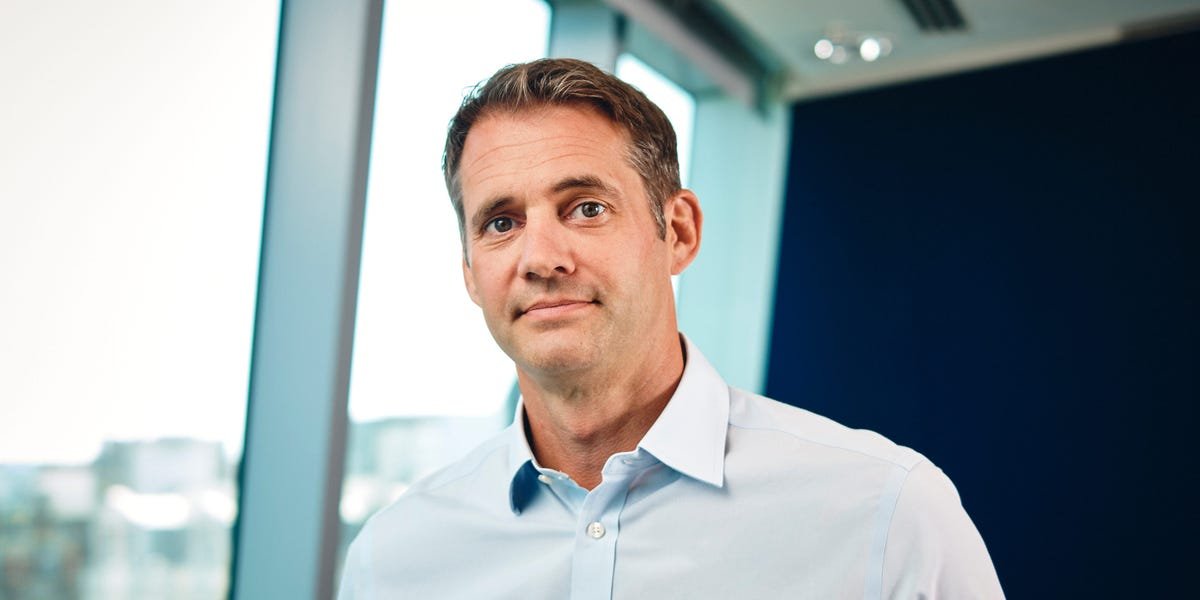
This as-told-to essay is based on a conversation with David Hatcher, the managing partner of Baringa. It’s been edited for length and clarity.
I’ve been a consultant since the late ’90s. I spent most of my career focused on the energy sector, but these days, AI has become a big topic of conversation.
I joined Baringa in 2012 after stints at EY and Accenture because I wanted to work at a much smaller consultancy with a slightly more entrepreneurial flavor. I was elected managing partner in 2026.
The role is effectively the same as being CEO. Baringa is fully owned by its partners. As the lead partner, I work with the rest of the partnership to set the business’s direction and execute its strategy.
Given the demands of the role, I find ways to build movement and time outdoors into my days.
I am happiest when I am outside, getting fresh air. That instinct also runs through many of the routines that help me manage my workday, from laps around the block and my Sunday-evening ritual: a planning walk.
6 a.m. — Wake up
My workday usually starts around 6 a.m., before the rest of London is awake. Sometimes I wake shortly before my alarm just because I’m so used to waking up at that time.
A couple of mornings each week, a personal trainer comes to my house. Hiring a trainer gives me accountability on days when I might otherwise be tempted to skip exercise.
6:50 a.m. — I catch the train and read the news
On mornings when I do not work out, I catch a train into central London at around 6:50 a.m. When I exercise, I usually take a later train at about 8:30.
I use the commute to catch up on the news. I read the Financial Times and scroll through a personalized feed covering the subjects most relevant to my work.
Once a week, I have a call with the team in Australia. There’s only a tight window in which I can catch them since I’m on UK time.
Between the station and the office, I stop for a cappuccino. I’m a creature of habit, so I usually get it from Pret a Manger. That may be sacrilegious to serious coffee enthusiasts, but I can’t start the day without one.
On a particularly good day, I may have a second coffee, though never after noon.
By 9 a.m. I’m in the office and in meetings
I spend roughly 80% of my day in meetings. Some meetings last 30 minutes. Others, such as quarterly strategy sessions, can occupy half a day.
These meetings cover everything from company strategy, branding, risk, major clients, culture, employee development, operations, country-level performance, and mergers and acquisitions.
I also try to have at least one client interaction every day, whether that means meeting a prospective client or checking in with an existing one.
Christopher L Proctor for BI
I like the visibility that comes with being in the role and the chance, informal encounters I have with the team while walking around the office. I feel I should be here, and those spontaneous interactions are something I would never get sitting behind a screen at home. That is why I like coming in.
I usually work from home only about 1 day every 2 weeks. We now have offices in 16 cities across four continents. So I probably travel somewhere to one of them every six weeks.
Lunch is usually at my desk
I generally don’t take a formal lunch break. My assistant will often bring me something simple, such as a salad or sushi, which I eat while continuing with the day.
I love a walking meeting as a way to get out of the melee. St. James’s Park is a beautiful park just around the corner from the office. If it’s not raining in London, I’ll often suggest taking a walk there and talking as we go. It’s a way to bring more exercise and movement into my day — and probably my best productivity hack.
By the time I come back around the block, I am guaranteed to have clarity in my head about the three things that would be best to prioritize in the afternoon.
Whether it’s email, Teams, LinkedIn, WhatsApp, or phone calls, there are constant demands on your time. It’s easy to get swept up in a day spent simply responding to messages.
1 p.m. — I’m focusing on the biggest issues facing the business
We do a lot of work in the energy market, so the energy transition, decarbonization, and the impact of climate change have been major topics for many years.
Another big topic is the international expansion of our business. We’re scaling rapidly in the US, Asia, Europe, and Australia, which means meeting new clients, building relationships, and helping them understand who we are in markets where Baringa is not yet a household name. Attracting top talent in those regions so that we can continue to scale quickly is a major priority.
What throws me off most is seeing people put their own interests ahead of those of their teams, colleagues, company, or clients. I don’t appreciate that behavior. My ethos is simple: Look after the people around you, and good things will happen to you.
6:30 p.m — I leave the office
On the train home, I try not to work. Instead, I watch what I call “brain-neutral” videos on YouTube to create a boundary between work and home. I have become particularly interested in videos featuring physicist Brian Cox, who explains topics such as relativity in accessible terms.
I typically attend about two work dinners each week with clients, prospective hires, or senior colleagues.
When I do not have dinner, I usually leave the office between 6:30 and 7 p.m. Either we’ll have dinner together, or if my family has already eaten, I might talk to my wife, or she’ll sit and talk to me while I eat.
10:30 p.m. — I aim to be in bed
I try to go to bed at about 10:30 p.m.
I learned the importance of sleep after previously experiencing sleep problems that affected my ability to function and work productively.
The first thing is to look after yourself so that you can then be at your best to look after others.
