
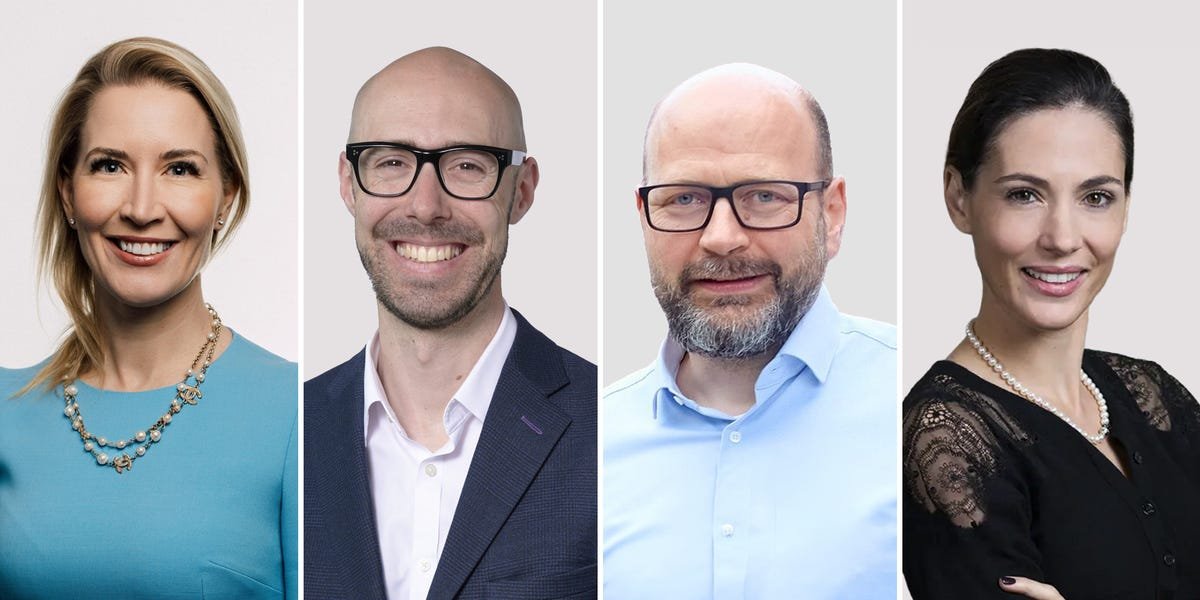
Four McKinsey & Co partners sit down around a table. One wears Chanel jewelry and a pantsuit; another a casual, billowy shirt. Several hands sport Oura rings, silently tracking their wearers’ heart rates.
There’s no punchline here — only a massive promotion. When we spoke in late June, this quartet was a week away from joining the top tier of McKinsey as senior partners or distinguished partners. It’s a level few people make it to: While McKinsey has more than 2,500 partners globally and typically adds around 200 partners every year, it added roughly 60 senior partners this year.
Consulting partners can be guarded and corporate when discussing their firms. But seated around the table in a stylish hotel room, the four McKinsey partners were relaxed, jokey, and interested in hearing about each other’s career journeys.
Our conversation covered the past and future of partnership: how they got to this point in their careers and how partnership is changing as AI shakes up the consulting world.
But first: the celebration
Partners typically learn about their elections (senior partners are elected by vote) by receiving a call from a leader in their practice. Anna Mattsson received hers late at night. Holger Hürtgen’s leader, a long-time friend, teasingly stretched out the conversation before sharing the news.
Alex Devereson’s call began with one word: “Congratulations.”
“When I got the call, I was trying to bundle my son out the door to a swimming class,” Devereson, who serves pharmaceutical, vaccine, and biotech companies, recalled. His celebration was low-key: swimming, followed by a trip to the park.
Maria Albonico, a London-based partner focused on financial services and private equity, said she received a “shower of love” from colleagues, taking so many hours of back-to-back calls that her husband thought something bad had happened.
As senior partners, the group will help drive the firm’s overarching strategy, steer high-stakes projects for McKinsey’s top clients, and hold a larger equity stake in the partnership.
Election and career strategies
Despite the prestige, day one in the new role probably won’t look drastically different from a normal Wednesday, said London-based Devereson.
All four said that reaching this level relied on demonstrating that they were already doing the job, rather than following a calculated strategy.
“You need to project manage the story around it a bit, but it’s not tactical,” said Mattsson, who joined McKinsey six years ago, after a career mostly spent at Deloitte. She now leads the Strategy & Corporate Finance Practice for Switzerland and co-leads McKinsey’s global separation and spin-off service line.
Mattsson said she had been “majorly disappointed” to be passed over for promotion last year. She decided to stop overthinking the politics, go all in on certain clients, and simply focus on what she enjoyed and did best.
McKinsey
Holger Hürtgen joined McKinsey in 2007 as the firm’s first data scientist and AI engineer in Germany. He was elected to “distinguished partner” — a new senior leadership role at McKinsey that recognizes deep, specialized expertise.
Hürtgen said partners had told him he was talented, but warned him that because he didn’t conform to the traditional image of a McKinsey partner, he would struggle to rise.
Hürtgen, who describes himself as “smart, stubborn,” said that he decided to focus on technology and AI, and ignore the advice about changing.
Inside the “CEO Factory”
McKinsey, founded in 1926, was among the first professional management consulting firms. Today, it projects a more youthful energy than some of its competitors. Its London and New York offices (the ones Business Insider has visited) are modern in a carefully curated way, rather than blandly corporate. The firm promotes people under 40 to partnership and fosters an entrepreneurial drive that has helped drive McKinsey’s reputation as a “CEO factory.”
In 2025, McKinsey elected 224 partners, 66 of whom were women, the highest share in the firm’s history. At the top level, the gender gap widened. Only 6 of the 56 promoted to senior partner earlier that year were women, Bloomberg reported.
To this point, Mattsson said she had been excited to become what she thought was the second female senior partner in the Swiss office. Two other women were promoted in her practice this June, and the four of them went out for a celebratory dinner.
Why they never left McKisney
Consultants often describe the appeal of their work as the chance to move between industries and problems. Outside of the industry, they’re often the butt of jokes and the targets of sarcastic questions about what they actually do.
What’s the reality of a career in consulting: Have those at the top ever considered leaving McKinsey, or the grind altogether?
McKinsey
You get approached a lot working at McKinsey, so the opportunity to leave is often there, said Mattsson, the Switzerland-based partner. She said she’s always returned to consulting because of “the excitement of being able to go and do different projects, work on different topics, be able to reinvent yourself every couple of years.”
It lets you “live 10 careers in one,” Albonico said. McKinsey has always offered the comfort of a large family with the freedom of entrepreneurship, she said.
“At the end of the day, I think we’re all entrepreneurs,” said Albonico, drawing murmurs of agreement around the table.
Hürtgen, the German AI leader and a 20-year veteran of the firm, has built his corporate longevity through a highly deliberate approach. In his first week at McKinsey, he received some advice: “If you want to be long-term, happy in the firm, you should always be outside with one leg.”
He regularly speaks to people beyond McKinsey, which reminds him to appreciate that, to him, the firm is “primarily always people.”
Every year between Christmas and New Year’s, Hürtgen says he sits down to decide whether his job still works for him and his family. Whenever he has a frustrating day at work, or “everything is really shit,” he remembers that he took that conscious decision.
“Holger, I think I couldn’t be further from you on the spectrum, in the sense that I’ve never done what you described,” Devereson chimed in.
Devereson said he has never considered leaving. His approach has instead been to trust his gut, which he said has consistently told him that he’s fortunate to be at McKinsey.
Partnership in the age of AI
Consulting is in the midst of an AI-driven transformation, disrupting everything from pricing models to daily workflows.
Entry-level analysts, whose data-heavy tasks are prime for automation, have been in the spotlight — but AI is also changing what is expected of those at the top.
The path to senior partnership has traditionally rested on several dimensions, Albonico said: the strength of client relationships and their ability to lead people.
Previously, that meant teaching technical skills and helping junior colleagues review analysis — work that AI can increasingly do, and do faster than humans.
“We’re not up anymore until 11 in the evening reviewing numbers because probably the numbers have merged to close at 6 p.m,” Albonico said. Instead, partners are spending more time orchestrating meetings, deciding who should participate, identifying skills individual team members need to develop, and building trust.
“There is in my world, a much bigger refocus on the human, which is a paradox that is actually quite nice,” she said.
Hürtgen, the AI expert, said he feels “uncomfortable every week” trying to keep up with the pace of change.
“I’ve been doing AI in whatever definition you want to take for the last 20 years, and I’ve never felt so much behind the curve as right now,” he said.
In Devereson’s field — pharmaceuticals, vaccines, and biotech companies — having a perspective on AI has become essential to a partner’s credibility. “That was not the case 10 years ago when I joined the firm,” he said.
Despite the changes in the industry, there is an “irreducible core” to what makes a McKinsey partner, Devereson said.
For Mattsson, that core is curiosity and personability. During her 23 conversations with McKinsey partners before joining, she initially wondered whether the firm was simply introducing her to the nice people. Once inside, Mattsson said she found everyone curious, eager to learn, and humble.
“It’s not about titles. It’s not about roles. It’s about how we lead our people? How do we serve our clients?”
