
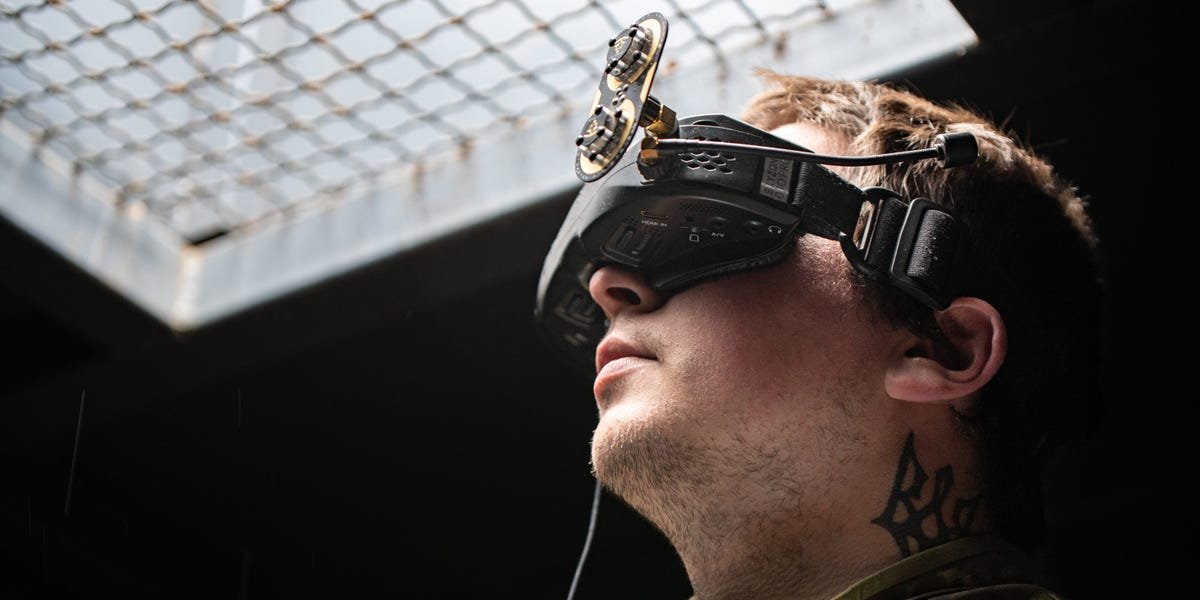
New technologies are allowing Ukrainian drone operators — who are high-priority targets — to control drones from relatively safer locations hundreds or even thousands of miles away. But human soldiers often still have to go to risky locations to transport, prepare, and launch these aircraft.
Ukrainian interceptor drone and other uncrewed aerial system operators are increasingly using satellite connections that allow them to operate far from the launch site — potentially even from another country. The makers describe these capabilities as a key way to protect the pilots in Russia’s crosshairs.
The aircraft, however, often still need to be brought to a launch site and prepared, meaning soldiers are still needed closer to the danger, at least for now.
Ukrainian drone maker Wild Hornets, for instance, has developed technology that allows pilots to fly the company’s interceptor drones from hundreds of kilometers away. The company told Business Insider that ground forces still transport and prepare the aircraft, though.
With satellite communications technology for combat drone operations, “we are able to put our pilots in any place when there is a stable internet connection for them,” Dmytro “Liber” Zhluktenko, a former drone operator who now serves as a lessons-learned analyst with Ukraine’s 413th Unmanned Systems Regiment “RAID,” told Business Insider.
“But this doesn’t remove the need for the ground groups, people who actually attach the explosive, put the drone outside of the bunker, et cetera,” he said.
Kostya Liberov / Libkos via Getty Images
Remote piloting removes the operator from the launch point, but not necessarily the rest of the support crew. Troops may still need to transport the drones, unload and assemble them, attach explosives and communications equipment, and position them for launch. There are efforts underway to leverage other uncrewed systems, such as ground robots, for launching interceptors and first-person-view drones, but these robotic motherships aren’t yet ubiquitous along the front lines.
New technology is moving some people to safer locations, but protecting everyone involved in a drone operation by keeping them far from the fighting is “impossible so far,” Zhluktenko said.
Trying to get troops out of harm’s way
Ukraine is doing what it can to keep as many soldiers as safe as possible, but there are limitations. Forces are still needed at the front for a range of missions even as robotic systems become increasingly prolific.
On more traditional missions with drones controlled by radio frequency connections, operators generally need to remain closer to their drones. But units are trying to, when possible, move “our drone operators further to give them more safety,” Zhluktenko said.
They do this “even if it comes at the expense of our capabilities, because these are our people and we value them so much.”
“The first principle, the first rule, is the safety of them, but it’s a very tough balance. We want to keep them extremely safe, but, at the same time, there is some work to be done. So it’s a very tough, tough balance thing.”
Keeping drone operators safe is critical for Ukraine because Russia often treats them as top targets, according to soldiers, drone operators, and military officials.
Ukraine’s drones destroy more Russian targets than any other weapon, and pilots are force multipliers. One operator can fly repeated missions to collect intelligence and launch attacks.
That makes technology that separates pilots from launch sites particularly valuable.
Then-defense minister Mykhailo Fedorov said in April that “the pilot is no longer tied to the position. The drone is in the sky, while control takes place from a protected environment in Kyiv, Lviv, or even abroad.”
“This increases interception effectiveness, minimizes risks to operators, and makes it possible to scale capabilities without being tied to the front,” he said.
Oleksandr Magula/Suspilne Ukraine/JSC “UA:PBC”/Global Images Ukraine via Getty Images
Ukraine is investing heavily in technology designed to keep its soldiers farther from the intense fighting, including drones, ground robots, AI, and autonomous systems that enable weapons to detect, target, and strike with little to no human involvement.
Ukraine wants to replace certain human tasks, such as front-line logistics, with fully robotic systems, both to protect lives and to offset Russia’s manpower advantage.
Ukraine’s defense ministry has said, for instance, that “the primary task of ground robots is to bolster our units and replace soldiers in the most dangerous areas.”
President Volodymyr Zelenskyy made that goal explicit in April when he said Ukraine’s ground robot force had carried out more than 22,000 front-line missions over the previous three months.
That meant “lives were saved more than 22,000 times when a robot went into the most dangerous areas instead of a warrior,” he said.
Then Commander-in-Chief Gen. Oleksandr Syrskyi said in October that Ukraine was prioritizing “high-tech systems that will help reduce the presence of soldiers directly on the battlefield.”
Ukraine’s ultimate goal is “to have less people on the direct battlefield and at direct risk, Zhluktenko said. For now, at least, human beings are still in the mix. It’s not total robotic warfare.
