
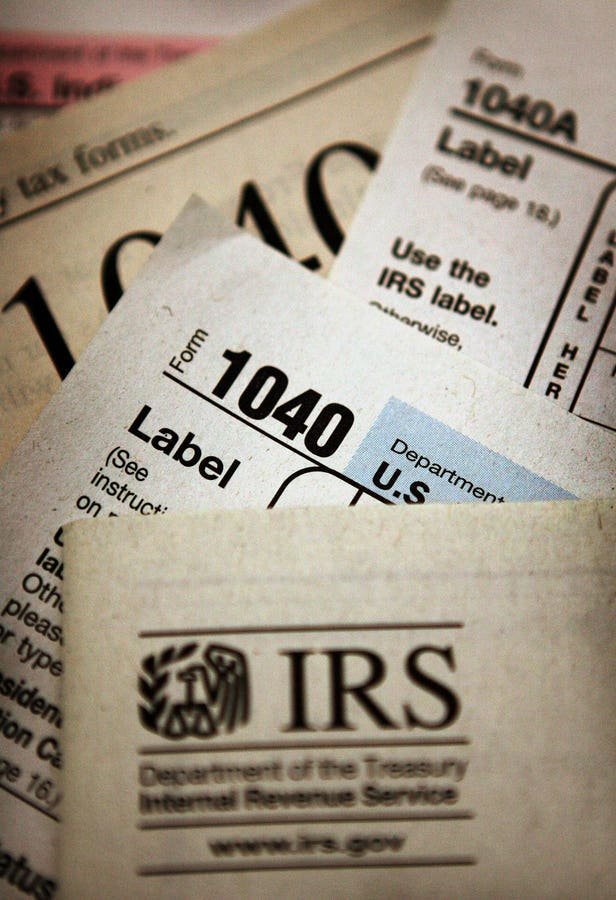
CHICAGO – NOVEMBER 1: Current federal tax forms are distributed at the offices of the Internal … [+]
Trusts are common, but there are numerous variations, and there is still considerable confusion about what is legal and what is not. There are at least two primary types. One type is a common to estate planning, and probably just about everyone should have one. You don’t want to die without a will, and but do you need a trust too? Most people regardless of their financial wherewithal should not need to admit a will to probate. Probate is public, takes a long time, and is expensive. But there is a simple way to keep it private and avoid the time and expense of probate.
For very little money (some people even do it themselves) you can create a revocable trust that calls for the disposition of your assets. You still write a will, but the will just says that everything you own goes via the revocable trust. It’s called a pour-over-will, since it pours all assets into the trust. The trust is private, is not separately taxable, and you can change your trust anytime you want. For example, you can add or delete beneficiaries over time, to make sure that the people inheriting your assets are the ones you want.
Does a revocable (also called living) trust save you taxes? No, but it doesn’t cost you taxes either, it is tax neutral. If you transfer your house or stock into a living trust, it is not considered a transfer for tax purposes. The other major type of trust is an irrevocable trust. That means you can’t take your transfer back or even amend the trust, and it is separately taxable and must file its own tax return. Transfers to an irrevocable trust can trigger gift taxes, but they can still save income, gift or estate taxes in the long run, depending on the facts.
Two other types of trusts are foreign and domestic trusts. Most living trusts and most irrevocable trusts are domestic, meaning U.S. law controls. If the trust is foreign, many complex rules apply that can make U.S. beneficiaries taxable on their share of trust income, even if it is never distributed to them. There are extra tax forms to file too, and the IRS can audit your taxes forever if you miss a key form.
Some trusts are designed to save state taxes. For example, some Californians hope to skip California taxes without moving. Let’s say you can’t move quite yet, so you wonder if a trust in another state might work? The usual living trust you form for estate planning doesn’t help, since the grantor must include the income on his return. They seek to wall off assets from California’s 13.3% tax rate via a ‘NING’, a Nevada Incomplete Gift Non-Grantor Trust. A ‘DING’ is its Delaware sibling. There is even a ‘WING,’ from Wyoming.
The idea is that the trust itself will be taxed—but since the trust isn’t in California, there’s no California tax. The donor makes an incomplete gift—with strings attached—to the trust, and the trust has an independent trustee. The idea is to keep the grantor involved, but not technically as the owner. New York State changed the law to make the grantor taxable on such trusts no matter what. For years, California’s Franchise Tax Board said it was studying the issue, but recently, following New York’s lead, by statute, these trusts to avoid California tax were outlawed.
How about other creative uses of trusts? Some plans go to far. Recently, a grand jury returned an indictment charging a Colorado man and a Texas man with conspiring to defraud the United States and with assisting in the preparation of false income tax returns. According to the indictment, since 2017, Timothy McPhee of Estes Park, Colorado, and Larry Conner of Frisco, Texas – along with others – promoted and sold an abusive-trust tax shelter to clients nationwide for fees ranging from approximately $25,000 to $50,000.
The indictment alleges that McPhee and Conner instructed clients to assign their income to a series of sham trusts to make it appear as if the income was no longer owned or controlled by the client. However, this paper trail was allegedly false as the clients continued to benefit from and control the income assigned to the sham trusts. These allegations are not yet proven, but the federal government has a high conviction rate in tax cases, and the stakes look high.
According to the feds, McPhee and Conner’s promotion and sale of the tax shelter allegedly resulted in tens of millions of dollars in federal income taxes not being paid to the IRS. McPhee and Conner allegedly assured clients that after transferring income or personal property to the sham trusts, the clients would retain full control over the assets and could continue to use them for their benefit. McPhee and Conner allegedly directed their clients to open bank accounts and obtain credit cards in the names of their sham trusts and to pay personal expenses with funds held in those accounts.
McPhee and Conner also allegedly directed their clients to transfer real estate and other assets to the sham trusts to avoid paying income taxes on any capital gains incurred from the sale of those assets. McPhee and his wife, Marcia Predmore, were also charged with using the abusive-trust tax shelter to conceal a substantial amount of their own income from the IRS. McPhee and Predmore allegedly signed trust instruments purporting to create four trusts, opened bank accounts in the name of each entity and paid for personal living expenses from those bank accounts.
If convicted, McPhee and Conner face a maximum penalty of five years in prison for conspiring to defraud the United States and three years in prison for each count of aiding and assisting in the preparation of false tax returns. McPhee and Predmore also face a maximum penalty of five years in prison for each count of tax evasion.
