
The angst over China’s latest AI models is missing an important business fact: “open weight” AI is not the same thing as open-source software.
Open-source software, where the code is freely shared, can be an amazing business. Think Red Hat, which IBM bought for $34 billion. Open-weight AI models are different — and, so far, they’re proving to be a terrible business.
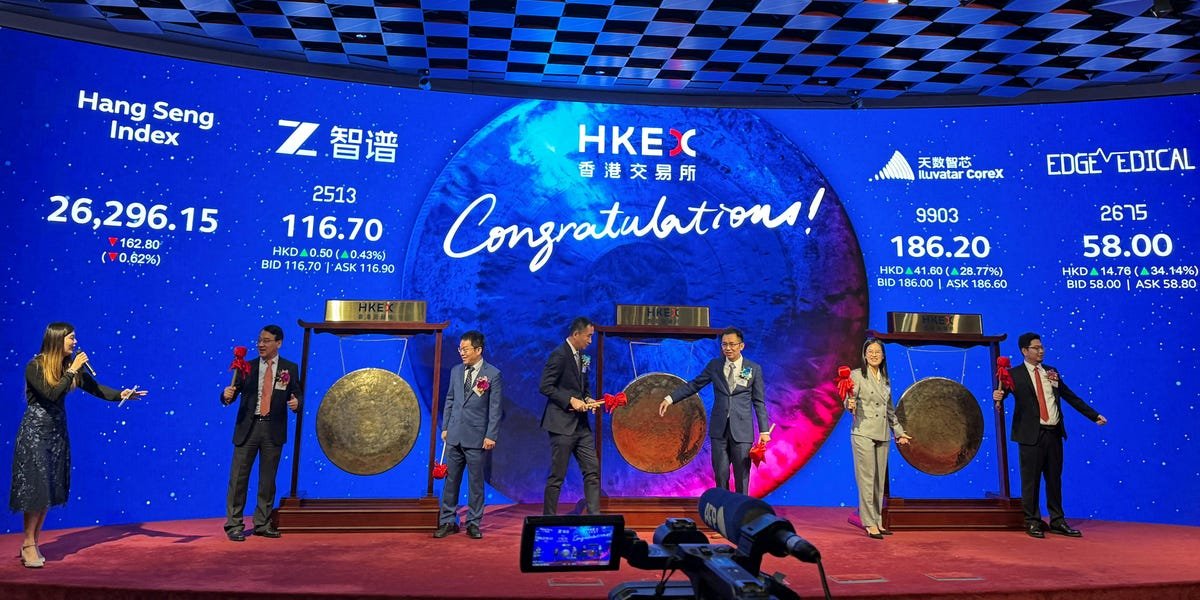
Take Z.ai, also known as Zhipu. It’s publicly traded, so we can see its finances. Last year, the Chinese company lost almost $500 million on revenue of about $107 million.
Zhipu is the lab behind GLM 5.2, an open-weight AI model that wowed the industry when it launched last month. You might expect the stock to have soared. Instead, Zhipu shares have plunged more than 40% over the past month.
MiniMax, one of the only other independent Chinese AI labs that’s publicly traded, lost $250 million last year on revenue of just $79 million. Its shares have fallen more than 50% in the past month.
“Open-weight models have a challenging path to making a profit,” William Blair analyst Arjun Bhatia wrote in a recent note to investors, in the understatement of the year.
Open-weight AI isn’t open-source software
The key difference comes down to economics.
Software can be distributed almost for free. Once it’s written, sending another customer a copy costs practically nothing. Profit margins improve as software companies grow.
AI doesn’t work that way. Every answer requires expensive chips, electricity, and data-center capacity. The next unit of software is nearly free; the next unit of intelligence is not.
Moonshot AI, another Chinese lab, illustrated the problem last week. Its new Kimi K3 open-weight model impressed the industry with frontier-level performance. But days after launch, the company had to halt new customer sign-ups because it didn’t have enough computing power to run the model.
If Moonshot were selling traditional software, adding millions of users would be relatively easy. Instead, every new customer increases the company’s infrastructure bill, capping its growth.
Someone else captures the profits
The way open-weight AI models are run, a process known as inference, makes the business situation worse.
Open-weight AI labs give outsiders their models’ trained numerical parameters, allowing them to download and run them. (Parameters are like tiny numerical dials inside a model’s brain that determine how these systems learn from data and what outputs they produce).
After that, these models are usually run by other companies, such as cloud giants Amazon, Microsoft, Google, Oracle, and Alibaba. There are also specialist providers such as Fireworks AI and Baseten, although they largely rent capacity from the big cloud companies.
Companies can also download these open weights and run the models themselves. Or, they can also use the Chinese model maker’s own inference service, but in the Western world, most corporate customers don’t do that for data security reasons.
Only that last option reliably generates real revenue for the model creator. In the other three cases, the AI lab that spent hundreds of millions of dollars building the model may receive little or no ongoing revenue.
That leaves the model makers in a difficult position. They’ve paid heavily to train the systems, then given away the key assets.
No wonder Alibaba’s stock is up about 13% over the past month, while AI labs Zhipu and MiniMax have been crushed.
Not Red Hat
“Unlike open-source software, open-weight models do not generate significant sums of revenue by selling support, services, and enterprise editions around the free offering (the Red Hat playbook),” William Blair’s Bhatia wrote.
“Instead, they primarily generate revenue by hosting the model and selling inference compute. But inference workloads will flow to whoever can operate the inference infrastructure most efficiently, and this is usually not the model provider,” the analyst added.
Raimo Lenshow, an analyst at Barclays, recently came back from China after researching the country’s AI sector. He reached a similar conclusion.
“Intense domestic competition has also led to more aggressive pricing competition,” the analyst told investors. “Some major models remain open-source or open-weight, accelerating the pricing pressure throughout the system. While this helps drive faster commercialization, it is also adding uncertainty to long-term profitability for those AI labs.”
So why give the models away?
Open technology has long been a strategy for challengers trying to catch market leaders. A late starter may not be able to match a leader’s customers or distribution, but it can spread its technology widely, attract developers, and make the leader’s product harder to sell at premium prices.
That may be exactly what China and its AI labs are trying to do. Open-weight models put pressure on OpenAI, Anthropic, and other US leaders by offering capable alternatives at lower prices. Even if the Chinese labs make little money themselves, they can force American competitors to cut prices and make it harder to recover the billions they spend training new models.
Bhatia said Chinese labs may be releasing open-weight models with “little regard for near-term profitability.” In his view, openness can turn advanced AI into a commodity, weakening the business model of US companies that keep their technology closed.
The financial payoff for the Chinese labs may come much later — or may be less important than the broader strategic benefit to China.
China’s leadership is now openly encouraging that strategy. In a recent speech in Shanghai, President Xi Jinping said countries should seize the opportunity to encourage “open-source, openness, collaboration, and sharing.”
A statement like that is more than a casual policy suggestion. Chinese technology companies are expected to align with the government’s strategic priorities.
After Xi put openness at the center of China’s AI strategy, companies such as Moonshot, Zhipu, and MiniMax are likely to face strong pressure to follow that direction — even if it makes their own path to profit much harder.
Sign up for BI’s Tech Memo newsletter here. Reach out to me via email at abarr@businessinsider.com.
