
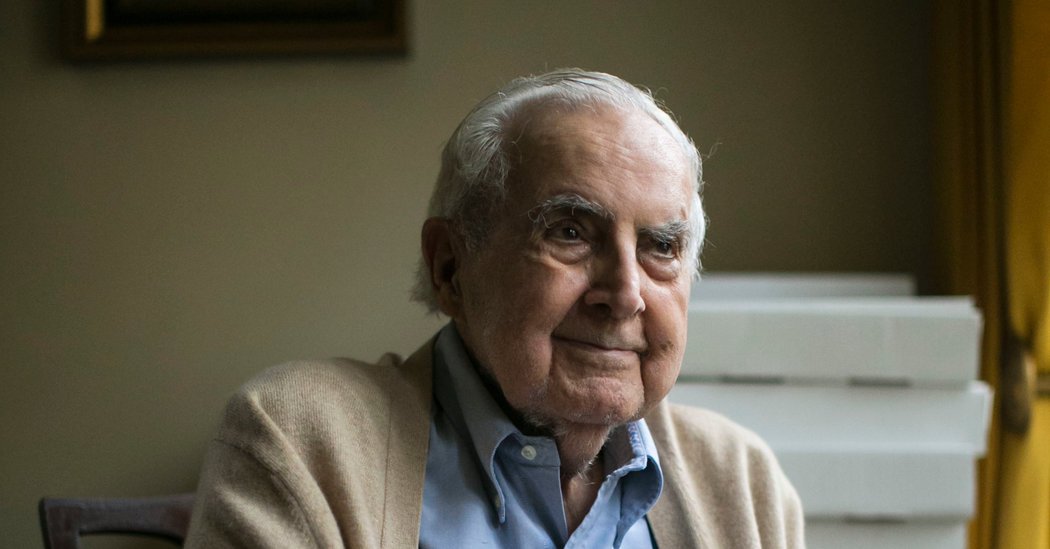
Charles Peters, the founding editor of The Washington Monthly, a small political journal that challenged liberal and conservative orthodoxies and for decades was avidly read in the White House, Congress and the city’s newsrooms, died on Thursday at his home in Washington. He was 96.
His death was confirmed by The Washington Monthly, which reported that Mr. Peters “had been in declining physical health for several years, mainly from congestive heart failure.”
Often called the “godfather of neoliberalism,” the core policy doctrine of the magazine, Mr. Peters was The Monthly’s editor from 1969 until his retirement in 2001. He also wrote five books on politics, government and history, and a column, “Tilting at Windmills,” offering pithy thoughts on politics and current events, from 1977 to 2014.
His work was not widely read, let alone understood by the general public. To the Washington cognoscenti, though, his voice was important in the capital’s cacophony. His neoliberalism offered liberals and conservatives reasons to step back and, if not to find compromises, at least to reassess their central beliefs.
In “A Neoliberal’s Manifesto,” which first appeared in The Washington Post in 1982, Mr. Peters set forth the neoliberalism movement’s broad philosophy: “We still believe in liberty and justice and a fair chance for all, in mercy for the afflicted and help for the down and out,” he wrote. “But we no longer automatically favor unions and big government, or oppose the military and big business. Indeed, in our search for solutions that work, we’ve come to distrust all automatic responses, liberal or conservative.”
Mr. Peters amplified his message in an interview with The New York Times in 1984, saying his movement favored a strong national defense with a military draft, the dismissal of public-school teachers who had been deemed incompetent, aid for entrepreneurs who created jobs, an end to Social Security for the wealthy, and patriotism, provided it was “not phony flag-waving.”
“Peters and his magazine began helping to redefine liberalism by advocating a number of positions that at the time were more associated with right-wing Republicanism — enthusiastic support for entrepreneurship and a hard-line attitude toward criminals,” Andrew Hearst wrote in the Columbia Journalism Review in 1999. The Peters neoliberalism, he said, “helped to influence the Democratic Party’s shift toward the center over the last two decades.”
A West Virginia Democrat who grew up in the Great Depression and World War II and adored President Franklin D. Roosevelt’s New Deal, Mr. Peters, a lawyer and state legislator, honed his ideals as a local official in John F. Kennedy’s 1960 presidential campaign and later as an executive in the Peace Corps, responsible for evaluating its global performance.
When he founded The Washington Monthly, Mr. Peters envisioned a journal that would also evaluate performance — Washington’s — focusing on the flaws and foibles of politics and government, a task that struck many critics as quixotic. He kept a drawing of Don Quixote and Sancho Panza on his office wall.
With no experience in journalism, he began with the premise that Washington worked poorly, and said his magazine would examine its culture “the way an anthropologist looks at a South Sea island.” He promised to help readers “understand our system of politics and government, where it breaks down, why it breaks down, and what can be done about it.”
Nothing was off limits. He targeted presidents, Capitol Hill, the Pentagon, Democrats as well as Republicans, lobbyists, the press; all were grist for the mill. The Monthly found a self-validating Washington where bureaucrats passed the buck, reporters got news from press releases, military leaders favored wars to advance their careers, courts served lawyers instead of the law, and no one was truly accountable.
“In government, as in human beings, fat tends to concentrate at the middle levels, where planning analysts and deputy assistant administrators spend their days writing memoranda and attending meetings,” Mr. Peters said in his 1980 book, “How Washington Really Works.”
Operating on shoestring budgets, with anemic advertising and rarely more than 30,000 subscribers, the magazine scored notable beats. A 1977 piece, “The Other Washington,” documented the growing power of lobbyists, and a 1980 exclusive warned of dangers in NASA’s space shuttle program six years before the Challenger broke apart over the Atlantic Ocean, killing its crew of seven.
Mr. Peters, a tough mentor, launched the careers of dozens of young reporters and editors who took low wages to learn serious advocacy journalism. Many went on to become famous authors and journalists, and assumed prominent positions at The Times, The New Yorker, The Washington Post, national magazines and broadcasters, and online journalistic Valhallas like Politico and Slate.
The alumni included James Fallows, a correspondent for The Atlantic; Nicholas Lemann, the former dean of the Columbia University Graduate School of Journalism; Jonathan Alter, an author and former Newsweek editor; Suzannah Lessard, a writer for The New Yorker; Taylor Branch, a Pulitzer Prize-winning historian; David Ignatius, a Washington Post columnist; James Bennet, the former editor of The Times’s editorial page, and Katherine Boo, a Pulitzer-winning investigative journalist.
Charles Given Peters Jr. was born in Charleston, W.Va., on Dec. 22, 1926, the only child of Charles Sr. and Esther Teague Peters. His father was a prominent trial lawyer and Democrat in state politics. Young Charles had a rebellious streak and at 13 was sent to the Kentucky Military Institute, near Louisville. Bullied, he quit after a year and went home.
At Charleston High School, he thrived with straight A’s and participated in student council and theatrical activities. After graduating in 1944, he joined the Army, but a serious training injury left him hospitalized until after World War II ended.
He graduated from Columbia College in 1949 with a humanities degree, and earned a master’s in English at Columbia University in 1951. He considered a theatrical career, but decided on politics and earned a law degree from the University of Virginia in 1957.
He married Elizabeth Hubbell that same year. They had a son, Christian Avery. They survive him, as do two grandchildren.
Mr. Peters won a seat in West Virginia’s House of Delegates in 1960, and managed Kennedy’s campaign in the state’s largest county, Kanawha, with Charleston, the capital, as its seat.
He joined the Kennedy administration in 1961 as an evaluator for the Peace Corps, reporting to R. Sargent Shriver, its director, on the progress of volunteers working domestically and overseas. He became the head of Peace Corps research in 1966 but quit a year later, depressed, he said, over America’s involvement in the Vietnam War.
For all his liberal inclinations, Mr. Peters said in his autobiography, “Tilting at Windmills” (1988), that his decision to publish The Washington Monthly was inspired by Henry R. Luce, the conservative publisher who founded the Time magazine empire and changed American journalism by introducing a point of view into the coverage of news.
“The conclusion seemed obvious,” Mr. Peters wrote. “I, too, should start a magazine and change the way journalism covered government.”
Paul Glastris, a former speechwriter for President Bill Clinton, succeeded Mr. Peters in 2001 as editor of the magazine, which switched to bimonthly publication in 2008, citing costs. In 1998, Mr. Peters, who lived in Washington, founded Understanding Government, a nonprofit that evaluated federal agencies. It closed in 2014.
His last book, “We Do Our Part: Toward a Fairer and More Equal America” (2017), urged Americans to abandon a culture of “self-absorption, self-promotion and making a barrel of money,” and rather embrace values of the Roosevelt era, when, he said, “the spirit of generosity was accompanied by a sense of neighborliness,” and “those who had little helped those who had even less.”
Eduardo Medina contributed reporting.
