
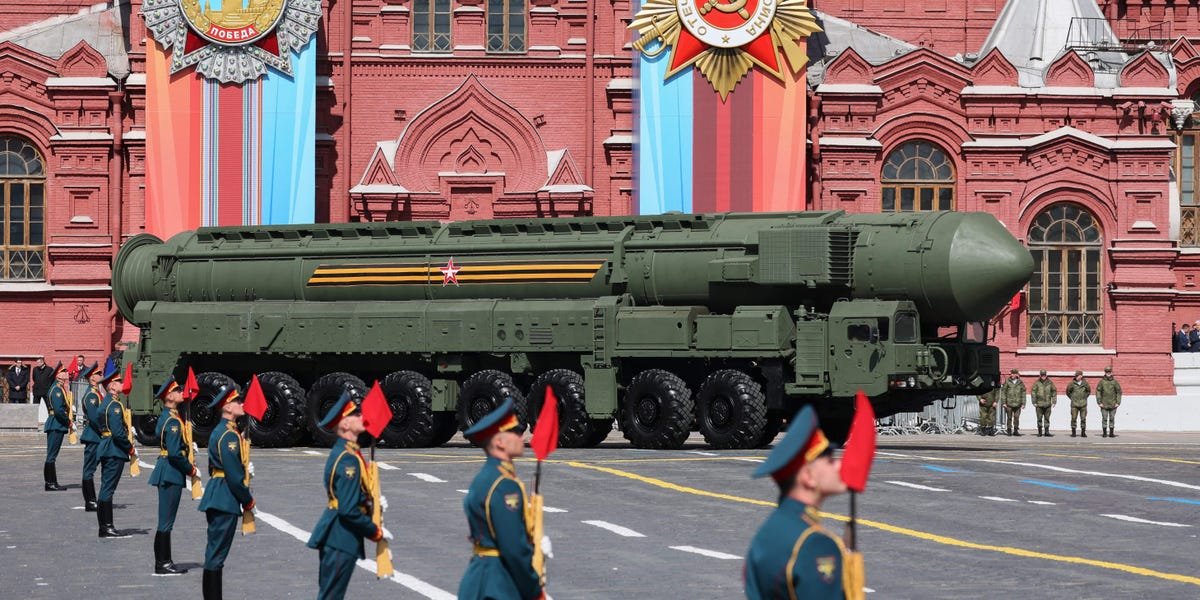
In a serious near-peer conflict, Western countries can’t count on their homelands remaining safe while their militaries fight overseas, a top NATO commander told Business Insider.
Air threats are more numerous and can reach much farther than when the West last fought a major war against a similarly capable adversary, Sir John Stringer, NATO’s Deputy Supreme Allied Commander Europe, told Business Insider.
Beyond traditional aircraft threats, powerful missiles and cheap long-range drones can now threaten places that once would have been considered safely in the rear.
The West had at least 20 years of fighting counter-insurgency campaigns, Stringer said. For the UK, that meant “we deployed 2,000 or 3,000 miles off the UK, fought and then we’d come back to a very secure rear area called the United Kingdom.”
“Those days, sadly, are also gone.”
The warning is not simply that NATO homelands could be hit in a future war. Western militaries have long known that stronger adversaries could threaten cities, bases, ports, and infrastructure in a major conflict.
NATO’s problem now is that cheap long-range drones, missiles, sabotage, and mass air attacks mean the rear is no longer just theoretically vulnerable. Instead, it could be routinely contested, and the West may not have enough defenses to adequately protect everything, requiring tough choices.
Now, Stringer said, it’s a case of protecting “the continent of Europe.”
DIRK WAEM/Belga/AFP via Getty Images
The US and its allies have, since the end of the Cold War, largely fought wars in which they controlled the skies and their homelands remained far removed from the battlefield.
But weapons, both cheap and expensive, can now strike much farther than when the West last faced that threat, Stringer warned. He said many longer-range weapons during the Cold War “had standoff ranges measured in the hundreds of kilometers or miles. We’re now talking thousands of miles.”
And, he said, “that’s not just expensive stuff launched off heavy bombers.” It’s now also cheap, uncrewed systems.
Ukraine’s fight against Russia’s invasion has demonstrated the risk to the West. The war has seen more drones used than in any previous conflict, and the long-range ones can be launched in the hundreds in a single night. Long-range missiles have also been launched at a scale the West has not had to face.
The war is also showing how drone threats can emerge far from the front. Ukraine, for example, smuggled drones into Russia and launched them at airfields in an operation that it said hit 41 Russian warplanes. Operation Spiderweb caused an estimated $7 billion in damage. Current and former military officials have said the West must study that operation closely as a new type of tactic and threat.
Scott Peterson/Getty Images
Stringer’s comments to Business Insider echo remarks he made at the UK’s Royal United Services Institute in 2023. “If you are seeking to protect what you’ve got, those notions of ‘home’ and ‘away’ and safe rear areas, etc., are no longer there, if indeed they have been for many years now,” Stringer said.
Other Western officials have also warned that the old divide between battlefield and homeland is breaking down.
US officials were sounding the alarm even before Russia’s full-scale invasion in 2022. Four years earlier, the National Defense Strategy said that “it is undeniable that the homeland is no longer a sanctuary.” It said that “during conflict, attacks against our critical defense, government, and economic infrastructure must be anticipated.”
Russia’s war in Ukraine has made those warnings harder to dismiss.
Mark Rutte, NATO’s secretary general, said last year that “The home front and the front line are now one and the same. War is no longer fought at a distance — our societies and militaries are in this together.”
“We will invest more in civil preparedness, so our societies are ready for the day we pray will never come. NATO works 24/7 to ensure that day never arrives.”
The UK government’s National Security Strategy 2025 warned that “for the first time in many years, we have to actively prepare for the possibility of the UK homeland coming under direct threat, potentially in a wartime scenario.”
Some other NATO members, such as Sweden, have told their citizens to prepare for the possibility of attacks on home soil.
Russia is the most immediate concern for NATO, but it is not the only long-range threat shaping Western planning.
The US warns that China’s growing arsenal of long-range weapons could directly threaten the US homeland, as well as US territories and bases closer to it.
Stringer said threats are rising from many regions, and “NATO rightly talks about the threat posed to Europe around 360 degrees.”
NATO is investing heavily in air defenses. But there are production backlogs and other barriers to building enough interceptors, sensors, and launchers at the scale a major war would demand.
Military officials, including in the US, say that the control of the air Western forces have long relied on in conflicts may simply not be possible in future wars.
Stringer said that the new mass of cheap weaponry available to a range of threat actors means “the days of thinking that you can sit back and be reactive and engage every threat that comes at you using traditional means like fast jets and some surface-to-air missiles” are over.
The problem is volume. If adversaries can fire more drones and missiles than defenders can affordably shoot down, Western countries may have to make hard choices about what gets protected — and what does not.
