
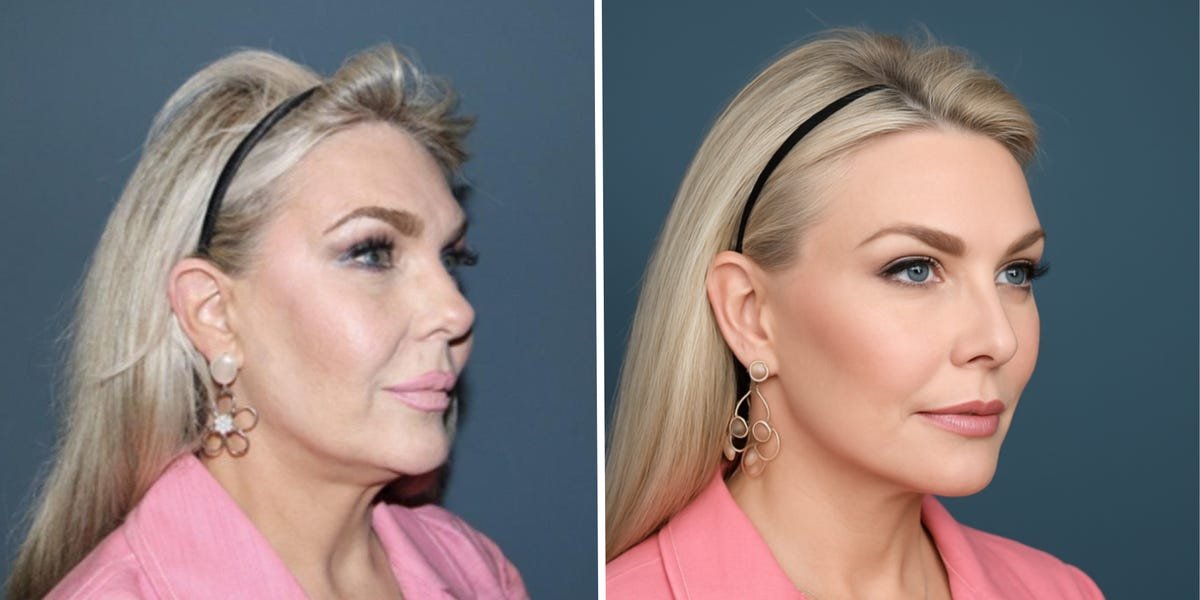
Unreal expectations are par for the course in cosmetic dermatologist Dr. Rachel Westbay’s line of work. Patients regularly bring in photos of celebrities or their younger selves, asking her to work her magic.
But earlier this year, she encountered something entirely new when a patient brought into her Upper East Side office what Westbay described as a caricature. The image was cartoonish, with lips too full for her face and enlarged, doll-like eyes.
Its creator was ChatGPT.
“It’s like saying I want to look like Ariel from ‘The Little Mermaid,'” Westbay told Business Insider. “I was shocked.”
Artificial intelligence is increasingly entering doctors’ offices.
Rather than letting plastic surgeons and dermatologists be in charge of the “after,” patients are prompting AI image generators to create their ideal versions of themselves. Some use ChatGPT or Nano Banana, others use specialized apps and AI filters. It’s the latest example of how technology, like Snapchat filters and Photoshop before it, is reshaping beauty standards and expectations.
The result can be a challenge for doctors, who have to confront patients about what is surgically achievable or physiologically safe.
A survey published last year by Beth Israel Deaconess Medical Center found that those who had experience using AI enhancers on photos had “significantly higher” expectations for plastic surgery outcomes.
Courtesy of Rachel Westbay
“It’s not necessarily a completely negative thing for people to explore the look or the goal they want,” Dr. Steven Williams, a plastic surgeon in the Bay Area and the president of the American Society of Plastic Surgeons, told Business Insider. “The important thing is recognizing that there are still limitations.”
He’s had patients come in with AI-generated images of breast augmentations, body contouring, and rhinoplasties. His overriding take: “Pixels are easier than surgery.”
‘Bodies aren’t clay’
Daina Jenkins wasn’t new to plastic surgery when, at 60, she decided to have a deep-plane facelift.
“If it’s sagging, bagging, or dragging, I’m going to lift it, suck it, or tuck it,” she told Business Insider.
After two years of research and a consultation, she settled on a surgeon for the procedure, but he didn’t provide images of what her after could look like. So she turned to ChatGPT, explaining the procedures she was planning and asking the AI to visualize them.
The result — pore-less skin, a sharp jaw, a particular pout — looked nothing like her.
Jenkins asked her surgeon’s office about the image and was relieved to hear that even if she liked it, those results weren’t possible.
Courtesy of Daina Jenkins
“It wasn’t reality,” she said. “I love that I look natural.”
The image generators tend to spit out what Westbay calls the “Bratz doll” look: plumped lips, big eyes, and a defined jaw. It doesn’t account for an individual’s facial structures, different ethnicities, or for balancing.
That gap between expectations and reality is key to AI’s effect on the industry.
When a woman in her 70s brought an AI-generated photo into a consultation, Dr. Sachin Shridharani, a plastic surgeon in Manhattan, said it was completely unrealistic. She was looking for a “surgical time machine” and to look like her granddaughter, forty years her junior.
“I explained that we can’t recreate what she looked like when she was younger, but she remained insistent,” he said.
While AI can visualize certain features — particularly nonfacial ones — quite well, it struggles with more complex procedures, such as nose jobs.
What follows are long consultations in which doctors break down what is possible and safe. They explain that a warped background suggests a filter was probably applied, that a specific nose tip would make breathing impossible, or that a waistline so narrow would mean there wouldn’t be room for internal organs.
“Bodies aren’t clay,” Williams said. “There are physiological and organ systems that we have to protect when we’re doing these surgeries.”
Beyond the reality that many AI images are impossible to recreate on the operating table, many of its suggestions wouldn’t look good in real life.
“There is no procedure I can do to enlarge eye size,” Westbay said. “Even if we could make it happen, it would have people looking at you like a cartoon.”
Of course, bringing in inspirational images is nothing new.
“Years ago, patients would come in with a cutout photo from Vogue,” Dr. Justin Sacks, a reconstructive plastic surgeon at Washington University in St. Louis’ medical school, told Business Insider. “That would be like a red flag, if you walked into my office and showed me a picture of Gisele Bündchen or Claudia Schiffer.”
As technology has shifted, so have those references, with social media bringing in an influx of requests inspired by filters or edited influencers.
A 2019 study by the American Academy of Facial Plastic and Reconstructive Surgery found that 72% of facial plastic surgeons had patients who underwent procedures to look better in selfies, part of a phenomenon known as “Snapchat dysmorphia.”
An AI upside
While patients using AI may cause some headaches, plastic surgeons and dermatologists see value in the technology.
Sacks, who uses AI tools as digital scribes during appointments, said that AI could also improve the image generators that doctors themselves use over time.
He imagines working on a reconstruction for a breast cancer patient and directing AI to create live simulations: What would this patient look like with 400 milliliters of a silicone implant? What about some soft tissue overlay?
“Do you realize the conversation that you would have and the expectations that you would have after that clinic visit? It would be astounding,” he said.
The images produced by AI or edited and plastered on social media have, for better or worse, pushed the limits of what surgeons thought was possible. Doctors are etching onto abdominal walls to create six packs and breaking ribs to achieve thinner waistlines.
As dramatic as the results may be, Williams warns patients to think about why they want a procedure.
“What’s your expectation?” Williams said. If it’s a new job, relationship, or social status, that’s a “red flag.”
Do you have a story to share about AI and plastic surgery? Contact his reporter at mberg@insider.com.
