
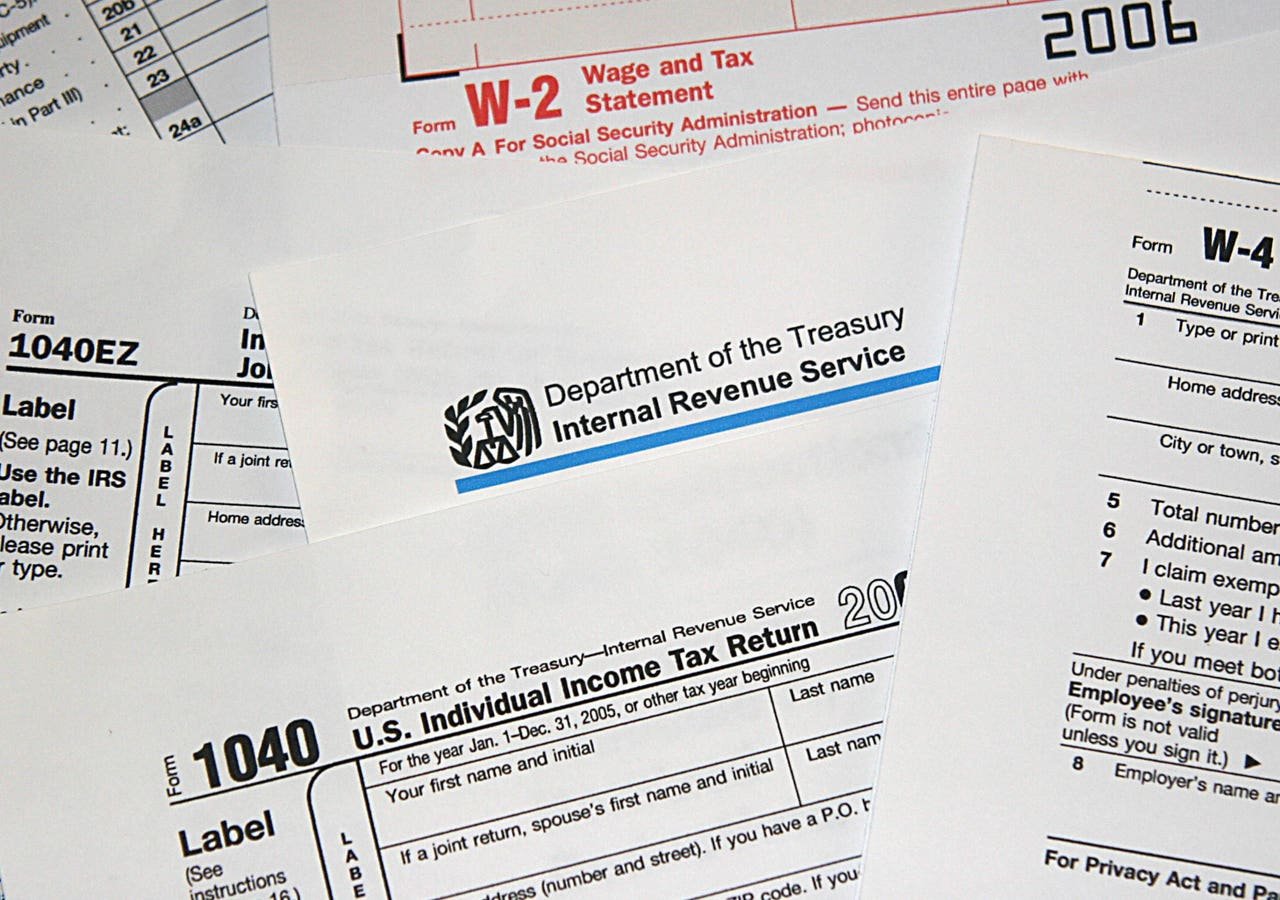
Washington, UNITED STATES: This 24 March, 2006 photo shows US Internal Revenue Service (IRS) tax … [+]
For some time, tax professionals have watched keenly as the case of Aroeste v. United States worked its way through a federal district court in California. In Aroeste, the taxpayer raised a novel argument that certain tax treaty provisions in the United States-Mexico tax treaty should govern whether the taxpayer had a United States FBAR reporting requirement. The government vigorously defended against this position, contending that taxpayers with dual residency should always be subject to FBAR reporting regardless of provisions in a tax treaty. On November 20, 2023, the court issued an order largely in favor of the taxpayer.
FBAR.
Under federal law, “United States persons” must file FBARs for any calendar year in which they have a financial interest in, or signature authority over, a foreign financial account or accounts that exceed $10,000 at any time during the calendar year. The governing FBAR regulations interpret the term “United States person” broadly to include United States companies and United States citizens and “residents of the United States.”
Those regulations attempt to provide additional clarity on the meaning of “resident of the United States.” Specifically, the regulations state that such term includes any “resident alien” identified in section 7701(b) of another statutory regime—the Internal Revenue Code (Code). In turn, section 7701(b) of the Code provides that such individuals include “lawful permanent residents of the United States” (i.e., “green-card holders”), provided such status has not been revoked nor administratively or judicially determined to have been abandoned.
There is also significant flush language in section 7701(b)(6) of the Code, which became central to the decision in Aroeste. In that part of the statute, it states that an individual is no longer considered a lawful permanent resident of the United States if the individual commences to be treated as a resident of a foreign country under provisions of an applicable tax treaty. To fall under this statutory exception, however, the taxpayer must not waive the treaty benefits and must also notify the government of the treaty benefits.
Background Facts.
The background facts in Aroeste are relatively straightforward. The taxpayer was born in Mexico and had lived there his entire life. Although the taxpayer and his wife had a home in Mexico, they also owned a condominium in Florida which they had purchased in 1980. They primarily used the condominium for vacation purposes.
In 1984, the taxpayer applied for a United States “green card,” the status of which had never been administratively or judicially revoked.
In 2012 and 2013, the taxpayer had financial interests in or signature authority over five foreign accounts based in Mexico. The balance of those accounts exceeded $10,000 for both 2012 and 2013.
Originally, the taxpayer and his wife filed joint individual income tax returns with the IRS. Those returns did not include Forms 8833, Treaty-Based Return Position Disclosure.
After the taxpayer was selected for IRS examination, he filed amended tax returns for 2012 and 2013, changing the filing status on those returns to married filing separately, and including Forms 8833.
Because the taxpayer never filed FBARs for 2012 and 2013, the IRS assessed $100,000 of total FBAR penalties against him for 2012 and 2013. The taxpayer filed a lawsuit against the government, contending that he was not liable for the FBAR penalties.
The Court’s Order.
From the beginning of the lawsuit, the taxpayer contended that he did not have FBAR filing requirements for 2012 and 2013. In support, he cited to the U.S.-Mexico tax treaty and argued that he was not a “United States person.” According to the taxpayer, section 7701(b) of the Code and the treaty completely exempted him from FBAR reporting.
Predictably, the government disagreed. After various rounds of discovery disputes, the government filed a motion for summary judgment on the issue. The taxpayer also filed a motion for summary judgment.
In the government’s motion, it raised three primary arguments. First, the government argued that the taxpayer had waived the treaty benefits by filing Forms 8833 after the applicable tax return filing deadlines. Second, the government contended that even if the taxpayer had timely applied for treaty benefits, he had failed to file a required Form 8854, Initial and Annual Expatriation Statement, thereby eliminating any treaty benefits. Third, the government argued that regardless of its other two contentions, dual residents such as the taxpayer could not avail themselves of the treaty benefits to remove an FBAR reporting obligation.
The court disagreed with all three of the government’s arguments. Regarding the late-filed Forms 8833, the court concluded that another statutory provision in the Code—section 6712—provided the consequences for a taxpayer’s failure to timely file Forms 8833. Thus, although the court agreed that the government could penalize the taxpayer $1,000 for each failure to timely file Form 8833 under that statute (here, $2,000 total), the court held that the taxpayer’s failure to timely file Forms 8833 did not waive the treaty benefits.
In line with a long line of recent Administrative Procedure Act (APA) cases, the court further determined that the taxpayer’s failure to file Form 8854 did not prohibit the taxpayer from availing itself of the treaty benefits. Because the government had not complied with the APA in issuing Notice 2009-85, the court concluded that the notice was invalid.
But the court’s decision regarding dual residency and FBAR reporting obligations was perhaps the most important issue in Aroeste. As mentioned above, the government argued that dual residents who claimed treaty benefits under an applicable tax treaty remained subject to FBAR reporting. In support, the government cited to the preamble of the FBAR regulations, which stated: “[a] legal permanent resident who elects under a tax treaty to be treated as a non-resident for tax purposes must still file an FBAR.” The court found this argument “unavailing” in that it was counter to the specific FBAR regulatory provisions that excepted from reporting United States residents who fall within section 7701(b)(6) of the Code.
With the government’s arguments all missing their mark, the court concluded that the taxpayer was a resident of Mexico under the U.S.-Mexico tax treaty “tie breaking” rules, which rendered him within the exception of section 7701(b)(6). Because the taxpayer was within the exception, the court found that the taxpayer did not have an FBAR reporting obligation. Given the court’s order, the taxpayer was liable for $2,000 for failure to file two years of Forms 8833, a far cry from the much larger FBAR penalties the government originally sought against him.
The case is Aroeste v. United States, No. 3:22-cv-00682 (S.D. Cal. Nov. 20, 2023).
