
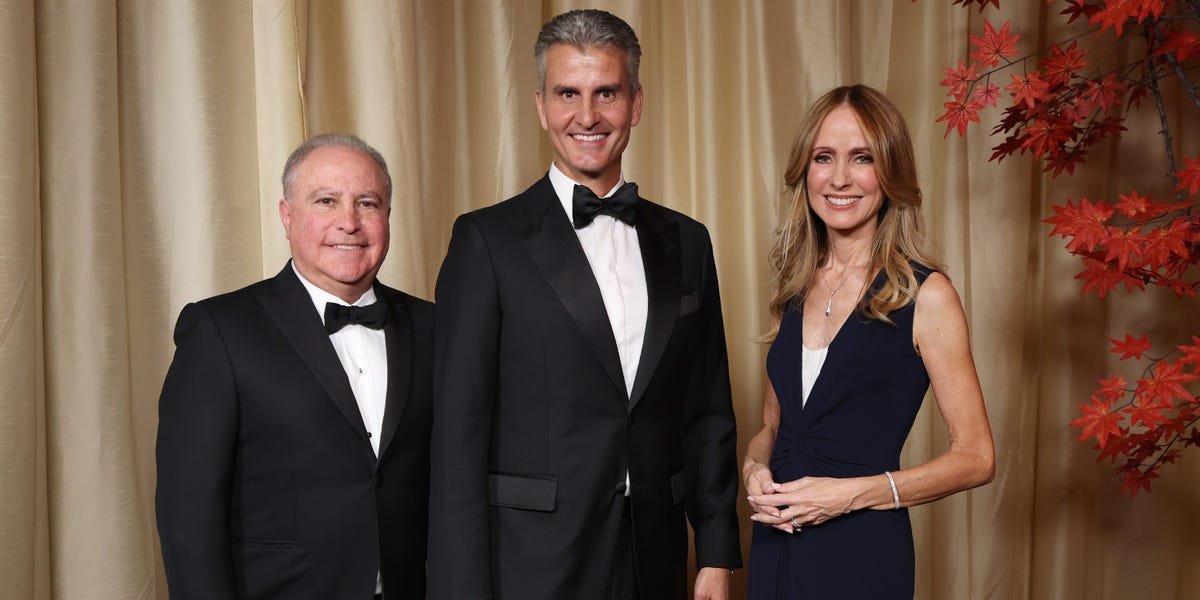
Disney CEO Josh D’Amaro shouldn’t expect a long honeymoon.
As head of Disney’s experiences division, D’Amaro charmed the executive search team, park guests, and employees who’ve met him.
Wall Street could prove harder to please.
Disney’s stock has barely moved in the last decade, and shares have nearly been cut in half from their all-time high five years ago.
We spoke with four media analysts as D’Amaro takes the reins on Wednesday from longtime CEO Bob Iger. They said Disney should focus on developing new franchises, investing in video games, and figuring out what to do with AI and the company’s declining TV networks.
One key: winning over a new generation that craves interaction.
“In this new world, you really need to take down those velvet ropes and let them onto the red carpet,” said Jon Giegengack, the founder of Hub Entertainment Research.
On the hunt for new franchises
Early in the streaming wars, Hollywood giants went all-out to beat Netflix by spending billions on new shows and movies, in hopes of attracting and keeping subscribers.
Content itself might not be enough to move the needle for Disney now, said Brandon Katz, a content strategy director at Greenlight Analytics.
“The real question for Disney now isn’t just, ‘Is this piece of content a hit?'” Katz said. “It’s: ‘Can this piece of content live across parks, merchandise, games, and streaming?'”
Analysts say Disney needs new franchises and can’t simply rely on squeezing cash from superheroes or nostalgia-inducing sequels. Shows like FX’s “The Bear” help, but they aren’t as inherently sellable as a new Disney hit.
“A primary area of focus should be building on the company’s strong base of existing premium IP while introducing new franchises that can keep the flywheel spinning,” MoffettNathanson analyst Robert Fishman wrote after D’Amaro was named CEO.
That’s a big challenge for D’Amaro and creative chief Dana Walden, though they don’t have to start from scratch. Disney’s next “Frozen” could come from a book or a video game.
“Disney has to start getting in on that, particularly as the superhero bubble waves and wobbles,” Katz said of using video games as IP.
Games could help Disney level up with younger audiences
Video games are both a potential treasure trove for new franchises and a way for Disney to reach younger generations.
Young people who grew up with endless content at their fingertips crave interactivity, whether it’s playing games with friends or joining digital communities.
To compete in this rapidly shifting landscape, Disney must move toward “participatory” media like video games, Hub Entertainment Research’s Giegengack said. He added that letting fans play as The Mandalorian in Fortnite, instead of just watching him on Disney+, is a “complete no-brainer” for Disney.
Disney has an uneven history in video games, though D’Amaro seems to see their value, as his division made a $1.5 billion investment in Epic Games. Fortnite players can explore a Disney-themed virtual world and wear “skins” of Disney characters like Captain Hook and Frozone.
Video games appear poised to become a larger part of Disney, as the games division is moving under Walden’s oversight alongside the streaming and content teams.
AI is a double-edged sword
Disney has already made a polarizing bet on interactivity through a deal with OpenAI. Soon, fans could be able to create and scroll through AI-generated short-form vertical clips on Disney+.
Iger hoped this deal would cement the value of Disney’s IP in the AI age and set guardrails around how its characters are used, all while boosting streaming engagement, which has stagnated in the US in recent years.
Giegengack said this deal also marked a major pivot for Disney, which has spent decades “protecting IP jealously.” Given how viewer habits are shifting, this bet on short-form and AI-generated video may pay off.
“It’s not without risk, but I think you have to explore ways to use your assets in new ways these days, particularly as it pertains to a social-driven young audience,” Katz said of the deal.
Others are less enthused by Disney’s move into AI. Alan Wolk, who cofounded media research firm TVREV, said Disney fans may play around with AI-generated videos, then get bored with them.
“I just don’t think it’s going to go any place,” Wolk said.
Joe Bonner, who covers Disney for Argus Research, said the Mouse House will be “very cautious” with AI-generated video to avoid damaging its brand or upsetting Hollywood.
“You don’t want your headline talent to walk away or get mad at you,” Bonner said.
To sell, or not to sell, TV networks
D’Amaro must also decide whether Disney should get a tune-up or a transformational makeover.
One decision: whether to reshape Disney by selling profitable but declining TV networks. Iger had floated the idea of selling ABC, saying it “may not be core,” before walking back the remarks months later.
Figuring out what to do with the TV networks is “the one thing Iger never really solved,” Bonner said.
Bonner thinks Disney’s long-lagging stock would rise if it ditched some of its cable networks, which he considers the weakest part of its business.
The impact of selling ESPN, which was recently valued at $30 billion, is less clear. Its must-see games are highly valuable in a fragmented media landscape, but the cost of live sports rights continues to soar.
The NFL recently started negotiating its next TV deal, and Bonner said it’s “the must-have of must-have content.” ESPN will almost certainly keep its spot, since the league owns a 10% stake in the network and sold it the NFL Network. It won’t come cheap, though.
If D’Amaro decides to auction or spin off ESPN, it could turn heads inside Disney — though it could win him fans on Wall Street.
Media analyst Rich Greenfield of Lightshed Partners, who for years implored Disney to get out of the linear TV business, wants D’Amaro to finally divorce the company from its linear networks.
“We view linear TV as a distraction for D’Amaro and not where we, nor investors, want to see Disney allocating capital and resources,” Greenfield wrote.
