Copy link
X
Bluesky
Threads
Impact Link
Save
Saved
Read in app
subscribers. Become an Insider
and start reading now.
Have an account? .
- On Sunday, Bad Bunny took the stage at Levi’s Stadium for the Super Bowl LX halftime show.
- The show was full of nods to Puerto Rico and included subtle political and cultural statements.
- Here are some details from Bad Bunny’s halftime performance that you might have missed.
Bad Bunny’s Super Bowl LX halftime show was more than a hit-filled performance — it was a carefully staged cultural statement.
Beyond the headline moments, the show was packed with intentional details, from visual symbolism to casting choices, that were easy to miss in real time.
We’ve rounded up the moments you might not have caught, and why they mattered.
Bad Bunny’s “Ocasio 64” jersey
Bob Kupbens/Icon Sportswire via Getty Images
Bad Bunny — born Benito Antonio Martínez Ocasio — wore a white Zara football jersey emblazoned with his last name, “Ocasio,” and the number “64.”
The number set off widespread online speculation about its meaning, with theories ranging from personal and musical references to Hurricane Maria, but no definitive explanation has been confirmed.
The cameos
Christopher Polk/Billboard via Getty Images
Bad Bunny’s halftime show featured several celebrity cameos from the likes of Lady Gaga, Ricky Martin, Pedro Pascal, Cardi B, Karol G, Jessica Alba, and Young Miko.
Lady Gaga appeared in a blue dress and sang a salsa rendition of her chart-topping hit “Die With a Smile,” while fellow Puerto Rican native Ricky Martin took to the stage to perform Bad Bunny’s “Lo Que Pasó a Hawaii.”
Maria Antonia Cay, known as Toñita, also made a cameo, briefly appearing onstage to hand Bad Bunny a drink. She runs Caribbean Social Club in Williamsburg, one of the last Puerto Rican social clubs in New York City.
An actual wedding
JOSH EDELSON / AFP via Getty Images
A couple featured in Bad Bunny’s performance actually got married during the set, league sources confirmed to ESPN.
The outlet said that the couple had originally invited Bad Bunny to their wedding. Instead, the singer invited them to get married during his show.
The power lines
Kevin Sabitus/Getty Images
During his performance of “El Apagón,” a song whose title translates to “the power outage,” Bad Bunny leaned into the track’s themes about the frequent blackouts in Puerto Rico.
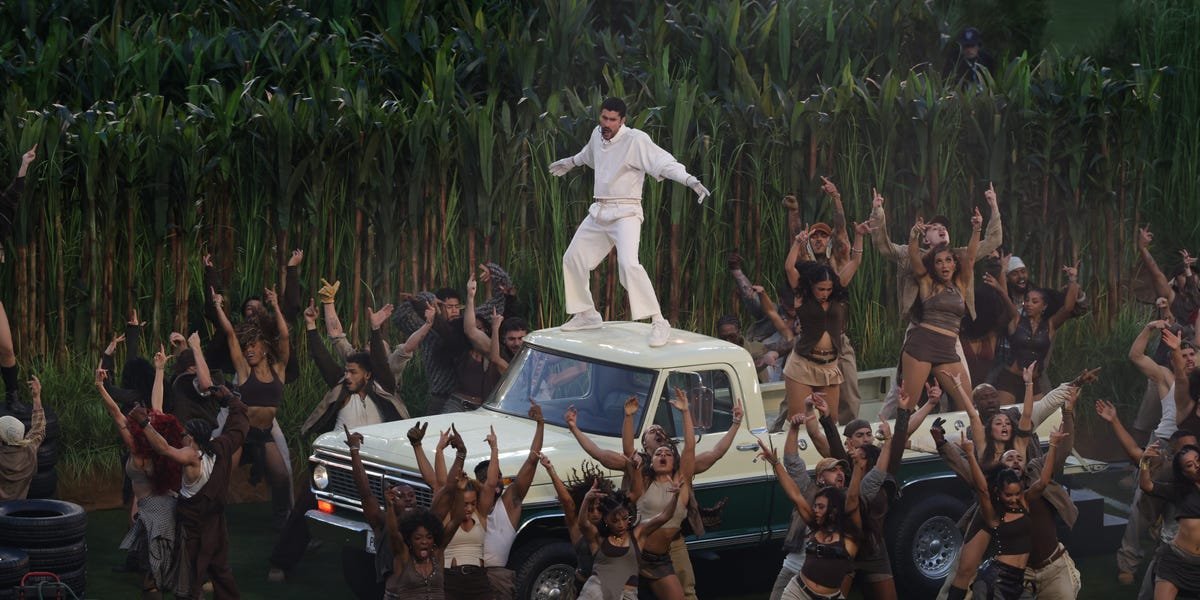
The stage featured his dancers dressed as jíbaros, or traditional Puerto Rican farmers, who began climbing utility poles that sparked and exploded.
The dancers dressed as plants
San Francisco Chronicle/Hearst Newspapers/San Francisco Chronicle via Getty Images
Bad Bunny brought Puerto Rico to Levi’s Stadium by covering the stage in greenery inspired by Vega Baja, where he grew up.
In another stadium, that kind of lush landscape would typically be created by wheeling carts of plant props onto the field, Bruce Rodgers, whose company Tribe Inc. handled the show’s production design, told Wired.
But NFL rules limited how many carts could be used to protect Levi’s Stadium’s natural grass, so the team dressed performers as plants to get the same effect, Rodgers said
Boricua pride on display
Patrick T. Fallon / AFP
Bad Bunny’s halftime performance featured several cultural symbols of Puerto Rico, including sugar cane fields, a piragua stand, and a casita.
The billboard message at the end of the performance
JOSH EDELSON / AFP
As fireworks lit up the sky to mark the end of Bad Bunny’s halftime performance, a stadium screen displayed the message, “The only thing more powerful than hate is love.”
The quote echoed a line from the singer’s Grammy acceptance speech last week.
While accepting the award for best música urbana album, Bad Bunny called out ICE.
“We’re not savage,” he said. “We’re not animals. We’re not aliens. We are humans, and we are Americans.”
Later that night, Bad Bunny also made history as the first artist to win Album of the Year with an all-Spanish record.
