
Look at economic data, and you’d think that young voters would be riding high right now. Unemployment remains low. Job opportunities are plentiful. Inequality is down, wage growth is finally beating inflation, and the economy has expanded rapidly this year.
Look at TikTok, and you get a very different impression — one that seems more in line with both consumer confidence data and President Biden’s performance in political polls.
Several of the economy-related trends getting traction on TikTok are downright dire. The term “Silent Depression” recently spawned a spate of viral videos. Clips critical of capitalism are common. On Instagram, jokes about poor housing affordability are a genre unto themselves.
Social media reflects — and is potentially fueling — a deep-seated angst about the economy that is showing up in surveys of younger consumers and political polls alike. It suggests that even as the job market booms, people are focusing on long-running issues like housing affordability as they assess the economy.
The economic conversation taking place virtually may offer insight into the stark disconnect between optimistic economic data and pessimistic feelings, one that has puzzled political strategists and economists.
Never before was consumer sentiment this consistently depressed when joblessness was so consistently low. And voters rate Mr. Biden badly on economic matters despite rapid growth and a strong job market. Young people are especially glum: A recent poll by The New York Times and Siena College found that 59 percent of voters under 30 rated the economy as “poor.”
That’s where social media could offer insight. Popular interest drives what content plays well — especially on TikTok, where going viral is often the goal. The platforms are also an important disseminator of information and sentiment.
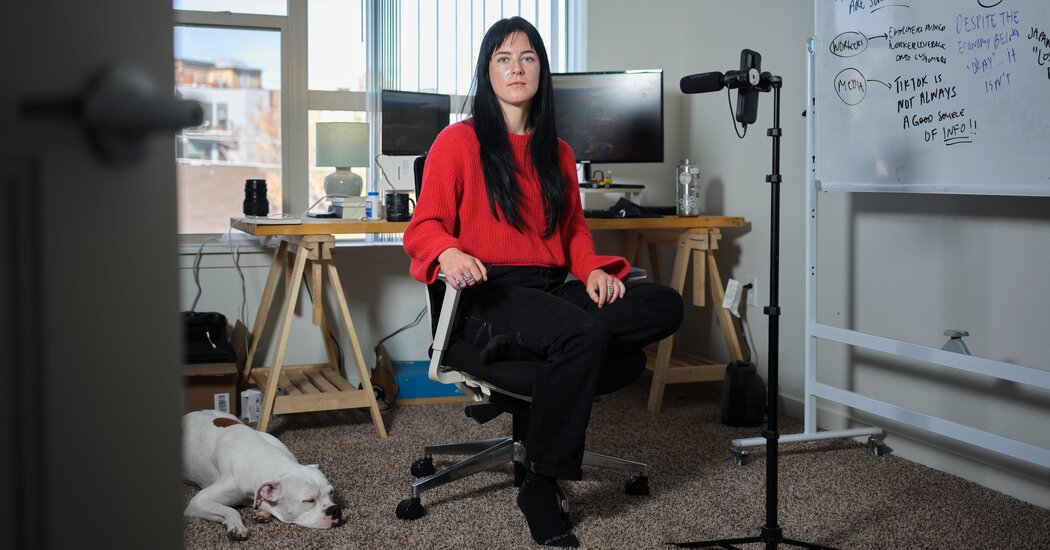
“A lot of people get their information from TikTok, but even if you don’t, your friends do, so you still get looped into the echo chamber,” said Kyla Scanlon, a content creator focused on economic issues who posts carefully researched explainers across TikTok, Instagram and X.
Ms. Scanlon rose to prominence in the traditional news media in part for coining and popularizing the term “vibecession” for how bad consumers felt in 2022 — but she thinks 2023 has seen further souring.
“I think people have gotten angrier,” she said. “I think we’re actually in a worse vibecession now.”
Surveys suggest that people in Generation Z, born after 1996, heavily get their news from social media and messaging apps. And the share of U.S. adults who turn to TikTok in particular for information has been steadily climbing. Facebook is still a bigger news source because it has more users, but about 43 percent of adults who use TikTok get news from it regularly, according to a new survey by the Pew Research Center.
It is difficult to say for certain whether negative news on social media is driving bad feelings about the economy, or about the Biden administration. Data and surveys struggle to capture exactly what effect specific news delivery channels — particularly newer ones — have on people’s perceptions, said Katerina Eva Matsa, director of news and information research at the Pew Research Center.
“Is the news — the way it has evolved — making people view things negatively?” she asked. It’s hard to tell, she explained, but “how you’re being bombarded, entangled in all of this information might have contributed.”
Mr. Biden’s re-election campaign team is cognizant that TikTok has supplanted X, formerly known as Twitter, for many young voters as a crucial information source this election cycle — and conscious of how negative it tends to be. White House officials say that some of those messages accurately reflect the messengers’ economic experiences, but that others border on misinformation that social media platforms should be policing.
Rob Flaherty, a deputy campaign manager for Mr. Biden, said the campaign was working with content creators on TikTok in an effort to “amplify a positive, affirmative message” about the economy.
A few political campaign posts promoting Mr. Biden’s jobs record have managed to rack up thousands of likes. But the “Silent Depression” posts have garnered hundreds of thousands — a sign of how much negativity is winning out.
In those videos, influencers compare how easy it was to get by economically in 1930 versus 2023. The videos are misleading, skimming over the crucial fact that roughly one in four adults was unemployed in 1933, compared with four in 100 today. And the data they cite are often pulled from unreliable sources.
But the housing affordability trend that the videos spotlight is grounded in reality. It has gotten tougher for young people to afford a property over time. The cost of a typical house was 2.4 times the typical household income around 1940, when government data start. Today, it’s 5.8 times.
Nor is it just housing that’s making young people feel they’re falling behind, if you ask Freddie Smith, a 35-year-old real estate agent in Orlando, Fla., who created one especially popular “Silent Depression” video. Recently, it is also the costs of gas, groceries, cars and rent.
“I think it’s the perfect storm,” Mr. Smith said. “It’s this tug of war that millennials and Gen Z are facing right now.”
Inflation has cooled notably since peaking in the summer of 2022, which the Biden administration has greeted as a victory. Still, that just means that prices are no longer climbing as rapidly. Key costs remain noticeably higher than they were just a few years ago. Groceries are far more expensive than in 2019. Gas was hovering around $2.60 a gallon at the start of 2020, for instance, but is around $3.40 now.
Those higher prices do not necessarily mean people are worse off: Household incomes have also gone up, so people have more money to cover the higher costs. Consumer expenditure data suggests that people under 25 — and even 35 — have been spending a roughly equivalent or smaller share of their annual budgets on groceries and gas compared with before the pandemic, at least on average.
“I think things just feel harder,” said Betsey Stevenson, a professor of public policy and economics at the University of Michigan, explaining that people have what economists call a “money illusion” and think of the value of a dollar in fixed terms.
And housing has genuinely been taking up a bigger chunk of the young consumer’s budget than in the years before the pandemic, as rents, home prices and mortgage costs have all increased.
In addition to prices, content about student loans has taken off in TikTok conversations (#studentloans has 1.3 billion views), and many of the posts are unhappy.
Mr. Biden’s student-loan initiatives have been a roller coaster for millions of young Americans. He proposed last year to cancel as much as $20,000 in debt for borrowers who earn less than $125,000 a year, a plan that was estimated to cost $400 billion over several decades, only to see the Supreme Court strike down the initiative this summer.
Mr. Biden has continued to push more tailored efforts, including $127 billion in total loan forgiveness for 3.6 million borrowers. But last month, his administration also ended a pandemic freeze on loan payments that applied to all borrowers — some 40 million people.
The administration has tried to inject more positive programming into the social media discussion. Mr. Biden met with about 60 TikTok creators to explain his initial student loan forgiveness plan shortly after announcing it. The campaign team also sent videos to key creators, for possible sharing, of young people crying when they learned their loans had been forgiven.
The Biden campaign does not pay those creators or try to dictate what they are saying, though it does advertise on digital platforms aggressively, Mr. Flaherty said.
“It needs to sound authentic,” he said.
