
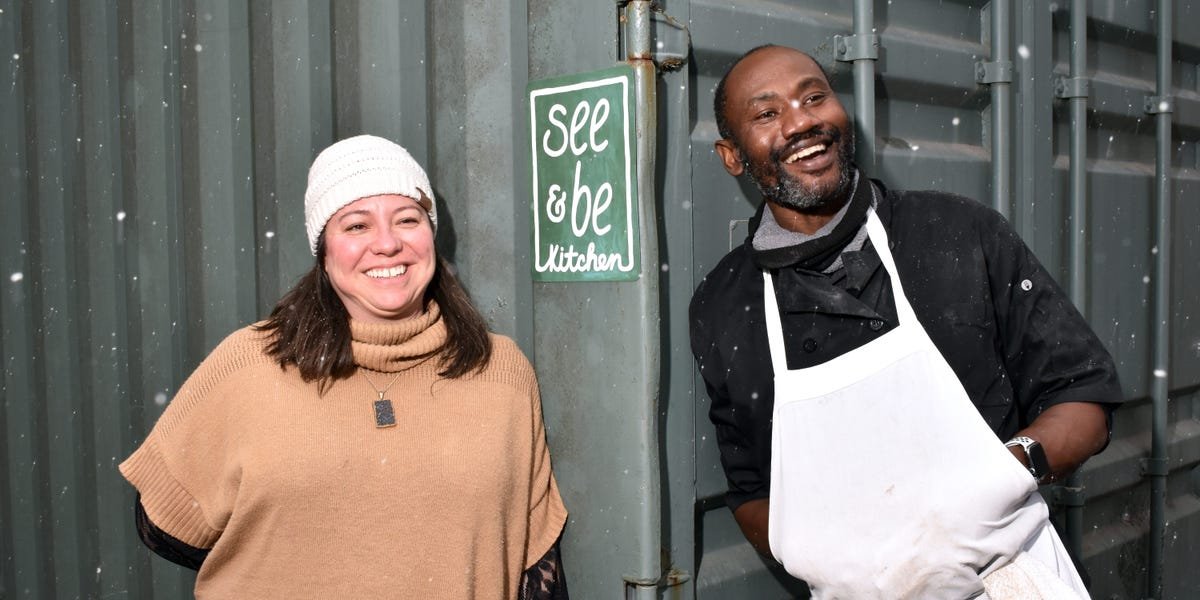
This as-told-to essay is based on a conversation with Chrissy Traore, 41, who opened See & Be Kitchen with her husband Ben Salif Traore in Cairo, New York, about 40 miles from Albany, New York. When their business expanded quickly, they began running parts of it out of shipping containers on their property. The conversation has been edited for length and clarity.
Ben and I met while I was a chef and he was a baker. We worked at the same restaurant — they had a bakery and a restaurant right next door, and I was their pizza chef and he was their head baker. I had to mix my pizza dough in his mixer and that’s kind of how we met.
Before, I worked on Madison Avenue in marketing and brand strategy, and in 2008, the economy crashed and my job crashed too. When that happened, I moved into food. I took a job on an ice cream truck and just fell in love with food work.
I was in the food industry in various ways in New York City from about 2008 until 2017.
While working in the industry, I was unhappy with the way that they treated employees. I was in management at the time, so I could see the full round numbers.
I thought, “There has to be a better way, but it’s not my job to change this business owner or this business.”
Ben and I talked a lot about it, and we were going upstate frequently — I was working at a place upstate as their first chef.
I said, “We should really move upstate.” It’s more our speed. We like the outdoors. We like having space. The quality of life is better. We love farming and being close to what’s happening on the ground, literally. In 2017 we said, let’s get out of the city.
We didn’t have a ton of money, and we had to be scrappy and thoughtful about how we deployed the resources that we had saved. We wanted a place where we could live and work, so we wanted property and land — that was important to us.
We found a property in Cairo, New York, and it had been a bar and a hotel, so it was already grandfathered in on DOH, and had some structures there. We have 11 acres, and the house was practically falling apart, so we could afford it. We paid $189,900, and that was it. We went all in.
Our business was rapidly expanding and we needed more buildings fast
We knew we wanted to open our own place and we were trying to discover what that was. We knew it would involve Ben’s bread and my cooking.
We started renovating the property and doing farmers markets, and that’s how we got to know the community that we were in.
We came in quietly, like, “Let’s see what’s already here and get to know people before we just bash them over the head with what we do.” Let’s see what they want, because ultimately we’re entering a community that’s not necessarily ours yet.
Nina Roberts
We were moving from Bed-Stuy in Brooklyn, and part of the reason we moved out was we saw that happening. People were moving in and they would say, “We need to fix this. This is broken.” And I’m like, “What is broken? This is a wonderful community. Please stop.”
Sometime in 2018, we turned into See & Be. Then, from there, we really got some traction at farmers markets.
We were doing porch pickups — people could pick up their orders at a local massage therapist’s house — so we had started operating, but we didn’t have a physical space yet.
We were still building out the cafe in the very small already existing structure on our property. We had one oven, with one proofer, a little cooktop that I would do the sandwiches on, and a coffee station with this beautiful wooden bar that people could sit at. And we opened that in February of 2019. Ben baked everything; I ran the front of house.
We had a five-year plan and it went into overdrive. Soon, we needed more space, and I could not get a building up fast enough. With traditional buildings, we looked at it and we thought it was going to take a year and a half to two years. We couldn’t do that. We needed space like tomorrow.
I had worked for a company while in Brooklyn that was actually my first shipping container job. That was at the DeKalb Market, and it was all built out of shipping containers.
I realized there was no way to get a building through the planning board and everything quickly enough — but I could get a shipping container.
Courtesy of Chrissy Traore
I looked at Ben and I said, “The fastest way we can do this is to get a shipping container.” And he said, “Are you kidding?” I said, “No.”
We really bootstrapped our business from day one. We had a $10,000 investment in building out the space over time. We costed it out, and we could afford it with what we had already made in the business.
We got our approval and I was so excited. I posted it on our Facebook page and we got over 4,000 interactions. We couldn’t not open.
Shipping containers are relatively cheap — but moving them isn’t
Our first shipping container was a regular shipping container — a 40′ by 20′ high cube. We placed it on wooden rail ties, which was not great — those degraded over the years, especially with heavy usage.
We thought of ourselves as scrappy: “Well, we did the cafe, we can do this ourselves. So why would I pay to have a spray foam? We’ll do that ourselves.” That was terrible idea.
I think we bought every spray foam insulation canister in a 200-mile radius of here from Home Depot and Lowe’s. We didn’t know what we were doing. We were just trying to figure it out. The walls were uneven and it worked, but it wasn’t a great solution.
Courtesy of Chrissy Traore
Then we pushed out of that shipping container and needed even more space. At that point, we needed more cold storage. I started doing more research into shipping containers and came across decommissioned reefers.
They’re pre-insulated and have steel walls. And unlike a regular shipping container that has a wood floor, this has a steel flat floor. So it’s already food-ready.
We bought the first container for $6,000 painted and delivered. And then we spent another couple thousand dollars in spray foam. God only knows how much the labor was, because we did it ourselves and that took forever.
We have running water and electric in the containers, but most of the mixing happens in our original building.
That following year, as our business grew and began to quickly scale, we kept outgrowing our space and needing more and more room. Once we saw how quickly we could get a shipping container in place — about a month — it was easy to go, “OK, well, gee, trucks can double my space in a month.”
The second container was much faster and easier to set up. I bought that directly through a broker at the port. We paid $8,500 for that one.
When we installed the second container, we leveled the ground, put in concrete pillars, and the cranes came in and moved the original container and did that whole process. Then, with the third container, it was very easy to attach it because the ground was already graded and leveled.
It cost about $7,500 to $15,000 per container at the end of the day, because we had to get the crane to get them moved, and we had to get them welded together.
Nina Roberts
It’s always funny when someone comes up to the building for the first time, and they’re just like, “What is this? Where is the bakery?” And then they knock on a shipping container door.
People are always shook to see that it’s a real production. They think we’re winging this or pretending because there’s these shipping containers. But when you walk in, you forget you’re in a shipping container.
