
Alibaba is developing a deposit-token payment system designed to streamline global commerce while working within the increasingly strict stance Beijing has taken toward stablecoins, according to new reporting and comments from company executives.
The effort reflects a broader push among Chinese firms to modernize cross-border payments without triggering regulatory backlash as authorities tighten control over digital currencies.
The initiative comes from Alibaba’s fast-growing cross-border e-commerce division, which on Friday also announced a new AI-powered subscription service meant to boost revenue.
As China Shuts Down Stablecoin Ambitions, Alibaba Shifts to Tokenized Bank Money
Kuo Zhang, president of Alibaba.com, told CNBC the company is preparing to use tokenized versions of the euro and U.S. dollar to settle international B2B payments more efficiently.
These tokens, often referred to as “deposit tokens,” are issued by regulated banks and backed directly by customer deposits, distinguishing them from privately issued stablecoins that regulators in Beijing have repeatedly warned against.
Zhang said Alibaba expects tokenized payments to reduce settlement times, cut intermediary fees, and allow funds to move “simultaneously” across markets such as the U.S., Europe, Hong Kong, Singapore, and mainland China.
He added that Alibaba.com plans to partner with global banking firms, including JPMorgan, whose own tokenization system, JPMD, officially launched this year for institutional clients.
The timing has drawn scrutiny. In July and August, Chinese firms, including JD.com and Alibaba affiliate Ant Group, lobbied to issue yuan-based stablecoins in Hong Kong.
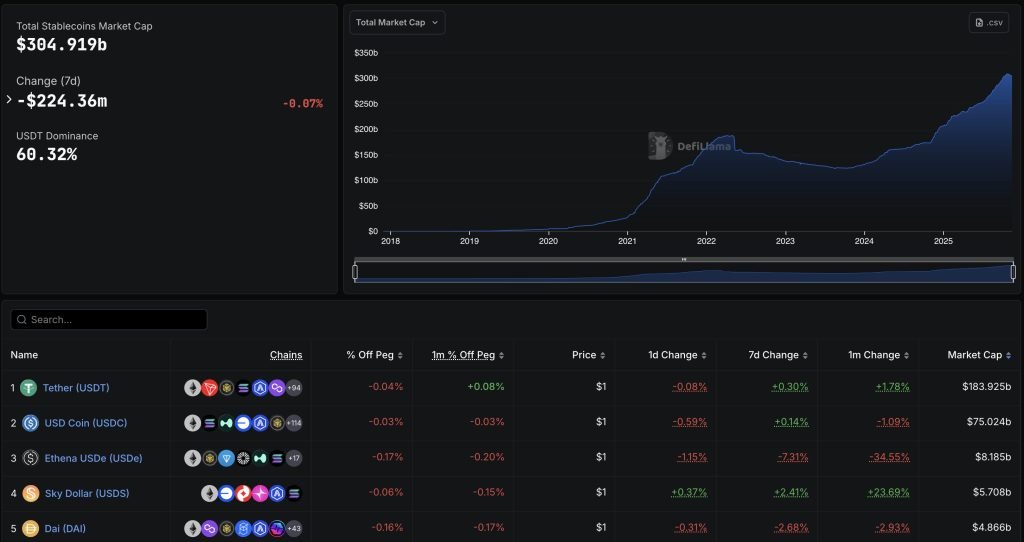
Their goal was to counter the overwhelming dominance of U.S. dollar stablecoins, which account for more than 90% of the $304.9 billion market.
However, by October, both companies abruptly paused those ambitions after the People’s Bank of China and other regulators privately instructed major tech firms to halt any plans to issue or back stablecoins, even in Hong Kong’s newly regulated environment.
Officials showed concern that privately issued fiat-backed tokens could erode the state’s monetary authority.
China's Ant Group and https://t.co/C3Cvy06AMt have paused their Hong Kong stablecoin plans after Beijing signalled that private firms should not issue currency-like tokens.#AntGroup #JD.com #Stablecoins https://t.co/u6zilMlnBh
— Cryptonews.com (@cryptonews) October 20, 2025
Regulators have since doubled down, warning companies not to publish stablecoin research or hold seminars on the topic, citing risks of fraud and illicit finance.
The PBoC governor, Pan Gongsheng, last month called stablecoins a growing threat to global financial stability and reaffirmed China’s zero-tolerance policy toward private digital currencies, even as the digital yuan continues expanding.
Alibaba Blends AI and Tokenized Finance as It Reboots Its Global B2B Strategy
Against that backdrop, Alibaba’s shift toward tokenized bank deposits reflects a calculated move, adopting blockchain-based settlement while avoiding the political sensitivities around stablecoins.
Tokenized deposits allow payments to be processed on distributed systems but remain entirely inside the banking sector, backed by fiat currency held on the balance sheet.
This mechanism aligns more closely with Beijing’s preference for state-linked digital finance rather than private token issuance.
Zhang said Alibaba.com plans to launch “agentic pay” in December, an AI-driven tool that automatically drafts commercial contracts between buyers and suppliers by analyzing their message history.
This feature is part of the company’s broader strategy to upgrade its B2B ecosystem with artificial intelligence.
Its new “AI Mode” search product allows businesses to compare suppliers by pricing, logistics, and production capacity.
Alibaba expects to charge roughly $20 per month or $99 per year for the service, creating a new subscription-based revenue stream.
Two Chinese artificial intelligence (AI) models, @deepseek_ai and @Alibaba_Qwen, lead an AI crypto trading contest.#Crypto #AIhttps://t.co/Oi0UtdSB0h
— Cryptonews.com (@cryptonews) October 27, 2025
The company’s renewed technology push comes as Chinese AI models gain global attention. In late October, Alibaba’s Qwen 3 Max posted a 108% gain in a live crypto trading contest, outperforming several Western AI systems.
Only DeepSeek, another Chinese model, delivered higher returns, while OpenAI’s GPT-5 and Google’s Gemini 2.5 Pro recorded steep losses.
The post Alibaba Develops Deposit Token to Sidestep China’s Fierce Stablecoin Crackdown: Report appeared first on Cryptonews.
