


Late one night in 1989, economist Jeffrey Sachs found himself in a smoke-filled room of government officials in Warsaw, Poland. The country had just declared independence from the Soviet Union, which had exerted central control over prices of tens of thousands of items, leading to frequent shortages.
For millions of Poles, that was a frightening proposition. Prices posted by the command-style government had been easy for ordinary people to see and understand, but the principles of the free market were an abstract theory. It required faith to leap into the unknown world of supply and demand where an unseen force called “the invisible hand” would now regulate prices.
Sachs’ plan was put in motion the next day, and newly unregulated prices of ordinary grocery items immediately spiked, causing anxiety across the country. The Polish finance minister, Leszek Balcerowicz, paced the streets, looking for a glimmer of hope. He decided to concentrate on one thing: the price of eggs.
If the market was working, the higher price of eggs would create incentives for farmers to bring more eggs to market, leading to a fall in prices. Sure enough, in a few days, egg prices began to drop. “That was an important day,” Balcerowicz recounted, a signal that the new free market was working its magic in allocating goods and services in the most cost effective manner.
* * *
But here’s the strange thing: the egg market is not acting in a way that economic textbooks would predict, and certainly in a different direction than Sachs’ confident prediction to the Polish people.
There are two egg puzzles that go well beyond Econ 101 textbooks’ standard explanations of how firms and consumers work together. The answers ultimately give us a richer understanding of the complexities of humans’ selling and buying behavior.
What’s going on here? In puzzle #1, the shortage of retail eggs and self-imposed store quotas indicate excess demand. In puzzle #2, the elevated wholesale egg prices mean a higher input cost for supplying retail eggs. Textbook economics predicts that in both cases, retail prices should be driven higher.
That means we should be paying at least $8 a dozen, not $5, on average nationwide.
Some might explain that this is happening because eggs are a “loss leader,” that encourages customers to buy other profitable items while they make their way to the back of the store, where eggs and milk are typically sold.
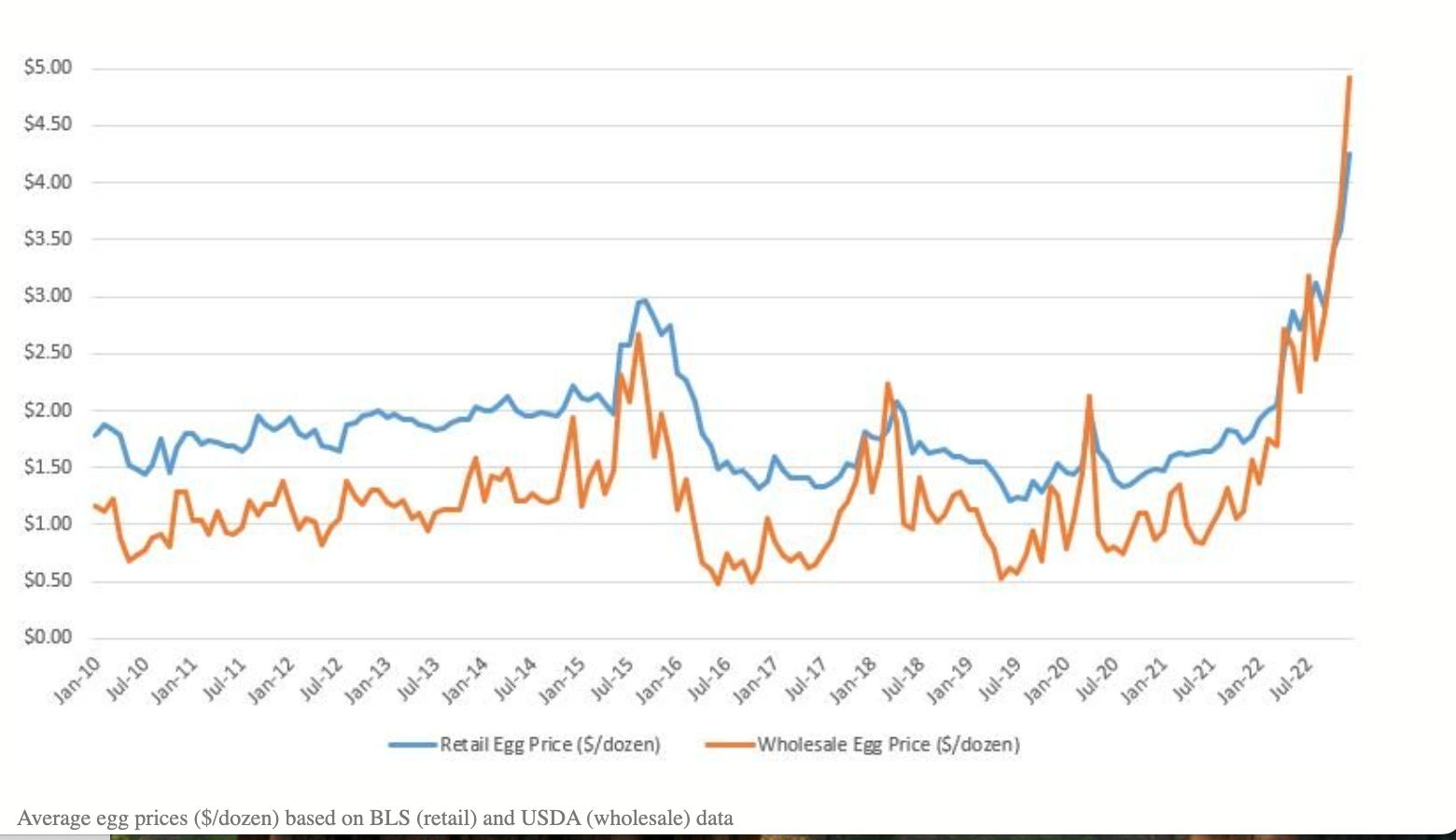
There is little evidence this explanation is true for any length of time. The below figure charts the past history of retail vs. wholesale egg prices. The orange line representing wholesale prices is almost always below the retail prices in blue.
In fact, we see an interesting phenomenon: grocery stores only lose money on eggs when the wholesale prices spike up very quickly, as they briefly did in 2015, 2018, 2020 and 2023 as well. Otherwise they are making around a reasonable 20-75 cents profit per dozen, depending on the type of eggs sold.
Figure 1. U.S. Egg Retail and Wholesale Prices, 2010-2023.

Since there has been no price control on retail eggs a la the former Soviet Union, we turn to the other explanation. A humble pack of a dozen eggs is likely an emotional purchase, at least when the prices go high. We are in touch with the prices of eggs as intimately as the Polish finance minister who wandered the streets, seeing them as a bellwether of the economy as a whole.
Grocery stores have a tough decision to make: they need to weigh the cost of their retail losses from egg sales versus the loss to their reputation if they are seen as “villainous price gougers” in a time of rapidly rising prices. It appears in this case at least, grocery stores will take the short-term losses on the chin, because they have thousands of other items where the profits can offset these losses.
Ironically, consumers may complain about sky-high egg prices in 2025, but they are largely kept in the dark about how protected they are from the reality of far higher wholesale prices.
The quotas instituted by the grocery stores now make sense: the nearly $3 loss per dozen eggs sold is like a store’s investment in retaining customer’s goodwill, serving to limit the damage from even higher priced eggs.
So it’s rational on the part of the grocery store to distribute their eggs among the largest possible customer base by disallowing bulk purchases by individual customers. That way, they enhance their reputation as a business who cares for customers and keep their eggs out of just one customer’s grocery basket.
The lesson: even in something as simple as an egg market, a delicate dance of emotion and reputation can intertwine with prices finding equilibrium. In all cases, the more competition the better, especially under long time frames. Consumers stand a far better chance of being protected by firms in these situations than command economies or regulations that create barriers to entry for other competitors, such as health insurance markets.
That is eggsactly what we should wish for. (I had to get a bad pun somewhere).
Craig Richardson is the BB&T Distinguished Professor of Economics and Finance at Winston-Salem State University.