


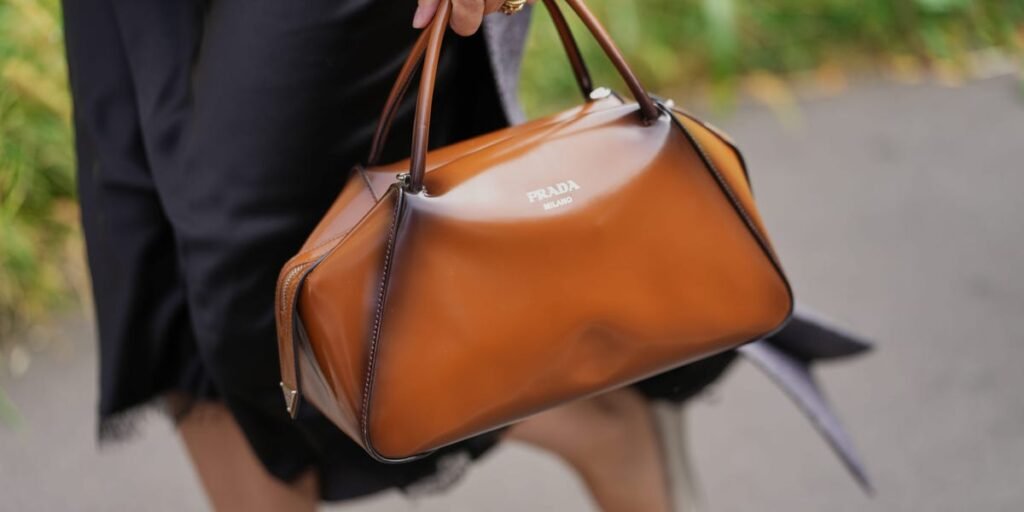
In college, Aliyah Muhammad had a guest speaker share a piece of career wisdom with her class: Don’t wear designer items to the office. It’s advice the 28-year-old software engineer has followed ever since.
Although she typically wears a Cartier watch on her wrist and dabbles in clothing from Pleats Please Issey Miyake, at work you won’t see the software engineer with anything “noticeably designer,” like a Louis Vuitton Neverfull over her shoulder.
“People generally know that it is not a $200 bag, and so they may feel some type of way,” she said. Although she’d be comfortable wearing the $2,170 Louis Vuitton bag in her day-to-day life, “when it comes to my career and my pay, I 100% care about what my manager and colleagues think.”
At work, she doesn’t want to deal with “pocket-watching” — a term used for people who monitor or speculate about another person’s finances and money habits.
What could a pricey bag potentially signify in the workplace? Unprofessionalism, shallowness, or even incorrect assumptions about someone’s income, the career coaches who spoke to Business Insider explained.
And as an early-career professional, Muhammad’s priority is advancement, and the assumptions that come with carrying a designer bag could overshadow that.
Increasingly, people — especially women like Muhammad — are opting to leave their designer at home when heading to work to avoid unwanted and often subconscious negative perceptions from coworkers and managers.
And although it might sound ridiculous that a luxury bag could cost you a promotion, these things do happen — even if they’re difficult to directly pinpoint.
“The reason we’re not able to track if it happens is because there’s no word for things like this,” explained Emily Durham, who worked as a recruiter across banking and tech for almost a decade before pivoting to full-time career coaching in 2024.
“There’s not a lot of easy data to access so that we can have conversations about this, but it happens in the background,” she said, “and it quietly influences all of these things.”
Edward Berthelot/Getty Images
The designer downside
The limited data we do have support Durham’s conclusion: A 2022 study published in the Journal of Personality and Social Psychology found that people are less likely to cooperate with those who signal status, for example, by donning luxury goods.
And when it comes to the workplace, especially, it’s typically a good idea to stay understated. Muhammad said she doesn’t wear noticeable designer items to her casual office so as not to “bring attention” to herself, but would consider doing so if it were common in her workplace and she were further along in her career.
In Durham’s case, she said a designer bag was to blame for an advancement opportunity she missed out on earlier in her recruiting career. Durham later learned from a coworker that the manager who made the decision had passed her over after learning she’d used her year-end bonus to buy a Louis Vuitton Neverfull. (As mentioned earlier, the bag retails for just over $2,000.)
“For the record, I was broke, and that was a horrible financial decision,” Durham said. To the manager, however, it may have signaled that she didn’t need the pay increase, as they “were like, ‘Well, I’ve got two identical candidates who’ve been at the company for the same amount of time. Clearly, this one’s doing OK, and this one needs a break. So let me give this person a break.'”
For those same reasons, Durham recommends ditching labels for an interview. “We run the risk when we show up to interviews dressed in designer that companies might perceive you to not need the money,” she said.
frantic00/Getty Images
It’s worth noting that sexism plays a role in this quandary, as appearance-based assumptions about a person’s character, competence, and personality all disproportionately afflict women.
“I’ve never had a man come to me and ask me questions about the signals that his work wear or appearance might be sending,” said Louise Thompson, a UK-based leadership and career coach. “And that is grossly unfair.”
Even so, despite how nonsensical these perceptions are, they contain some truth. “You might have people who are, frankly, subconsciously, quite sexist with their relationship to fashion and dressing, who now look at you and think, ‘Oh, you’re high maintenance,'” Durham added.
Consider your context
Does this mean you should never wear anything high-end to the office? Not exactly. Context is the key factor in these situations, said Thompson.
“It’s not your responsibility to have to carry what someone else might be feeling about your designer handbag,” she said. “However, I do also think you’ve got to be intentional and recognize that everything you say, the way you behave, the way you choose to dress, your appearance — they’re all part of your communication style. They’re all signals.”
Mariana Silvestre/Getty Images
For 27-year-old Kimberly McArthur, who works in sales and marketing for an oil and gas company, dressing up and carrying a designer bag to the office is one way she signals ambition in her male-dominated workplace. “We’re always told growing up that you dress for the job you want, not the job you have,” said McArthur. “I want to dress as if I’m going to be the CEO. So why wouldn’t I wear designer?”
Temi Fayiga, a 26-year-old judicial law clerk, points to her industry as one of the reasons she chooses the Longchamp Le Pliage for her work bag. With its simple style, lack of distinct designer logos, and a retail price of $180, it’s a more accessible, practical luxury option.
“I’m not really looking to wear things that draw attention, especially because of the field that I’m now in,” said Fayiga. In the legal field, “you’re there for your client,” she explained.
“It runs directly contrary to your role as an advocate if you’re showing up in an effort to be the center of everything that’s going on.” That can apply to flashy designer clothing, as well as bright colors, said Fayiga.
And a luxury purse sends a different message than a wardrobe of ready-to-wear. “Clothing is something you’re switching every single day. If it’s a handbag, it could be a gift,” said Fayiga. “If you’re pulling up in a designer top that has obvious branding on it every single day, then that’s less likely to be a gift and more likely to be something that you yourself are buying.”
When starting out in your career, these choices are especially meaningful, said Thompson.
“You might think all of these things are rooted in sexism and are totally, totally ridiculous,” said Durham. “But at the end of the day, we have to protect our paychecks.”