


When Mirav Steckel opened each of her 15 credit cards, she thought the discounts and rewards they offered would save her money. Instead, her plastic portfolio pushed her into impulse purchases and forced her to reevaluate her spending habits.
“If it was a really bad day at work, my first thought wasn’t, ‘Oh, let me go home and chill.’ It was, ‘I’m going to go treat myself to something that’s going to make me feel better,’ but it got to a point where I was asking people around me for money to pay my cards off,” Steckel tells me. “That’s not the type of life that I wanted to live.”
Steckel chalked it up to financial illiteracy — she was 18, she didn’t know the crushing consequences of debt, and signing up for the cards was deceptively easy. Now 21, she has a new trick to follow her monthly budget: use cash. Seeing the physical money rather than making a seamless digital transaction has been instrumental to curbing her spending.
Steckel’s frictionless financial experience is an example of the cascade of credit card deals, Buy-Now-Pay-Later plans, and digital personal loans designed to grease the wheels of your spending and make it easy to obscure — or ignore — the purchases you’re on the hook for. Consumer spending gurus told me that while these products can benefit those who truly need a financial reprieve, they can also trap people in an endless debt cycle that is difficult to escape. And with the risk of renewed inflation and heightened economic uncertainty, some consumers are more willing to enter payment plans, putting less money down up front in the hope that conditions will improve in the future. The Federal Reserve found that 15% of Americans used BNPL in 2025, up from 10% in 2021. That’s coupled with 81% of Americans holding a credit card in 2025.
“If I make you wait or if I make you click through a bunch of things or physically pull out a wallet or, God forbid, cash, that will give you all these moments to pause and rethink things,” Scott Rick, a marketing professor at the University of Michigan, tells me. “I just want to be a hot knife through butter here. I want to make it as easy and frictionless as humanly possible.”
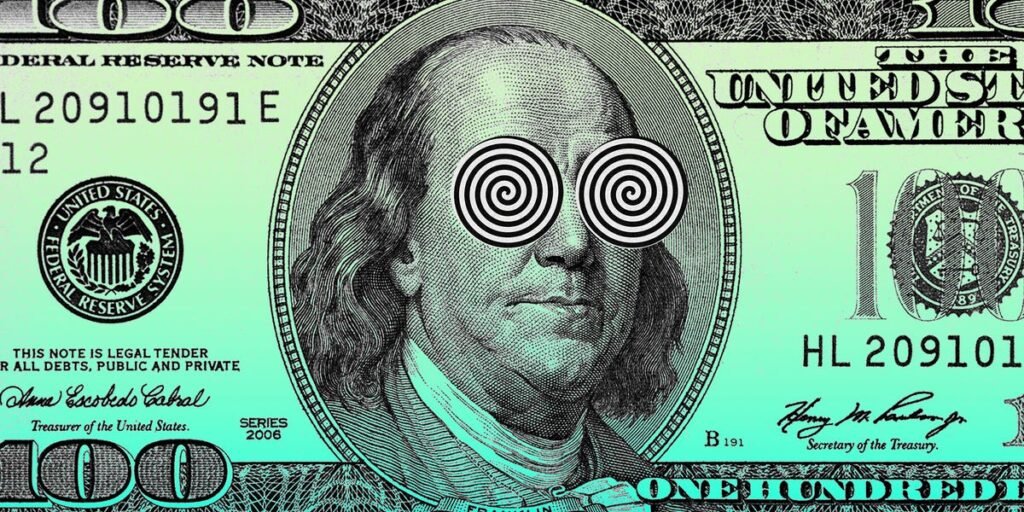
Welcome to the funny money economy, where credit is king and companies excel at making their products so easy to access that you don’t stop to think about whether you can actually afford to pay for them.
‘It’s gotten so easy to spend’
Maybe you know the feeling: You’re online shopping, and you only need that sweatshirt, but when you go to check out, there’s a $9.99 shipping fee. If you spend $15 more, though, shipping will be free. You don’t really need that jacket that you’ve been eyeing, but if you buy it, shipping is free. It’s a steal. Sure, it’s a little more than you’d expected to pay, but if you use a BNPL plan, the first installment fits snugly in your budget, and you can manage the other payments down the line. Congrats, you’ve been sucked into the funny money economy — fueled by the ease of technology and artful tools to prevent consumers from getting a full grasp on their financial situations.

Every time Ayelet publishes a story, you’ll get an alert straight to your inbox!
Stay connected to Ayelet and get more of their work as it publishes.
The modern shopping experience is drastically different from what it was even just a decade ago, Abigail Sussman, a marketing professor at the University of Chicago’s Booth School of Business, tells me. It’s not only the switch from cash to credit cards, she says, it’s also the ability to store your card information on the web and automatically fill it in when prompted. Other forms of payment like Apple Pay make it easy “to spend without even looking at the price, frankly, without even really pausing to internalize it,” says Sussman. And even if you consider the number on your screen, it may not be the final final cost.
“I don’t think consumers are doing anything wrong. I think it’s just that the systems that are in place are really designed to make spending frictionless,” she says.
These changes also prey on our brain’s desire for instant gratification, says Kristina Durante, a social psychologist at Rutgers’ business school. Hundreds of thousands of years ago, humans were solely focused on survival — they weren’t thinking about what meal they’d have in two weeks. Our brains are still in that mindset, Durante says. While we can think about the future in an abstract way, the human brain doesn’t excel at accounting for the future.
“The part of our brain that wants what it wants when it wants it is so much stronger than the part of our brain that’s a brake system that says, ‘Wait, hold on, can we really afford this?'” Durante says.
Rick, the University of Michigan professor, says that in addition to the ease of shopping, some companies are using entertainment to pull consumers in. He referenced the TikTok shop, where ads for various products pop up in a user’s feed while they’re watching videos, and people can purchase them with one click. Or take Disney resorts, where a visitor can tap their wristband or use Disney dollars to make a purchase, leading the consumer to feel like they’re using “play money” even as their accounts are slowly drained.
‘It’s hard to keep track’
The mechanisms that make it so easy to spend also make it easy to get access to debt to spend even more. New technology allows companies to instantly approve new customers for credit cards, and there’s an expanded availability of specialized cards, like those intended for people with low credit or ones geared toward students with limited credit histories. These lower barriers are helping fuel a record amount of debt. The latest figures from the New York Federal Reserve show Americans’ outstanding credit card balances are at a record high of $1.28 trillion, up nearly 6% from one year ago. Over the same time period, the usage of alternative spending, like Buy Now, Pay Later products, has grown — a December 2025 report from the Consumer Financial Protection Bureau said that the six firms in its sample reported a combined 53.6 million consumers who took out a BNPL loan in 2023, a 12% increase from 2022, at an average amount of $848, up from $725.
When it comes time to settle up your accounts, companies are making it confusing to get a handle on where you stand. Credit cards have variable interest rates that can go up or down depending on a range of factors, including credit score. By offering rewards, points, and limited-time low-interest rates, a consumer might not realize what they’re signing up for until it’s too late, Ayelet Fishbach, a behavior science professor at the University of Chicago, tells me.
“Points don’t feel like much,” Fishbach says. “And so if you can convince me that I’m not paying with money, but with some monopoly money such as credit card points, that will obscure the price.”
BNPL products similarly use smart marketing and our own mental biases against us. Ying Lei Toh, a senior economist at the Kansas City Federal Reserve, says that while they could help some consumers responsibly make big purchases, they are structured to make people feel “less financially constrained” by breaking the cost into installments.
“It could really worsen the overspending problem and the indebtedness, and the possibility that people would really be spending way beyond their means,” Toh says. A CFPB report from 2025 found that Americans are taking on BNPL debt more frequently, and at larger amounts, with the average annual loan increasing from $745 in 2022 to $848 in 2023, up 14%. For credit card companies and BNPL providers, allowing consumers the option to split up payments could generate profit because some afterpay plans come with hefty interest rates and late fees. At the same time, the increased availability of these plans helps companies reach a demographic that might not have traditional credit cards or prefers to make payments in smaller installments.
Stephanie Blanks, 35, managed to escape the BNPL trap — but it wasn’t easy. When she had her first child about five years ago, she underestimated how much savings she needed. She ended up maxing out her credit cards and turned to BNPL to buy diapers, groceries, and clothes for her baby. Those small, twice-monthly payments turned into about $3,700 in debt.
“You’re like, ‘Oh, $10 every two weeks doesn’t sound bad at all. I can totally afford that,’ until you get 25 or 26 loans in and you’re drowning in them,” Blanks says. She started paying off that balance at the beginning of September 2025 and hasn’t used a BNPL product since. “It was just extremely overwhelming, and I felt like I couldn’t get out of the hole,” Blanks says.
BNPL plans aren’t all bad. When Gabby Raines, 29, moved in with her husband about 10 years ago, they needed a new mattress but couldn’t afford it all at once, so they turned to a BNPL plan. “It was a total lifesaver,” she says. She has since used BNPL to buy a treadmill and clothes, but even as a savvy, experienced buyer, the ease of signing up sometimes causes her to spend more than she intended.
“We live in a world of such instant gratification and overconsumption, which as Americans we are all guilty of, so sometimes we all should take a step back and really look at the consequences of what we feel like we need right now,” Raines said.
The serious consequences of the funny money
While being able to push off or spread out purchases can give you freedom in the moment, the expenses can pile up, and you might find yourself months later with dozens of loans and thousands of dollars in debt that you didn’t anticipate.
For some consumers, alternative forms of financing are a means of survival. When the pandemic hit, and she lost her job, Susan Cannon, now 73, used her credit cards to pay for groceries, bills, and complete needed home repairs. While it was necessary, it’s also come at a steep cost: Cannon is nearly $40,000 in credit card debt and struggling with sky-high interest rates. “I’ve always tried to put some in savings, but it’s gotten to where it’s all going toward interest,” Cannon says. “So it’s like I cannot get ahead.”
For many Americans, though, the funny money economy is a means to fuel nonessential consumption. The Bureau of Economic Analysis’s measure of personal expenditures, which includes spending on products like apparel and household appliances, stood at $21.4 billion in the last quarter of 2025, up from $19.2 billion in the last quarter of 2023. The keeping-up-with-the-Joneses culture ingrained in American society has fueled overspending, Sussman says. Your neighbors can only see what you’re spending — not the giant debt bill on the backend — which can aggravate the tendency to buy more than you can afford when you’re constantly comparing yourself to others.
The rise of social media has made that constant comparison a lot easier, Durante says, because instead of comparing our lives with our neighbors, we can compare ourselves with someone who lives across the country, or the world. “Your brain is categorizing someone far away as someone who is a competitor,” Durante says. Social media has also turned spending into a joke, with trends like “girl math,” a type of mental gymnastics in which someone might justify using a gift card as free money or consider returning an item as a way to make money. But girl math is really just “human math,” Durante says, because it’s another way that our brain is thinking about the present without accounting for the future.
“We have a brain built for scarcity living in a world of abundance. And there’s going to be a lot of poor decision-making that’s made because of that,” Durante says.
In the worst cases, funny money can lead to long-term strain. Consumers who fall behind on loans could find themselves facing wage garnishment, and their credit scores could take a hit, making it difficult to rent a home or get an auto loan. Bankruptcy filings increased 11% in 2025, indicating that more Americans are turning to the courts as a last-ditch effort to be absolved of their debt. Higher debt loads slow economic growth, as consumers put less money into the economy and more toward paying back what they owe.
The very nature of funny money, though, is that these tough consequences can be under wraps until they come crashing down all at once. And it’s unlikely these trends will reverse anytime soon, given pervasive economic uncertainty, Fishbach says. High inflation might lead a consumer to think that it makes economic sense to purchase something now even if they cannot fully afford it, “because the price might be higher later, tariffs might make it higher,” Fishbach says. And the existence of mechanisms like debt forgiveness, bankruptcy, and Buy Now, Pay Later products all feed into the funny money mindset, where it’s nearly impossible to predict your financial situation a year or even a month from now, making it easier for consumers to put off payments.
“People are smart, but they are busy, and you are not required to get a master’s degree in economics before you go to the grocery store,” Fishbach says. “We created a system that makes it very hard to make good financial decisions. “
Ayelet Sheffey is a senior reporter on Business Insider’s economy team, covering education, student loans, and the federal workforce.
Business Insider’s Discourse stories provide perspectives on the day’s most pressing issues, informed by analysis, reporting, and expertise.