


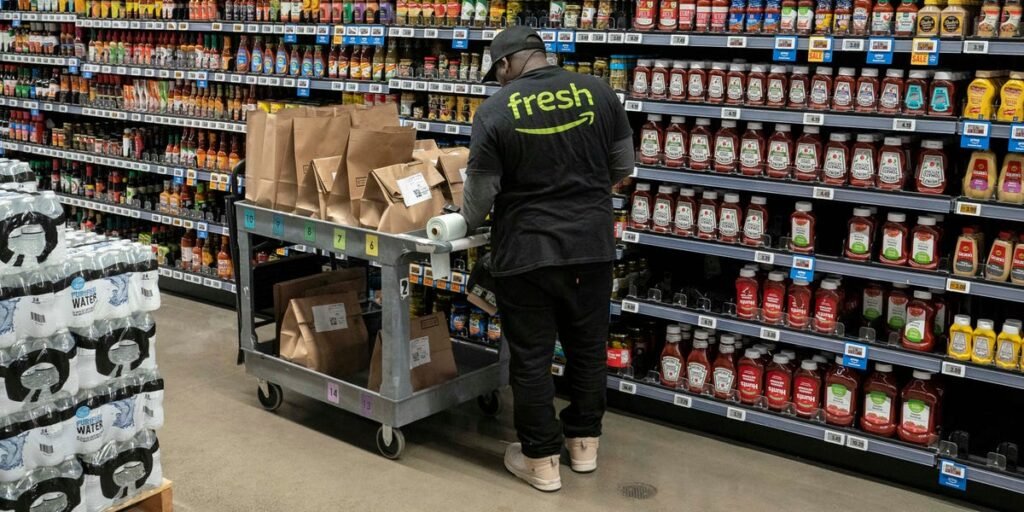
At an Amazon Fresh store in New York, some customers would walk in and ask employees: Do you have products from Amazon’s other grocery store here?
“I would run into people looking for a specific product from Whole Foods,” one employee at the store told Business Insider.
Amazon opened Fresh in 2020 after acquiring Whole Foods in 2017. Some assumed that Amazon Fresh would offer their favorite organic yogurt or premium meat because of the shared ownership. While Fresh stores did stock some Whole Foods 365 products, store employees said, Amazon sought to offer more affordable groceries and showcase its technology, such as Just Walk Out and smart shopping carts, at Amazon Fresh.
On Tuesday, the technology and retail giant said it would close its roughly 60 Fresh stores in the US. Meanwhile, Amazon plans to expand Whole Foods and its grocery delivery services as it tries to compete with grocery stores like Walmart and its Supercenters.
For Amazon, grocery represents an industry the company has yet to crack in the same way it did with books or cloud computing. Market-research firm Numerator estimates that Walmart controlled about 21% of the US grocery market, across online and in-store sales, as of September. Amazon and Whole Foods each held roughly 1.6%. An Amazon spokesperson told Business Insider on Friday that Numerator’s figures “underrepresent” the company’s grocery share.
The Fresh store closures also mark the latest setback in Amazon’s efforts to expand its physical retail presence. Since opening its first brick-and-mortar bookstore in 2015, the company has tested a range of formats, including cashierless Amazon Go stores and 4-Star shops featuring curated merchandise. It has since shuttered all of those concepts.
Once Amazon Fresh closes, Whole Foods will be the company’s sole remaining physical retail brand.
Massage chairs and infinite coupons
While Amazon acquired Whole Foods’ reputation for quality standards and affluent, liberal-leaning shoppers when it bought the brand, it had to establish Amazon Fresh from scratch.
It offered more affordable groceries and items that Whole Foods doesn’t sell, such as sugary sodas. Amazon also touted Fresh stores for their tech, such as the Just Walk Out checkout system and smart shopping carts.
Amazon said in Tuesday’s statement that it never quite found “a truly distinctive customer experience with the right economic model needed for large-scale expansion” in the grocery industry.
Amazon Fresh tried a variety of promotions to draw customers into its stores. Store employees who spoke to Business Insider said some were more successful than others.
One store in Southern California set up free massage chairs for customers next to the produce section and had carnival-style games for kids as part of a daylong event a few months after opening, an employee said, adding that the attractions helped boost foot traffic.
Many stores gave customers who returned an Amazon order at a Fresh store $10 off if they spent at least $40 there. Staff said some shoppers overused the offer. At the Southern California store, a QR code leading to the coupon was often left out at the customer service desk, creating a standing discount for shoppers who noticed it, according to the employee.
“You wouldn’t even have to return anything,” the employee said. “They’d just scan it, and they’d use that every time they bought their groceries.”
Amazon does not separately disclose sales for Whole Foods or Fresh. Instead, it reports revenue for its “physical stores” segment, which is largely made up of Whole Foods and has grown roughly 5% to 8% in recent quarters. That business generated $5.6 billion in revenue in the third quarter.
Amazon Fresh was never famous for anything, employees said
A more structural problem may have been what Amazon decided to carry in its stores.
Besides food, early versions of Amazon Fresh stores also included tech products, home goods, and other items Amazon sold online.
At the New York store, employees often had to throw away ready-to-eat foods from a hot bar, such as mac and cheese, after they sat largely untouched, an employee who worked there said.
The store also tended to be overstocked on health and beauty products, such as hair dye, this employee said.
“Just For Men is not really a hot seller at an Amazon food store,” she said. “But we still have two cases of it in the back.”
The eclectic offerings at Fresh stores left many customers without a clear reason to return, said Phil Lempert, a food industry analyst and editor of the website SupermarketGuru.
“They tried everything, and I think that that was, frankly, the downfall,” Lempert said.
That strategy differed from grocery chains like Wegman’s, Publix, or Whole Foods, which have established themselves for specific offerings, such as organic food or pub subs. “These retailers are curating the offerings,” he said.
By narrowing its focus to Whole Foods, Amazon is now aiming for a more niche grocery proposition, said one of its corporate employees. The Fresh stores lacked a clear draw for shoppers, the person said, while chains such as Whole Foods, Trader Joe’s, and Costco offer distinct reason for customers to visit.
Amazon is also seeking to appeal to more mainstream grocery shoppers by expanding pickup options for everyday staples, such as Coca-Cola and Doritos, at select Whole Foods locations, according to another employee, who had direct knowledge of the strategy. One upgraded Whole Foods store in suburban Philadelphia, announced last year, now fulfills Amazon orders from a dedicated area in the back of the store.
Slow adoption of in-store tech
Amazon’s in-store technology, which the company promoted as one of Fresh’s major advantages over rivals, got a lukewarm reception from many patrons, several store employees said.
One who worked at another Southern California store said in-person customers tended to bypass Amazon’s Just Walk Out technology in favor of traditional or self-service checkout, he said. Amazon pulled the tech from Fresh stores in 2024.
Amazon then focused on Dash Carts, smart shopping carts, to speed checkout. An employee at a store in New Jersey said store managers never showed him or his colleagues how to use the Dash Carts — a problem when customers asked how they worked. Amazon told Business Insider that it trained some employees specifically for assisting customers, including instruction on using the Dash Carts.
Last year, Amazon put on hold plans to sell its Dash Carts to other retailers, according to people familiar with the matter. The company recently said the Dash Carts would expand to dozens of Whole Foods locations.
Tension between Whole Foods and Fresh
Amazon’s $13.7 billion acquisition of Whole Foods was intended to accelerate a push into physical retail. Integrating the grocer into Amazon’s broader ecosystem has proved challenging, however, according to current and former employees at both companies.
An update to the Whole Foods app that surfaced Prime discounts confused some customers, workers said. Amazon also became more involved in Whole Foods’ day-to-day operations, pressing for more prominent Prime messaging throughout stores. That friction contributed to delays in rolling out Amazon’s cashierless technology at Whole Foods locations, Business Insider previously reported.
Last year, Amazon put Whole Foods Chief Executive Jason Buechel in charge of the entire Fresh grocery operation.
Buechel has sought to ease the strain. Over the past year, he has worked to bring the businesses together under a “One Grocery” initiative, and Amazon began migrating Whole Foods employees onto Amazon’s internal systems last year, Business Insider previously reported.
One of the SoCal workers said he had a sense that a big change might be coming.
Last fall, he said, a manager informed him that his role picking items from store shelves for online orders was being eliminated. The store, he said, was rarely busy, including at peak shopping times, such as after work or on weekends.
He got a job doing the same kind of work at one of Amazon’s nearby grocery fulfillment warehouses, an area the company is doubling down on.
“That’s where the future is,” the worker said.
Have a tip? Contact these reporters, abitter@businessinsider.com or via encrypted messaging app Signal at 808-854-4501, and ekim@businessinsider.com or Signal, Telegram, or WhatsApp at 650-942-3061. Use a personal email address, a nonwork WiFi network, and a nonwork device; here’s our guide to sharing information securely.