


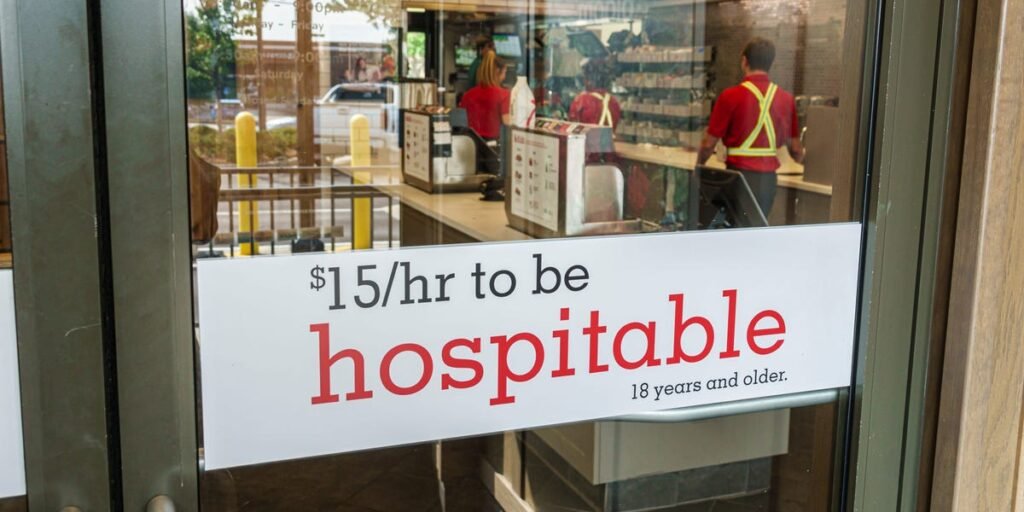
For workers in 19 states, New Year’s won’t just mean festivities and futile resolutions — they’ll also be getting paid more as minimum wage increases kick in. For some, those raises will be historic: In six states, the minimum wage will reach at least $15 an hour for the first time.
The 19 states hiking wages will impact over 8 million workers, an analysis from the Economic Policy Institute, a left-leaning think tank, found. Women, Black, and Hispanic workers are set to be disproportionately affected by the new increases, per EPI’s analysis, and workers in states like Missouri and Nebraska will see their annual wages increase by nearly $1,000 on average.
The map below shows which states are set for a raise in January, and what those increases will be. Most January increases are due to inflation adjustments, although some are tied to legislation or ballot measures, such as in Rhode Island, where legislation set a gradual increase from $15 in 2025 to $17 by 2027. The minimum wage there will reach $16 on January 1, 2026. A few states will hike their minimum wage later this year; Florida will increase its minimum by a dollar to $15 at the end of September.
The new round of raises will hit an “important milestone for the minimum wage movement,” according to EPI’s Sebastian Martinez Hickey.
“What’s really distinctive is that for the first time this January, there are going to be more workers that live in a state with at least a $15 minimum wage compared to those that live in a state with the federal minimum wage, which is still $7.25,” Hickey said.
However, the fresh round of statewide increases means an even greater discrepancy in some local wages and the federal minimum wage. The majority of states have stepped in to increase their pay beyond the federal minimum, although 20 states still either mandate $7.25 or default to the federal line.
Yannet Lathrop, a senior researcher and policy analyst at the National Employment Law Project, said that while the new spate of $15 minimum wages will likely be a boon for many — and reflects a long history of organizing — workers will still contend with affordability concerns.
“Even these wages, as good as they are, as positive as they are for workers, none of them are going to fully cover the cost of living for even single workers without families in any state or locality,” Lathrop said. “These workers are still going to be facing a crisis of affordability. It’s just that in some places where minimum wages are going up much more, the pain of that gap between what the cost of living is and what the minimum wage is going to be a little bit better for workers.”
As states opt to hike pay on their own, a federal minimum increase still looks unlikely. Democrats failed to garner any Republican support for an effort to raise the minimum wage to $15 during President Joe Biden’s term. President Donald Trump had previously opened the door to raising the wage beyond $7.25, but there has been no legislative movement toward making that a reality.
Are you set to be affected by a minimum wage increase, or currently make the minimum wage? Contact these reporters at jkaplan@businessinsider.com and mhoff@businessinsider.com.