


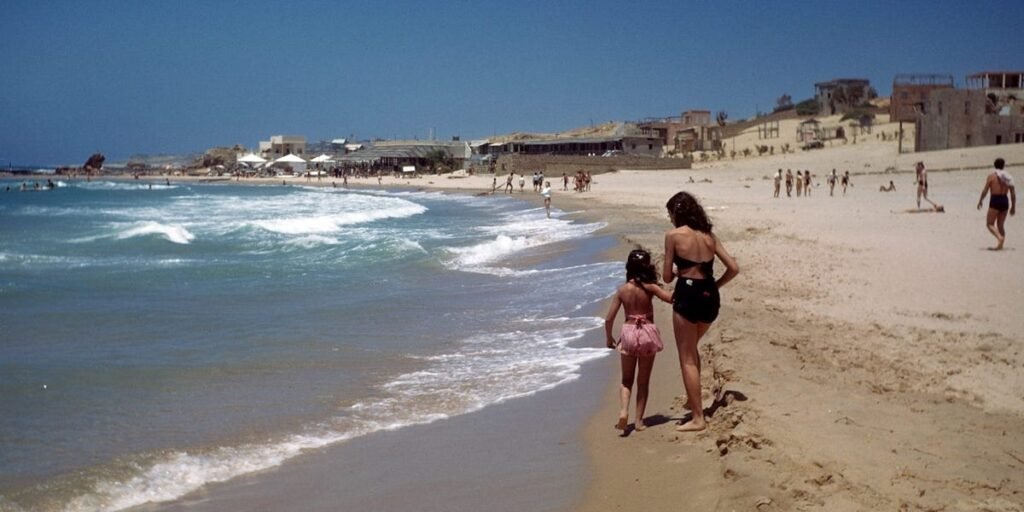
Beirut has been inhabited for over 5,000 years, making it one of the oldest cities on the planet. And, much like any other ancient city, it has been shaped by years of trade, complex domestic and foreign conflicts, and colonialism.
But one of the city’s highest points came following World War II, after Lebanon gained independence from France in 1943. Celebrating newfound freedom, combined with French metropolitan influences, a temperate climate, and access to the Mediterranean Sea, Beirut became a popular tourist destination and a prosperous city, earning it the nickname “Paris of the Middle East.”
Stars like Elizabeth Taylor, Marlon Brando, Brigitte Bardot, and Peter O’Toole on breaks from filming “Lawrence of Arabia” were spotted there, and luxury hotels and clubs dotted its beaches.
However, not everyone was living like an A-list movie star during this period. Economic disparity persisted, and conflicts were brewing that would lead to one of the bloodiest periods in the city’s long history.
When the Lebanese Civil War broke out in 1975, this “Golden Age” came to an end. Almost 1 million people fled the country, and over 150,000 people were killed, per the Middle East Research and Information Project.
The Civil War ended 15 years later, in 1990, though unrest and violence continue in Lebanon to this day. For decades, the country has been drawn into repeated conflicts with Israel, with which it shares a border, and new fighting between Israel and Hezbollah, the Iran-backed Shiite Islamist group based in Lebanon, started in 2023. This conflict has complicated efforts to end the wider war involving the US, Iran, and Israel.
Here’s what Beirut looked like during one of its most prosperous periods.
When Lebanon achieved independence from France in 1943, it signaled a new era for Beirut, its capital.


AFP/Getty Images
Beirut has been inhabited for 5,000 years, but the mid-20th century was a prosperous time for the city.

Michael Ochs Archives/Getty Images
Beirut International Airport opened in 1954, bringing the city more visitors than ever before.

Michael Anton/iStock
Its unique location meant locals and visitors could drive up the Lebanon Mountains in the morning …

Michael Ochs Archives/Getty Images
… and make it back to the Mediterranean Sea in the afternoon.
Michael Ochs Archives/Getty Images
Tourism was a significant part of Lebanon’s economy. In the two decades before the Civil War, it made up 20% of the country’s GDP.

AFP/Getty Images
This photo, showcasing the nightlife of 1955 Beirut, resembles the lights of Las Vegas.

Express/Getty Images
A photo taken in 1965 shows the Acapulco Beach Club, one of the city’s ritziest resorts. It also had a lively nightclub.

Keystone Features/Getty Images
French-inspired design was prominent. This road, Hamra Street, was compared to Paris’ Champs-Élysées.
Gazioch/ullstein bild/Getty Images
Another photo, taken in 1973, shows a well-stocked flower shop, street vendors selling their wares, and other businesses.

Jean-Pierre PREVEL/AFP/Getty Images
The other draw of Beirut, of course, was its proximity to the Mediterranean.
Michael Ochs Archives/Getty Images
The beaches were filled with sunbathers.
Michael Ochs Archives/Getty Images
One of the most famous seaside resorts was the Hotel St. Georges. It was built by a French investment group and opened in the 1930s. It closed in 1975 due to the civil war.
Nik Wheeler/Sygma/Getty Images
It resembled an oasis.
Michael Ochs Archives/Getty Images
When the civil war broke out in 1975, tourism steadily declined. The US lists Lebanon as a Level 4 travel advisory, which means “Do not travel.”
Michael Ochs Archives/Getty Images
These photos preserve a glimpse of the Beirut that helped inspire its moniker as the “Paris of the Middle East,” a glamorous chapter in a longer, more complicated history.

ullstein bild Dtl./ullstein bild/Getty Images