


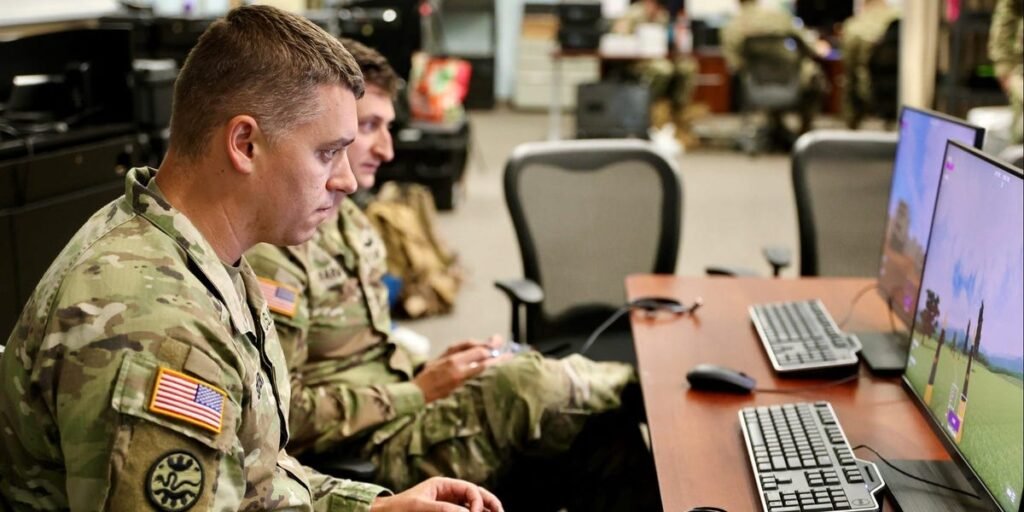
The US Army’s attempt to catch up on drone warfare is teaching soldiers what it feels like to be hunted.
The Unmanned Advanced Lethality Course is designed to help the US Army close gaps exposed by conflicts like Ukraine, where cheap, small drones have been reshaping how soldiers fight and survive, by teaching students how to operate small drones and understand how lethal they can be.
But it’s not just the practical skills of piloting a drone that US troops need.
Wolfgang Schwan/Anadolu via Getty Images
Maj. Rachel Martin, the course director, told Business Insider that instructors deliberately use drones against students so they understand just “what it’s like to be hunted by another operator from an adversary force: what it sounds like, what it feels like, how often they need to displace in order to survive or not be observed.”
That matters because “the minute you’re observed, you need to move,” she said. “What follows that is usually fires of some capacity,” such as artillery.

Every time Sinéad publishes a story, you’ll get an alert straight to your inbox!
Stay connected to Sinéad and get more of their work as it publishes.
The aim, she continued, is to simulate an enemy force actively searching for them and to test their reactions “so they get used to one being hunted by the enemy.”
Ukraine and other recent conflicts have shown the Army how inexpensive drones can be turned into effective weapons capable of destroying systems worth millions of dollars and how vulnerable forces can be without that experience, Martin said.
Preparing for that kind of war requires a mindset shift for US troops long used to controlling the air and less accustomed to looking up. In a future fight, that advantage may not exist, meaning anything overhead has to be treated as a potential threat.
“That is something we need to teach and ingrain in every soldier,” Martin said.
And there’s little time for soldiers to think through whether something is friend or foe, she said. By the time you hear the sound, it may already be coming for you.
A new psychological terror
Carl Larson, a US veteran of the war in Iraq who had fought in Ukraine, said at a drone conference last year that the mass of drones on the battlefield is “incredibly corrosive to your ability to conduct combat operations.” He said they hurt morale and hinder the ability to move around.
Paula Bronstein /Getty Images
He said that many of the drones are “damn near undetectable,” explaining that “they come in hot at over a hundred miles an hour,” which leaves soldiers feeling vulnerable at all times. It’s exhausting for troops to be constantly on edge.
Martin shared that she had been personally targeted by one-way drones in Iraq and said “the psychological aspect of it is real.”
If Ukraine is anything to go by, future fights may be on another level, and experts say the US military needs to be prepared.
“Psychologically speaking, this is not what the US military is used to because the US military is used to controlling the air,” Samuel Bendett, a drone expert with the Center for Naval Analyses, told Business Insider. In Ukraine, drones “roam that airspace and present just absolutely a horrendous threat to the forces below.” Kyiv’s forces have been adapting to that for over three years.
“You need to train for the situations where you are going to be stressed all the time. You are going to be looking up all the time. You won’t be able to relax normally,” he said, predicting that soldiers will be on alert for the sound of quadcopter drones, “which is the new nightmare fuel.”
Preparing for a sky full of drones
Ukrainian soldiers have described skies so crowded with drones that they’re unable to figure out which side they belong to, sometimes leading to orders to engage any drone they see.
Kostiantyn Liberov/Libkos/Getty Images
That saturation makes it difficult to stay safe, even far from the front lines. Soldiers resort to tactics like building fake positions and digging deeper trenches to avoid detection. It also slows advances and complicates evacuating wounded troops.
Martin said that a key lesson they are imparting to students as a result is that “we can’t be a static army.”
In this kind of environment, “mobility is survivability. So we’re trying to teach that concept that you may be in the observation post for a few minutes and then you’re going to have to move, either to survive or to get a better picture of what’s happening forward of you.”
It means feeding back to the rest of the Army that “they can’t stay in the same place for very long.”
Plans for the future of the training course, which held its inaugural three-week session in August, include introducing more advanced tactics and complex scenarios. The Army also hopes graduates will return to their units as trainers themselves, with Fort Rucker serving as a hub for advanced instruction and a model that units can adapt into their own qualification programs.