


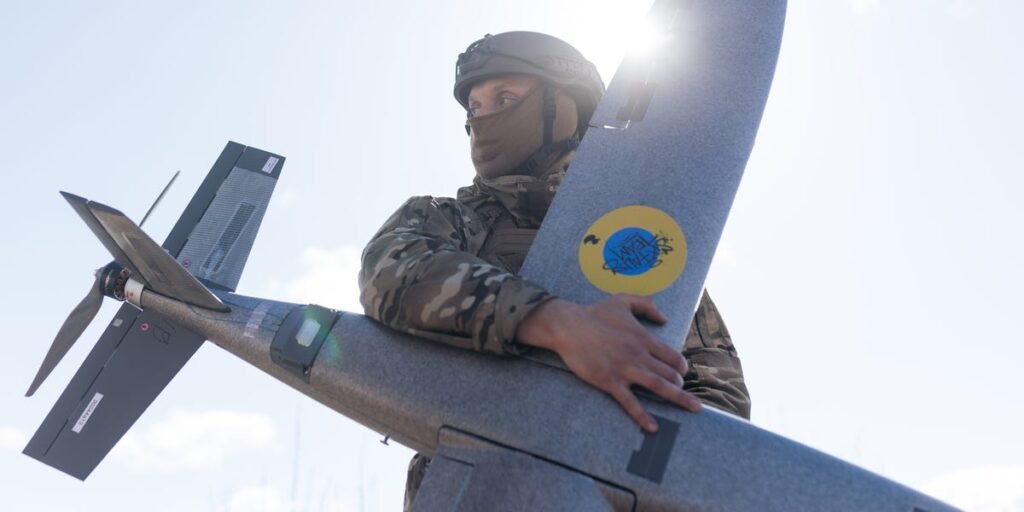
Ukrainian weapons makers say they have a selling point many defense firms farther from the battlefield can’t match: Their weapons are being tested, adapted, and used in modern combat every day.
Serhiy Goncharov, the CEO of the National Association of Ukrainian Defense Industries, or NAUDI, which represents roughly 100 companies, told Business Insider that the defense industry is receiving interest “because of the battle experience” and because “for us it’s simple to explain to the military customer how it works compared to, for example, some European countries,” where companies might be limited to selling test flights, trials, or computer simulations.
Ukraine’s defense industry has boomed since Russia launched its full-scale invasion in 2022, creating countless new wartime weapons makers that are trying to turn battlefield experience into a competitive edge.
Because Ukrainian-made weapons are used in combat, Goncharov said, Ukrainian makers can also offer expertise in training and maintenance, insight into “the actual battle experience,” and advice on “how it actually should work against your enemy.”
“This experience is priceless,” he said. It is a pitch increasingly echoed by Ukrainian firms seeking closer ties with Western militaries and industry.
AP Photo/Evgeniy Maloletka
Many US and European companies offer combat-tested systems, have decades more experience and deeper industrial capacity than Ukrainian firms, and make the kind of high-end weapons that Ukraine still needs. And some Western systems are also being used in Ukraine, giving them their own battlefield record.
But in some fast-changing areas of modern war, especially drones, counter-drone systems, and other weapons that can be rapidly adapted, Ukrainian firms say proximity to the battlefield gives them an advantage, especially over companies that are trying to sell capabilities solely based on tests and simulations.
Mykyta Rozhkov, the chief business development officer at Frontline Robotics, a Ukrainian drone and weapons maker, told Business Insider Ukrainian companies have an “unfair advantage.”
“We have a war, unfortunately,” he said, but the proximity to the fighting gives the local defense industry chances to adapt and test far more effectively than any companies not working there. “It means that we have direct contact with the military that is using our systems 10 times per day, and we don’t even have to ask them for the feedback. It goes directly 24/7 into our inbox.”
Mykhaylo Palinchak/SOPA Images/LightRocket via Getty Images
He said that partner nations should “integrate these ready-made Ukrainian solutions” into their defenses. He described Ukraine right now as “the most experienced, sophisticated, technologically prepared army in Europe” and encouraged allies to integrate its tech, through approved means like joint ventures, “in order to train and prepare your defense industry to be as capable as possible.”
Stanislav Hryshyn, the cofounder of Ukrainian drone maker General Cherry, said Western partners are “very interested in Ukrainian defense tech, as our experience and expertise are pretty valuable for them.” Western officials have said Ukrainian expertise and battlefield innovations are key to future defense aims.
The demand is seen particularly in drone warfare, where Ukraine has more combat experience than its Western partners.
Interest in Ukrainian interceptor drones, for instance, grew as Iranian-designed Shaheds became a major threat in the Middle East. Ukrainian counter-drone technology and drone experts have been active in the region, giving Ukrainian firms another combat example to cite. Other companies are developing similar systems, but Ukrainian arms makers can point to their unusually heavy battlefield use as a prime selling point. The weapons aren’t theoretical but proven in practice.
Ihor Fedirko, the CEO of the Ukrainian Council of Defence Industry, another industrial body representing over 100 companies, told Business Insider that the success of Ukrainian counter-drone systems in the Middle East was a testament to the readiness and capabilities of Ukrainian systems and defense companies.
Given its advantages, Ukraine is moving to export drones, which its industry says would help fund expanded production for its own military. NATO allies and Western firms, meanwhile, are pursuing partnerships with Ukrainian companies to tap their battlefield-tested tech and pair that experience with Western industrial processes, scale, and safer production farther from the war.
Croatian drone and equipment maker ORQA, for example, is teaming up to make components with General Cherry. ORQA cofounder and CEO Srdjan Kovacevic told Business Insider that “the operational excellence that Ukrainian defense forces have developed is unparalleled in the Western world,” and its industry has more experience producing huge volumes of drones to meet demand. That, combined with Western technological expertise, is a key combination, he said.
Ukrainian President Volodymyr Zelenskyy said last month that Ukraine’s security experience and its military expertise “are now the most sought-after products for dozens of countries worldwide.”
And industry sees the potential. Rozhkov, the Frontline Robotics exec, said: “We see ourselves not in the future, not in isolation, but as a part of the European defense sector.”