


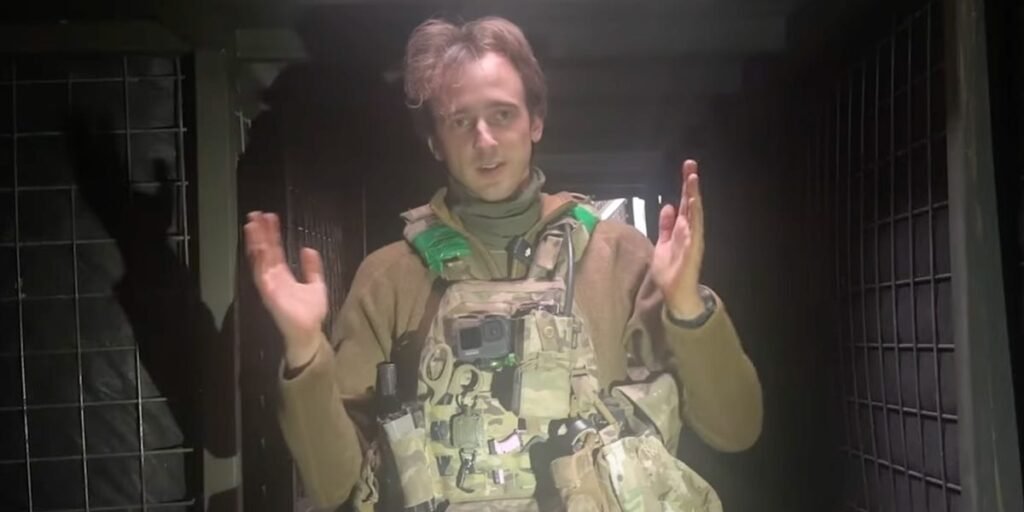
A Ukrainian soldier, until recently a drone operator, shared a video earlier this month walking viewers through the gear he carried with him into battle against the Russians.
It featured an interesting mix of stuff, from drone detectors to weaponry to what he characterized as “tactical Crocs.”
Dimko Zhluktenko, now an analyst with Ukraine’s Unmanned Systems Forces, spoke to Business Insider about the items that he considers key to staying alive, comfortable, and as effective as possible against Russia. He still carries a lot of the gear with him, even though his role has changed.
He picks his gear with great care, emphasizing that much of what he carries was his choice, not government-issued.
“The stuff that the government issues sometimes is good, but it’s not the best fit.” He said the military largely trusts soldiers to choose what works best for them.
Zhluktenko, who worked in tech before the war, said his gear comes from a mix of state funding, items he bought himself, and crowdfunding. He tries to keep what he carries on his person to around 10 kilograms, calling it “a comfortable amount of gear that is still extremely useful,” though he can carry more when needed.
Dimko Zhluktenko
Basic gear for countering advanced technology
This war has seen low-tech solutions fielded against cutting-edge weapons, such as wire mesh and cages used to stop advanced drones, or wooden decoy tanks designed to fool expensive munitions.
As a drone operator, Zhluktenko carried a pair of scissors to sever the cables of fiber-optic drones that now litter the battlefield as these jamming-resistant drones become increasingly prevalent.
Cutting the cables “became a part of our standard operating procedure” in areas saturated with fiber-optic drones, he said. Units are sometimes instructed to cut “each and every” cable they see, just in case.
Viktor Fridshon/Global Images Ukraine via Getty Images
Zhluktenko said that they don’t even worry about friend or foe concerns. Similar responses have been seen with the radio-frequency drones, with soldiers panic-jamming everything regardless of who the systems belong to.
Zhluktenko said that he bought retractors for all his team so they wouldn’t lose their scissors.
He carried an issued firearm — an old Soviet-designed weapon — which is good enough for his role because he doesn’t operate in areas with much direct fighting.
He said it is “much older than I am,” but noted that he modified it and “it’s not too bad.” He replaced some internal components and the handguard, adding one from Ukrainian manufacturer Kpyk to improve grip. He said its primary use is targeting drones that can’t be stopped in other ways. Gunfights are not the norm in this war.
Dimko Zhluktenko
He also carried extra magazines and a pouch for empty ones.
To improve dexterity, he wore silicone-grip gloves from the American company Mechanix Wear, which make it easier to operate drone controllers. The grip provides “extra sensitivity” for precise movements and prevents slipping.
He carried a mechanical compass because Russia’s electromagnetic warfare throws off the ones in his iPhone and Garmin.
And Zhluktenko also had sunglasses, since spotting his own drone in a crowded sky is critical and the “sun is a big factor.”
Staying comfortable
Zhluktenko had a pair of shoes he brought with him that resemble the American-designed footwear Crocs, but his are made by a Ukrainian company, M-Tac. He said they are “absolutely essential” because it’s impossible to wear combat boots all the time.
He called them “tactical Crocs,” explaining that he only breaks them out in moments when the threat is low.
When it was time to get to work, he would wear combat boots made by the German company Lowa. He said he had been using these boots for around four years, along with orthopedic insoles. He said that he can wear them all day without pain.
Dimko Zhluktenko
He also carried hand sanitizer — “you probably remember those from COVID era, but I still use them at war,” he said, — a multitool that includes a knife and spoon to eat with, and a cap to protect him “from excessive sun” in the field.
Technology for a tech-driven fight
Zhluktenko said he carried a drone detector, an electronic system that scans radio frequencies to detect incoming drones. He said it can alert him if a drone is flying toward him and sometimes show the video feed from the enemy drone, revealing what it is seeing.
Dimko Zhluktenko
Ukraine has bigger systems in place to try to warn soldiers of incoming drones, but they can sometimes miss one. Even if they don’t get a warning from command posts, “there might be just some random FPV drone that just flew in and might damage us.” He explained that these drone detectors are “becoming more and more essential” and are needed “ASAP.”
He also carried a Motorola radio, a “basic” one where he can talk with his brothers in arms, and night vision goggles that he uses for nighttime drone launches and landings.
He put a GoPro on his chest so he can rewatch his actions for improvements, almost like sports teams do with replays.
Zhluktenko also has a Ukrainian-made MITLA anti-drone gun, which shoots nets to stop drones flying toward him by snagging their propellers. He said he got his recently and has never had to use it. It’s a single-use product that was released this year.
And he carried electrical tape “because there is always something that you could fix” when it comes to his technology and other gear.
Staying alive
Zhluktenko said that his body armor is the “most important” piece of gear that he carries, regardless of his role. He bought and selected it himself.
“I didn’t use whatever the government gave to me,” he said. “It wasn’t bad, but it wasn’t a good fit.”
He chose a system that allows for extensive customization. He uses armor from M-Tac and added components such as a weight-distribution system from the Ukrainian company Balistyka, which attaches to the vest and gives him “the flexibility to move around much better.” Most of the injuries in battle come from shrapnel, so he wanted to protect as much of his body as possible without limiting his ability to move quickly.
He customized his armor with additional panels to protect areas like his stomach, spine, ribs, and hips, areas where a tourniquet can’t easily be applied. He shared that many soldiers use neck protection, but he found it didn’t offer enough freedom of movement.
He also wears glasses with ballistic protection to shield against shrapnel.
He uses a “very lightweight” helmet from Team Wendy, which supports his night-vision goggles. He said weight is important to him so that it doesn’t strain his neck.
Dimko Zhluktenko
He also carries tourniquets and bandages. The first, on a battlefield where medical evacuation and trauma care are likely not readily available, is crucial for staying alive. He said these tools — he carried four on his person at the time of filming — are among his “most important stuff.”
A few extra items in the kit
Zhluktenko carried a “proper knife” that he said is old and getting “a bit rusty” but still works well enough, along with a multitool that includes features like a small saw. A follower on X sent it to him. He also uses a carabiner to carry extra gear.
He carried zipties and padlocks so his unit could take over and secure vacant positions. Many positions have doors, and they would lock them and write on the door which unit took it, along with their call sign and phone number.
He also carried a flashlight with red and white modes made by a friend’s company, Syaivo, which gives them to Ukrainian soldiers for free. He also had two other flashlights that he could put on his helmet and armor.