


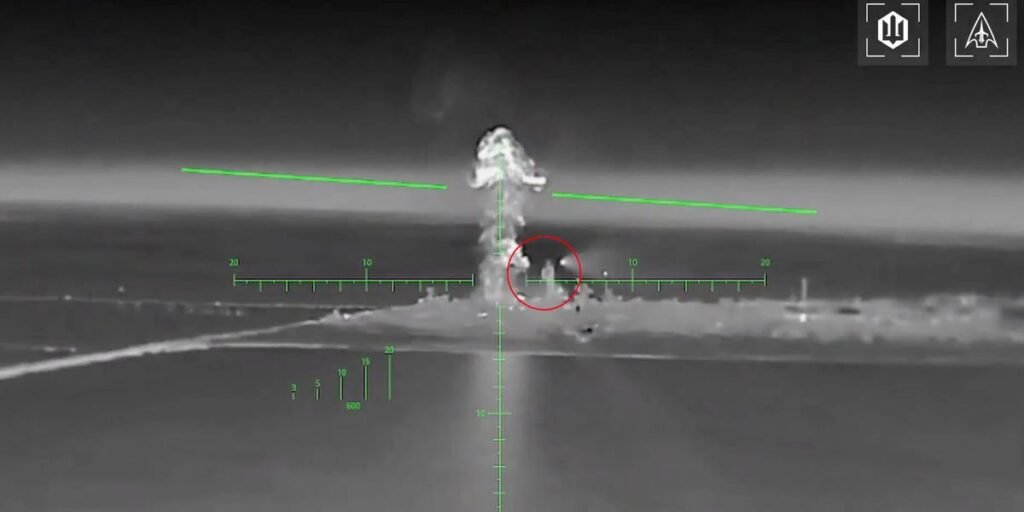
Ukraine has been fitting long-range attack drones with cheap unguided rockets, using them in the Russian rear to bombard strategic assets and suppress air defenses.
The Unmanned Systems Forces, or USF, said on Monday that units had equipped fixed-wing exploding drones with up to eight rockets each.
The military branch posted several drone-camera clips that appear to show pairs of rockets flying toward ground targets in quick succession, indicating that the eight munitions were split into two pods, with one under each wing.
According to the video, at least one of these attacks was carried out on Sunday by the USF’s 1st Separate Center against a naval installation belonging to Russia’s Black Sea Fleet in Crimea.
The drone-mounted rockets were also used to harass air defense crews over fields and forests in the Russian rear area, per the video.
“The task is set — zero out these machine gunners and MANPADS crews,” read a caption on the montage, referring to Man-Portable Air-Defense Systems, which are typically shoulder-mounted missile launchers.
“From now on, UAVs will be equipped with rocket pods for engaging different types of targets,” the USF added, using a term frequently said by Ukrainians to describe Russian soldiers.
The 414 Magyar’s Birds, a drone unit founded by the commander of the USF, Robert Brovdi, said some of the rocket strikes were launched at “operational depth up to 500 km,” or 310 miles.
That’s about the distance between Ukraine’s border and Moscow.
The Ukrainians said that, besides the rocket strikes, they still deployed the drone’s original 132-pound explosive warhead.
Doubling up on attack missions
Fitting unguided rockets to long-range drones gives Kyiv’s forces an expendable way to deploy them deep in enemy territory, without risking attack helicopters or strike aircraft that have traditionally launched the munitions.
These rockets also provide a more cost-effective way of fighting at such a range. Simpler unguided rockets, such as the Ukrainian or Russian S-8, can cost a few thousand dollars each.
A more expensive fixed-wing drone, typically priced in the tens of thousands, could use the cheaper rockets to attack secondary threats while reserving its more powerful warhead for a primary, valuable target.
The tactic could also benefit the drone’s original mission. As the montage suggests, the rockets might suppress or destroy Russian air defenses seeking to disrupt the drone mid-flight.
Ukraine has launched hundreds of long-range drones at Russia, but many are brought down by a layered network of surface-to-air missile systems, electronic warfare, and gun crews.
Magyar’s Birds and USF didn’t name the exact drone model used, but published a clip of a drone shaped like a small airplane firing rockets from its wings. The video emerged last week among open-source intelligence social media accounts, which said the drone was attacking a Russian mobile air defense unit in Crimea.
Business Insider could not independently verify when or where the clip was filmed.
The drone’s design closely resembles that of the FP-1 or FP-2, made by local manufacturer Fire Point. They were built to fly nearly 1,000 miles with a 132-pound warhead. Each is reported to cost about $50,000 to $55,000.
Serhii Okunev / AFP via Getty Images
Magyar’s Birds and the 1st Separate Center did not immediately respond to requests for comment sent outside regular business hours by Business Insider.
Russia, too, has deployed missiles and rockets on its long-range drones before. In December, Ukraine’s intelligence agency said the Kremlin had been firing R60 air-to-air missiles from its Shahed-type drones.
The agency said the R60s were used against Ukrainian helicopters and aircraft trying to destroy the delta-wing drones.