



Features writer
Connor Sephton


Features writer


Share


Fact Checked by
Elena Bozhkova

Features Lead


Coinbase’s battle with advertising regulators in the UK has just intensified.
The exchange’s big-budget, two-minute commercial — first released last summer — has been banned from YouTube and streaming services.
If you haven’t seen the Coinbase advert before, it’s quite a watch. It depicts Britain as dirty, rat-infested and damp — a place where prices are out of control and jobs are difficult to come by.
Workers sing “everything is fine” as they’re showered with excrement in the streets, while a posh couple in a convertible declare they’re off to Dubai.
The Coinbase advert has attracted millions of views online, but now, the Advertising Standards Authority has ruled it was irresponsible after 35 complaints were made.

The main concern was that the Coinbase advert positioned cryptocurrencies as a solution for those suffering from financial difficulties — and didn’t make it clear that digital assets can be a risky investment.
“By presenting the country as failing in areas such as the cost of living and home ownership, the ads implied to consumers that they should make a financial change … We considered this had the effect of positioning Coinbase as an alternative to traditional financial systems.”
Bitcoin wasn’t mentioned once in the commercial. In fact, there wasn’t any small print at all. The only text shown said: “If everything’s fine, don’t change anything.” Regulators added:
“We considered that using humour to reference serious financial concerns, alongside a cue to ‘change’, risked presenting complex, high-risk financial products as an easy or obvious response to those concerns.”
Although the Coinbase advert was designed to be an entertaining watch, it was trying to make a serious point. A sharp jump in inflation since the coronavirus pandemic has caused the cost of groceries to soar — eroding the spending power of the British pound. One scene shows a till breaking because of the cost of fish fingers. Another depicts a man losing his white-collar job and beginning to work as a delivery driver.
The exchange, and others, position BTC as a compelling alternative, with a fixed supply that helps preserve wealth.
It wasn’t just the two-minute ad that’s been banned. Billboards that appeared at train stations and on the London Underground — which highlighted the housing crisis and slowing wage growth — also can’t appear again unless changes are made.

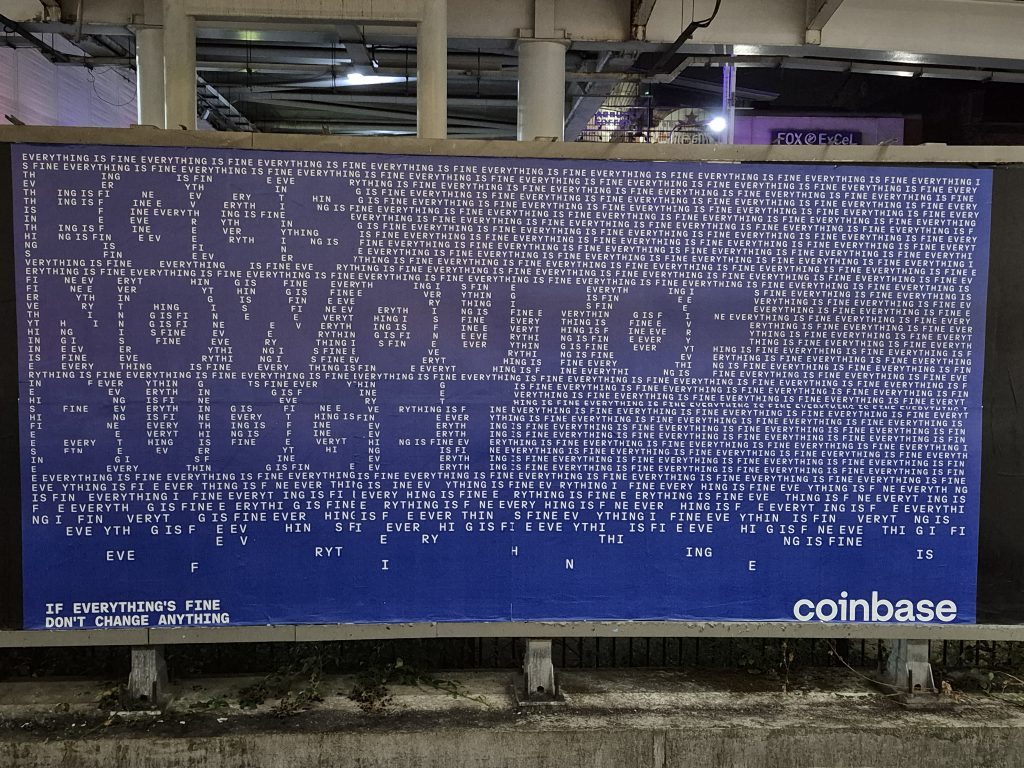
As you might expect, Coinbase strongly disagrees with the Advertising Standards Authority’s stance. It argued that consumers are more aware about digital assets than ever before, and Bitcoin shouldn’t be compared to gambling. The exchange added:
“Coinbase said the ads did not encourage socially irresponsible behaviour … They did not explicitly or implicitly suggest any specific solution to the highlighted problems. The main characters in the ad were depicted as being financially stable and not inherently vulnerable.”
Given one of the characters is shown falling through the ceiling while in a bath, with a coughing family suddenly plunged into darkness, it might be a bit of a stretch to say they were “financially stable.”
Nonetheless, the exchange was on safer ground as it explained the protections that exist for new users on its platform. Anyone opening an account in the UK needs to complete a short quiz to test their knowledge about digital assets, and also benefit from a 24-hour cooling-off period.
For Coinbase CEO Brian Armstrong, all of this amounts to censorship. In his eyes: “If you can’t say it, then there must be a kernel of truth in it.”
But given that the advert failed to include any small print about digital assets, you could argue that his exchange knew it would never be approved in the first place. And as history tells us, banned adverts tend to get a lot more attention from consumers anyway.
Coinbase will still be able to show “Everything Is Fine” on its social media platforms. The only distinction is that it can’t be used as an advertisement before YouTube videos or TV shows and films on streaming channels. If it wants to, the exchange could also make tweaks to ensure it complies with British advertising regulations.
In other words, from a publicity standpoint, this is something of a triumph for Coinbase. Why? Because it’s attracted far more attention than it would have done if its ad had been approved and shown on TV.