


Jorge Villalba/E+ via Getty Images
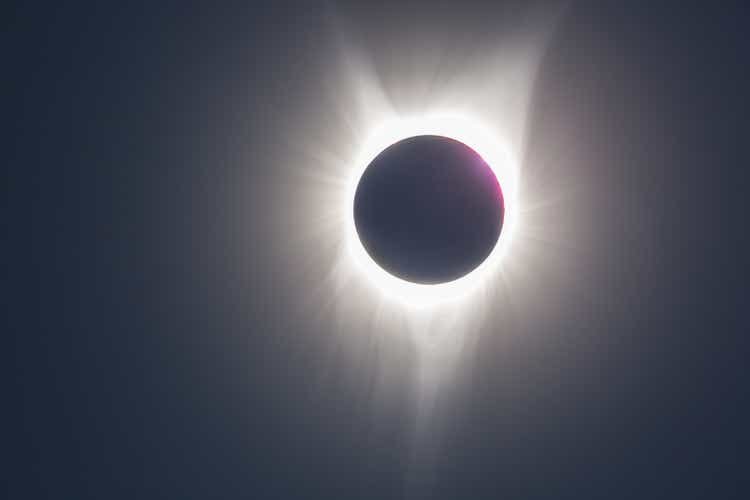
Grid operators across the U.S. say they have been preparing for months for Monday’s total solar eclipse, with plenty of time to ramp up alternative energy sources, even as more than 6.5 GW of domestic solar PV capacity will be totally obscured from sunlight, according to data from the Energy Information Administration.
NASA estimates the path of totality – when the sun is fully blocked by the moon – will affect installations from Texas to Maine and many states in between from roughly 1:30 pm CDT to 2:35 pm CDT in the U.S.
Texas will lose the most capacity of any state, with top grid operator ERCOT estimating solar generation will drop by as much as 92% at the peak of the eclipse, and to fall from more than 10 GW to ~1.3 GW for at least two hours.
Despite experiencing only 40%-59% partial sunlight reduction, California will be the state most severely affected by the eclipse, as “the state’s significant use of utility-scale and small-scale solar capacity makes the eclipse’s impact more significant,” the EIA said.
ERCOT and California’s CAISO have said they do not expect to face grid reliability issues from the eclipse.
Grid operator MISO, which operates in all or part of 15 states in the West, Midwest and the South, normally would garner 5,500 MW of solar capacity on a sunny day, and it has said the eclipse could cut that by 4,000 MW followed by a 3,000 MW rebound, but it does not anticipate reliability problems.
ISO New England, New York’s NYISO and PJM – which covers all or part of 13 states in the eastern and midwest U.S. – also expect to meet demand by other power resources that can come online quickly such as batteries, pumped storage or natural gas.
The EIA has said ~100 GW of distributed and utility-scale solar PV has been added to the U.S. grid since 2017, and ~15 GW of battery storage.
ETFs: (NYSEARCA:XLU), (TAN), (ICLN), (QCLN), (PBW), (PBD), (ACES), (CNRG), (ERTH), (SMOG)