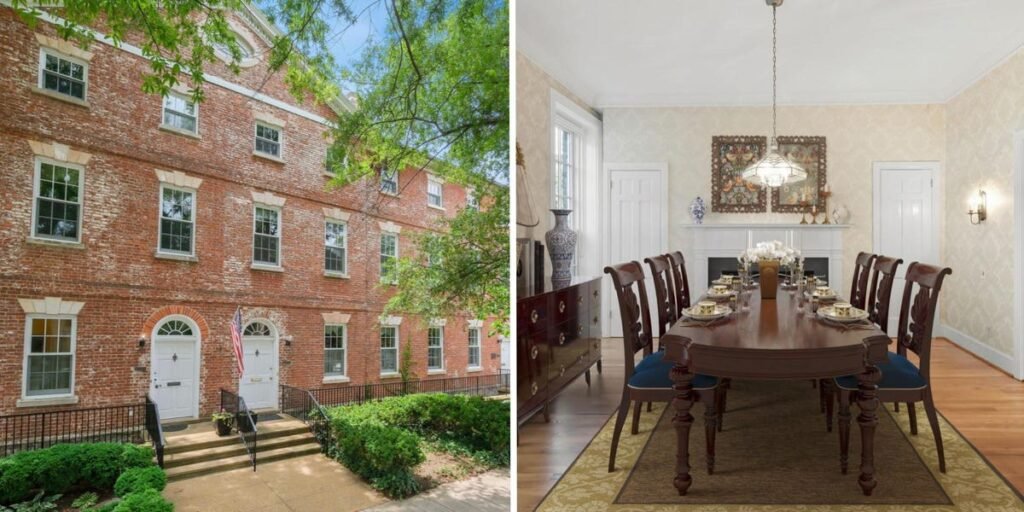
In 1794, there were just 15 states in the Union, Philadelphia was still the nation’s capital, and George Washington was leading armed forces through Pennsylvania to put down the Whiskey Rebellion.
That same year, a collection of rowhouses in Washington, DC, known as Wheat Row, was being constructed. They still stand today, and one of the homes is up for sale.
Located on 4th Street SW near Washington, DC’s Southwest waterfront, the home is listed for $1.15 million after a recent $150,000 price cut. The property blends historic character with updates designed for modern living, according to Eric Stewart, the home’s listing agent from Long & Foster Real Estate.
“It’s comfortable for contemporary living and enjoyment, but with the heart of classic colonialism,” Stewart told Business Insider.
The seller, a retired history professor, has an appreciation for the home’s past, according to Stewart. He added that the ideal buyer would carry this same appreciation.
“Everybody wants to be able to see something built in that era, but not everybody wants to live in a home from that age,” Stewart said.
The homes in Wheat Row are listed on the National Register of Historic Places and were among the first housing developments built in DC after it was chosen to become America’s capital city.
Today, the home is fitted with more modern amenities, sparing potential buyers the conditions the first residents endured before DC had a sewage system.
Take a look inside this historic Wheat Row home.
The homes on Wheat Row have had many different owners throughout their history.
Library of Congress
The Wheat Row homes were constructed by James Greenleaf starting in 1794. The Wheat Row name comes from an early 19th-century resident of one of the homes, John Wheat, a gardener and messenger for the US Senate.
The buildings later took on non-residential functions in the mid-20th century. In the 1940s and ’50s, the Barney Neighborhood House, a community service organization, occupied multiple Wheat Row homes, including the one for sale. Other units were used as a location for the US Service Men’s Club and a daycare, according to the National Register of Historic Places.
With their inclusion in the Harbour Square development project in the ’60s, the homes all reverted back to residences.
Today, the 3,408 square-foot home is defined by its high ceilings and hardwood floors.
Justin Callas/Arume, LLC
Though the four-floor home is narrow and compact, the 12-foot ceilings make for a spacious interior.
Hardwood floors cover nearly the entire house, including the stairs.
Handcrafted designs and other historic touches are seen throughout the house.
Justin Callas/Arume, LLC
The home has eye-catching millwork in nearly every room. According to Stewart, the home’s wooden moldings date back to the 19th century and possibly earlier.
This extensive woodworking was common in this era of homes, with moldings and trims produced by skilled artisans influenced by European styles, according to Pebbles & Thorns Woodworking.
Chandeliers and colonial light fixtures appear throughout the house.
Justin Callas/Arume, LLC
In multiple rooms, there are low-hanging chandeliers or candle-like light fixtures, once again defined by the colonial era.
Chandeliers were once a symbol of wealth and extravagance, and while that standard is still reflected in modern design, the introduction of electric lighting in the late 19th century allowed for more affordable chandeliers, per The Examiner News.
An elevator allows for easy access between the home’s four floors.
Justin Callas/Arume, LLC
Even though the elevator was added in 2005, it has a classic charm, with all-wooden walls inside.
A kitchen renovated in the 1960s mixes retro with classic.
Justin Callas/Arume, LLC
The home’s large kitchen was last renovated over half a century ago, meaning it would need about $100,000 of work to bring it into the modern era, by Stewart’s estimates.
Alternatively, a buyer could work to restore the kitchen’s true colonial look and feel with classic wooden cabinets and finishes.
The home has four bedrooms and two living spaces.
Justin Callas/Arume, LLC
This not only creates the potential for multiple residents, but the home’s four different floors also allow for privacy.
It has four full bathrooms, plus a powder room.
Justin Callas/Arume, LLC
The home’s 1950s bathrooms could also be renovated. One quirk is split bathrooms on the third and fourth floors — they have a shower and toilet/sink separated by a wall.
A total of seven fireplaces keep the house warm.
Justin Callas/Arume, LLC
Common for the time period, the property’s centerpieces are its seven fireplaces, which appear on every single floor of the home.
Although this defining feature adds to the home’s quaintness, it creates hurdles for any buyer considering renovation. Stewart said that the rooms’ layout around the fireplaces complicates any attempts at reconfiguration.
The property suits multiple kinds of buyers, according to the listing agent.
Justin Callas/Arume, LLC
“We’re looking for a buyer who likes a home that is older in style and feel and embraces the uniqueness of the property, or somebody that has the vision to restore the majesty of the property, but refresh and renew it into a 21st-century rowhouse,” Stewart said.
With lots of opportunities for renovation, the home could appeal to buyers looking for a project.
“It poses a good value for someone who has a vision,” Stewart added.
The home is for sale at an uncertain time in the DC housing market.
Justin Callas/Arume, LLC
Stewart said the housing market in Southwest Washington, DC, has been struggling after a wave of job cuts last year.
Historic homes like the Wheat Row home could attract outside buyers looking to stake their claim in pieces of American history.
The home is less than five minutes from DC’s Southwest Waterfront.
Justin Callas/Arume, LLC
The Wheat Row homes sit along DC’s Washington Channel, running parallel to the Potomac River.
Wheat Row residents, as part of the Harbour Square co-op, get access to a rooftop deck, which overlooks the water. Other co-op amenities include a shared heated pool, gardens, and a fitness center.
The property has quick access to attractions in The Wharf, the waterfront’s mixed-use neighborhood.
Justin Callas/Arume, LLC
The home sits in the middle of a booming modern neighborhood known as The Wharf, which has undergone redevelopment over the past two decades.
The area is filled with theaters and concert halls, offices, restaurants, and public spaces.
Editor’s note: This story was originally published in February 2026 and was updated in July 2026 to reflect the property’s price drop.

