fatido/E+ via Getty Images
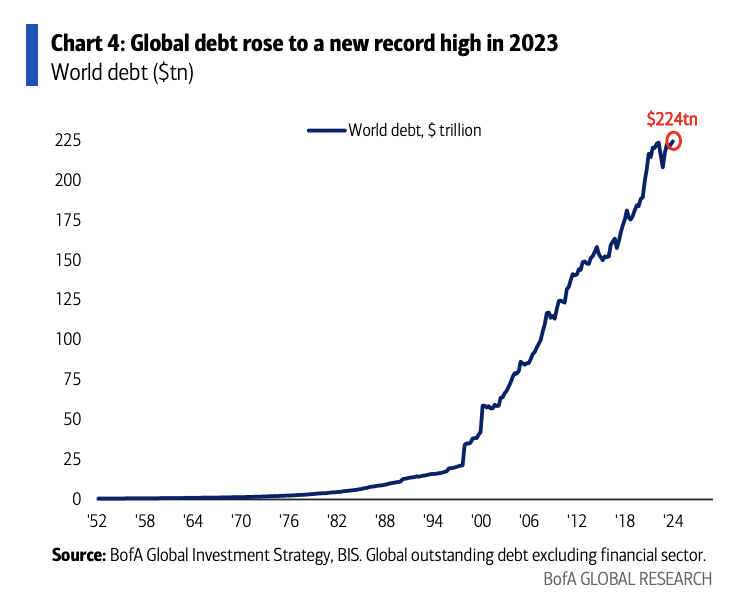
Global debt hit a new record of $224 trillion in Q4.
That figure was $150 trillion in 2013 and $75 trillion in 2003, according to BofA Securities strategist Michael Hartnett.
In the past 10 years, “government debt +60% to $83tn, corporate debt +50% to $86tn, household debt +40% to $55tn,” Hartnett wrote in his weekly Flow Show note.
Fiscal excess and the “government bubble” remain big explanations for U.S. growth “exceptionalism,” he said, noting that the fiscal deficit of 7.5% of GDP under President Joe Biden and the 6.6% deficit under President Donald Trump were the biggest since the Great Depression/World War II.
Indeed, “governments & corporates issued more debt in Jan than ever before ($760bn … of which $410bn govt & $350bn corporate),” he added. The bottom line is that the cost of capital “ain’t falling” very much with a big recession.

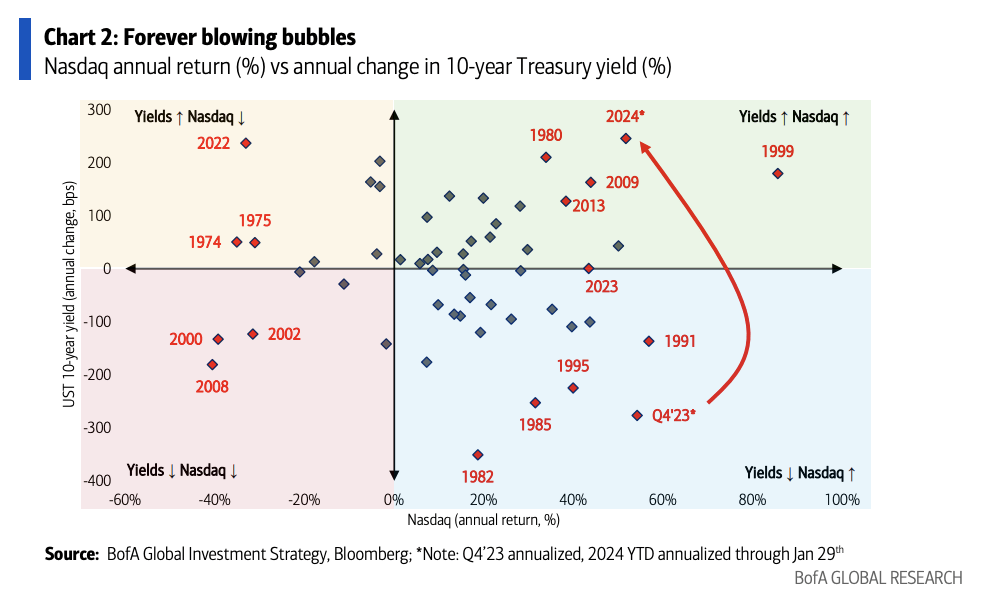
Hartnett also noted that the traditional narrative of “bonds master, stocks servant” looks to be changing — and that only happens in times of bubbles and deflation.
Treasure yields (TBT) (TLT) (SHY) (IEI) (IEF) were down and the Nasdaq (NASDAQ:QQQ) was up “bigtime” in Q4, “but script flipped to ‘Nasdaq up = yields up'” in the first four weeks of 2024, Hartnett said.
That’s price-action that occurs either post-recession (2009) or with bubbles (1999),” he added.
Investors positioning for “Fed cuts/AI-mania” say the optimal strategy is barbell of bubble stocks and very distressed assets, which were emerging markets (EEM) in 1999 and likely China (MCHI) (FXI) (CQQQ) (GXC) or small cap (IWM) (SCHA) in 2024.