



Author
Ahmed Barakat


Author


Share


Fact Checked by
CryptoNews Editorial Team
Author


The Senate passed a short-term funding measure by a 90-6 vote, reducing the immediate odds of a US government shutdown and removing one macro overhang for risk assets heading into the fall. Bitcoin is just about managing to hold onto $64,000, with Government shutdown odds increasing.
The bill funds federal agencies at current levels through December 11, but it still needs House approval and Trump’s signature before the threat is actually removed.
That distinction matters more than the headline vote count. A Senate funding bill passing by a wide bipartisan margin is a signal of intent, not a resolved outcome, and for Bitcoin, which has spent the past year trading as a rate-and-liquidity proxy as much as a risk-on tech asset, the gap between “Senate passed it” and “it’s law” is exactly where volatility tends to live.
Discover: Everyone’s Got a Take. Join Kalshi and Get a Free $25 to Actually Trade Yours
Government Shutdown Odds and Why the House Vote Still Matters
The House has already passed its own version of a continuing resolution that funds the government only through December 4, a week earlier than the Senate’s December 11 target.
Reconciling those two bills is not a formality; the chambers will need to work out the actual funding date and any policy riders attached to it before either version reaches the president’s desk.
Senate leadership moved unusually early, nearly two months ahead of the typical eleventh-hour scramble, in part to avoid repeating a shutdown during election season.
That urgency followed a stretch of shutdown fights that have already tested market patience once this year, and traders are unlikely to fully exhale until the House sends something Trump can sign.
Discover: Your Market Calls Are Worth Something. Start With Free $25 on Kalshi
Government Shutdown Odds On Polymarket: What Reduced Shutdown Risk Actually Does for Crypto Markets
A government shutdown does two things that matter directly to crypto markets: it delays official economic data releases- CPI, jobs reports, GDP revisions- that traders use to price Fed policy, and it stalls regulatory and legislative work at agencies like the SEC and CFTC, along with congressional efforts on market-structure legislation.
Both are Bitcoin-relevant. Delayed data widens the uncertainty band around rate expectations, and stalled legislative work pushes back timelines on the kind of regulatory clarity crypto markets have been pricing in for months.
Removing near-term shutdown odds doesn’t create a bullish catalyst on its own; it removes a tail risk. That’s a meaningful but narrow distinction: Bitcoin isn’t rallying because Washington avoided a crisis; it’s simply not pricing in one additional source of macro noise for the next several weeks.

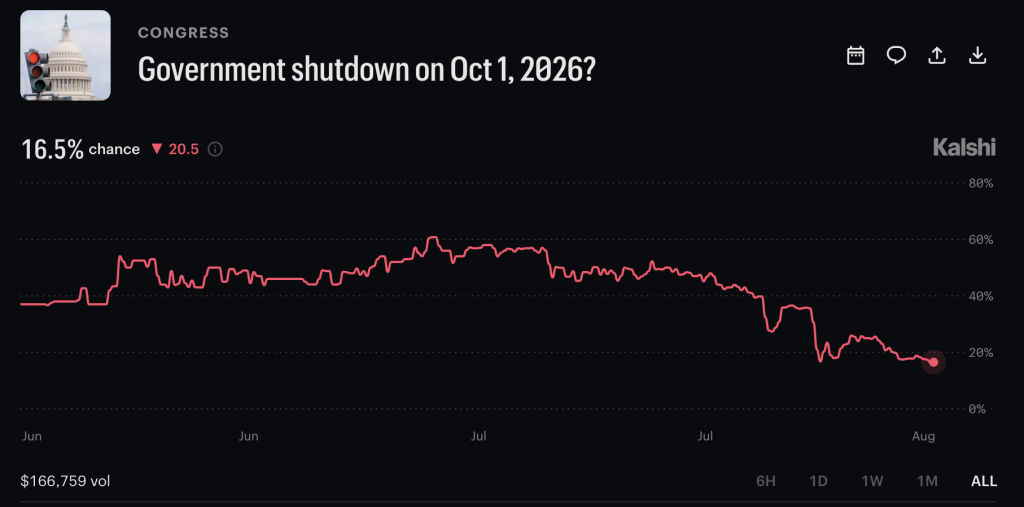
Traders watching how BTC reacts to shifting liquidity conditions should keep an eye on current key price levels for signs of whether that removed risk is actually translating into positioning.
The bigger question is whether reduced political noise changes anything about the Fed’s data dependency. If shutdown risk had escalated, delayed CPI and payrolls prints would have forced the market to trade rate expectations on stale information, a dynamic already explored in the context of upcoming CPI-driven price scenarios for BTC/USD.
With that scenario pushed back, at least temporarily, the macro calendar reasserts itself as the dominant driver over the next stretch.
The December 11 Deadline Is the Real Test
Nothing about this vote eliminates shutdown risk; it deferred it. December 11 is now the operative date, and if the House and Senate can’t reconcile their competing bills before then, the same volatility setup returns with less runway and higher stakes given year-end liquidity conditions.
This isn’t the first time this year that legislative friction has bled into crypto positioning. The pattern of Senate-level delays complicating market-structure timelines showed up recently with the CLARITY Act’s own stalled progress, another example of Capitol Hill gridlock functioning as an indirect but real headwind for digital-asset regulatory certainty.
Three scenarios are worth tracking into December. If the House adopts the Senate’s December 11 timeline cleanly, expect the shutdown discount to stay compressed and crypto markets to trade primarily on rate expectations and spot flows rather than political risk.
If negotiations drag and reconciliation slips toward the deadline itself, expect the same pre-deadline jitteriness that hit risk assets earlier this year to resurface, with Bitcoin likely to trade defensively alongside equities. And if the two chambers can’t agree at all, the shutdown clock resets entirely, pushing regulatory work, economic data, and the broader risk-on setup crypto traders have been counting on right back into limbo.
Don’t Miss Out on Our $1,000 USDT Airdrop on ByBit